Category Archives: Experiences

Order in the Case!

So far in my life, I have had the opportunity to actually go to court twice.  The first was for an accident I had gotten into when I was just a wee lad at 16 years old. The second time was when I got pulled over about ten years ago in Tampa for speeding.

In both cases I learned a few important lessons.  First, when you have a court date, it’s vital that you show up – on time – for the hearing. Other folks who didn’t discovered quickly that the judge didn’t take kindly to tardiness.

It’s also critical to know that when the judge is talking, you are supposed to sit quietly and pay attention.  Back during the case when I was just a novice driver, the lady across the aisle trying to convince the judge that I was reckless liked to make snide comments under her breath concerning her opinion of the judge’s abilities – while he was speaking.

That, my friends, is a big time no-no.

Basically, the judge is charged with keeping order in the court.  Things have to go a certain way if a case is to be heard properly and be able to hold up in a court of appeals should someone choose to go that route.

When it comes to woodworking, keeping order in your project process is critical if you want to keep yourself out of trouble during the building process.

Case in point, your honor…

On this project with my friend Paul, this case is the most complicated one in the build.  All of the others so far have just been boxes.  Sides, top, bottom and back.  But, this case is where his CPU will live.  And where he wants to hide his wireless router, networking hubs, power strip, a boatload of cords and other computing essentials.
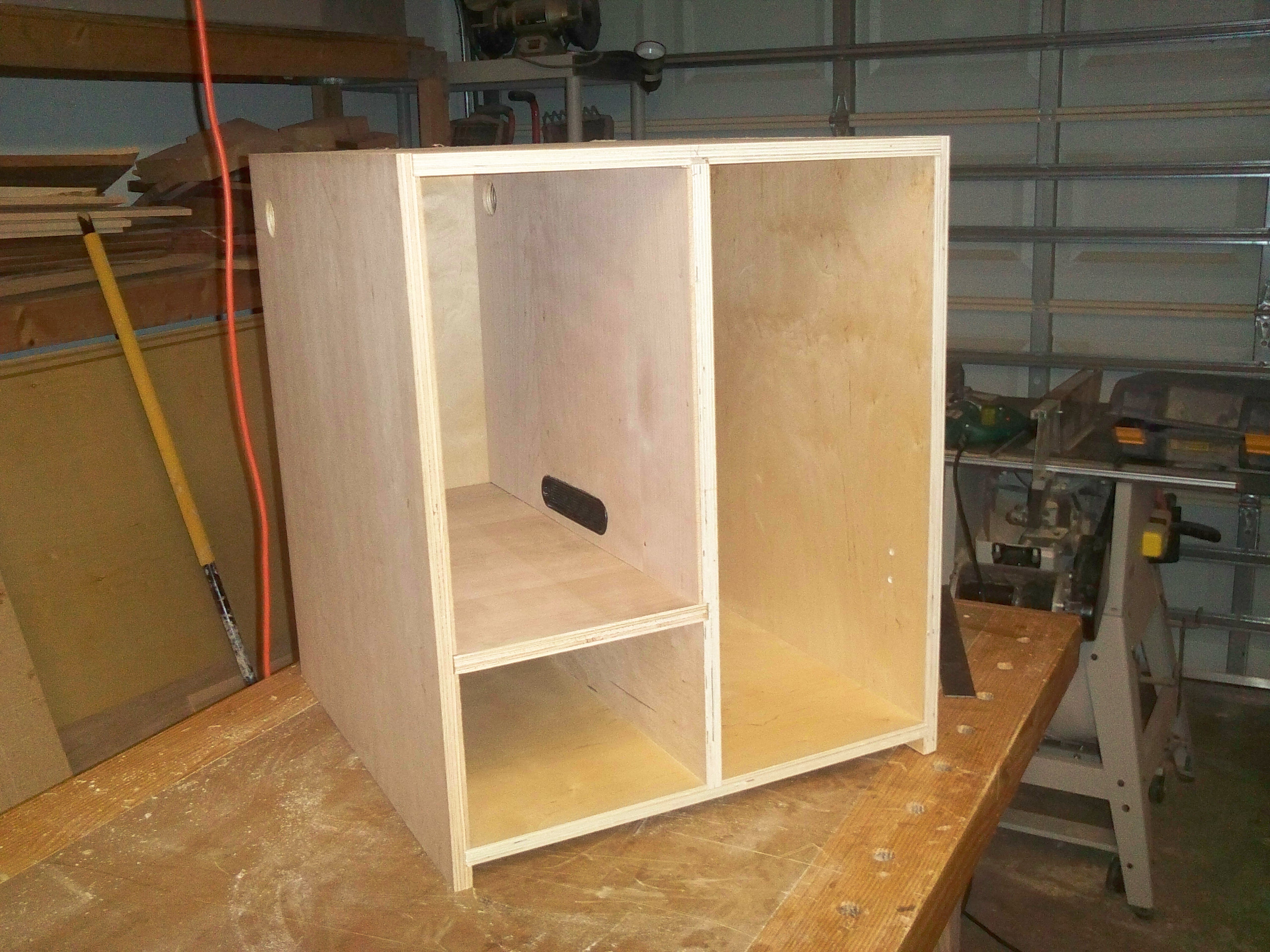
Sure, we could have built this case as two separate cases, but that would have involved more material, more assemblies and more coordination when joining the separate cabinets together on site.

So, we went with a single cabinet.  Me, I was rarin’ to go. Cut ’em down, mill  the joinery and slap ’em together.  No fuss, no muss.

Fortunately, Paul is a little more level-headed than I. He kept bringing up some very important points that I was missing.  For instance, a number of holes needed to be drilled to allow wires to go from one cabinet to the next. If I tried to feed my drill which, with a hole saw attached, comes out to 14″ long from drill bit tip to butt end, into a 12″ wide cavity, how did I plan on making the hole?

Similar questions were brought up over and over again – just for this one case.  When should I insert the divider which broke the piece into two distinct cavities?  When should I drill the shelf pin holes for a shelf in the equipment side? When and where should I drill a slot to accept a grille that would allow air between the two sides?  Should I notch out an area of the top to receive a vent before or after assembly?

All great questions, and all required a moment of quiet reflection and a bit of mental gymnastics. It got to where Paul and I were talking through each step of production and assembly of the case in order to make things work properly. If I put this piece in now and then drill those holes…

Ultimately, taking the time to mentally walk through the steps of the project helped out tremendously. Before long, we were able to get the assembly together with all of the holes in the right place and pieces where they had to be.

Later, we’ll just need to face frame the piece out and we”ll be good to go.

Of course, the finished product will be the final verdict in judging how well we did.

The Wooden inspiration

Unless you are a big sports fan, you may have missed the passing this past weekend of John Wooden.  Who was he?

Only the most revered basketball mind to ever play or coach the game. He was inducted into the basketball hall of fame once as a player and once as a coach.  Known as the Wizard of Westwood, he coached the UCLA Bruins Men’s Basketball team to 10 national championships. He went 88 consecutive games without a loss, and had four perfect 30 – 0 seasons.

But, to say that John Wooden was an outstanding basketball coach would only be scratching the surface.

No one gets to Coach Wooden’s level of success without learning – and teaching – many valuable lessons.  He didn’t just ‘luck’ into a good program and enjoy the benefits.  His work ethic, determination and wisdom led to his success.

Those lessons translate very well off the hardwood.  Wooden was a much sought-after speaker for universities, corporations and many other groups.

And, I believe that what he had to teach works well for woodworkers.

How many times do we go to our shops looking to build the ‘perfect’ project.  One with absolutely no flaws, no mistakes, a perfect grain match and perfect finish. Or, maybe you are looking to build a commissioned project that will improve your bottom line and allow you to buy more tools.

In other words, you want to be a ‘success’ at woodworking.  But, what the heck is success?  How will you know it when you see it?

According to Wooden, success is the peace of mind which is a direct result of self-satisfaction knowing you made the effort to become the best of which you are possible.  In other words, success is not measured in perfect projects, smiling recipients or the sale of a project.  It’s in knowing you have done the best you are capable of.

Click on this image to see a larger version

So, how do you get there?  To climb to this zen-like state, Wooden set out a pyramid of success with each block building on the last ones.  Sure, it may look like some BS graphic created by an MBA student looking to get an A in a class, but one thing Coach Wooden did was live this, leading to the success his teams enjoyed.

At the top of the pyramid is competitive greatness – the ability to perform at your best when your best is required.  But, how do you get there?  You need to have poise (the ability to not be shaken when things go against you) and confidence (You have to believe in your abilities).  The only way to get poise and confidence is to condition yourself (get your mind right to achieve the task), develop your skills and enjoy team spirit.

Yeah, team spirit.  An ability to learn from others and share your expertise freely. The ability to work with your family to ensure everyone stays happy so there’s less friction when it comes to working in the shop.  The pyramid goes on from there…

Since I saw Coach Wooden’s pyramid of success, I have printed it out and placed it in my shop.  It’s a subtle reminder to me that I have come far with woodworking, but I still have much to learn and do to truly achieve success.

Thanks, Coach, for what you have done for sport and for life. I’ll keep putting 100% effort into improving myself, just as you taught others.

A project post-mortem

Sweet redemption.

How many times has it happened to you?  You are cutting a part for a project and something goes wrong.  Maybe you get a little splintering on one edge.  Instead of a crisp edge, you round it over.  There. No need to throw it away.

How about that board you cut too short?  Easy.  Just cut another piece and start over.  Issue resolved.

Maybe something else goes wrong… well, that’s just a design feature.

In fact, in many cases, anything that does go wrong can be gracefully recovered from with minimal fuss. The projects look great, and no one is the wiser.

But, there are projects that could be declared dead on arrival after a big boneheaded move.  Unfortunately, I had one of those last week. Remember that beautiful box I had milled the parts for weeks ago and had glued up on my triumphant return to the shop?  Yeah, the one with sapele sides and the sweet elm burl veneer lid? I had that sucker looking good, and I had even gotten to where I had routed dovetail slots on the corners to take some beautiful maple splines.  It was on its way to being a sweet little piece.

Well, I made a big time mistake.  The veneered panel was wider than the grooves I had milled for it. So, I had to rabbet the panel about 1/8″ in order to make it fit. Now, when I designed the box, my plan was to put the rabbet face up, shortening the distance between the top of the lid panel and the top edge of the box.  Of course, I glued it rabbet down.

Part of the construction process is to build the box and later cut the top off to make a lid.  I carefully marked where the bottom of the groove was located and was sure that I cleared the bottom of the groove in order to carefully free the lid.

Of course, you can see how with the new internal measurements this wasn’t going to work.  Please, feel free to laugh.

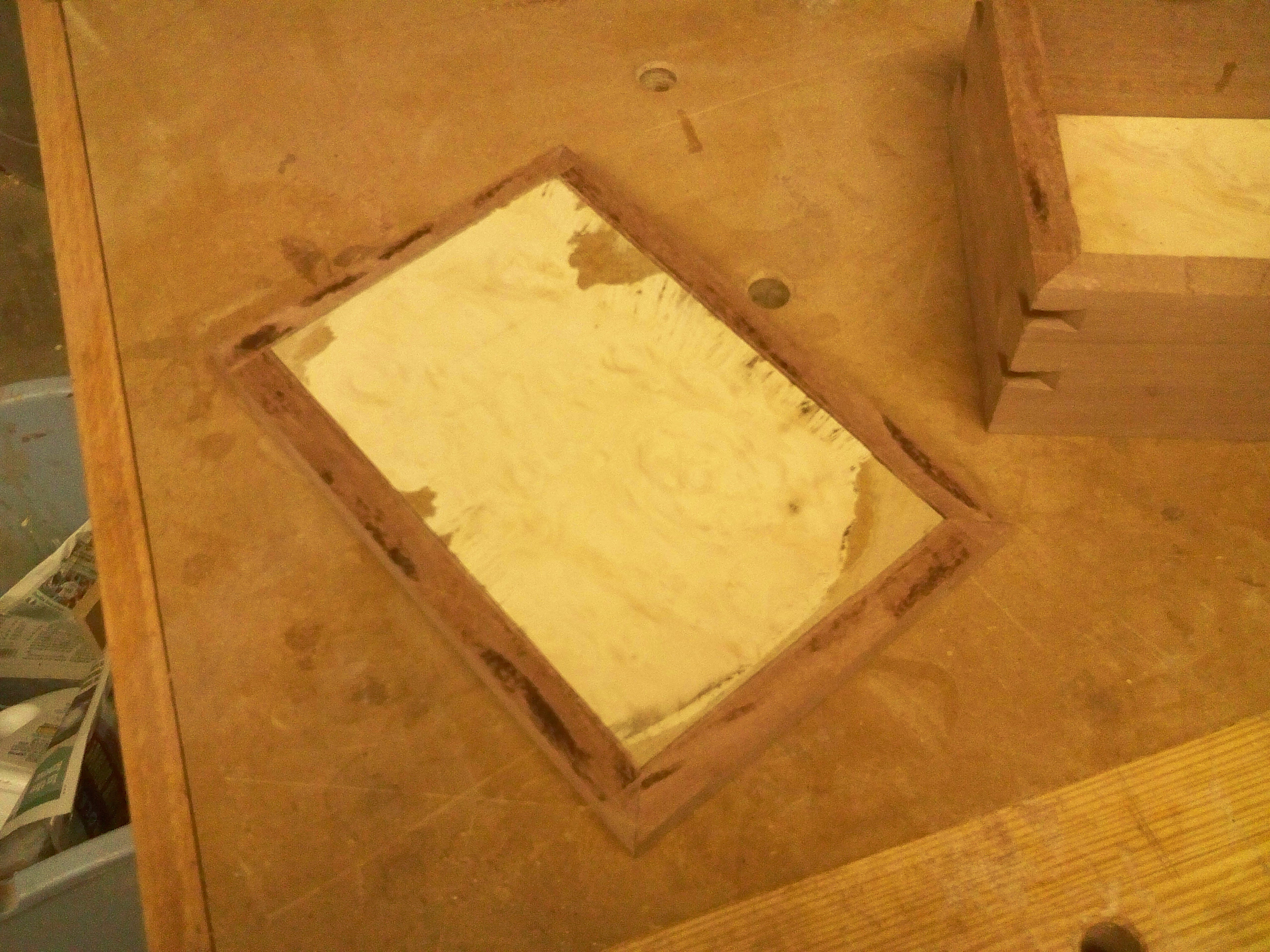
Yeah, that’s pretty ugly.  My first thought was to see how this could be saved.  How could I possibly fix this mess and make things better?  My wife had a few suggestions, including routing out the inside of the lid and gluing in a mirror or making it a picture frame.  Interesting, but something I would be thinking about whenever it was opened.

No, friends, this one looks pretty doggone dead.  A fatal flaw in my execution.  I can just say that I am fortunate that there was only a small amount of material involved.  It doesn’t happen frequently – even in my shop.  But, when it happens, it happens in a bad way.

Oh, well, at least I still have all ten fingers.

I’m jonesing…

It’s been a long few weeks…

This week, I’m at the Governor’s Hurricane Conference in Fort Lauderdale, working the media room at this big hurricane season kick-off event.

Last weekend, I was getting my stitches out only to head outside to do all of the yard work I missed while getting them in the first place.

And, that’s just what I did the weekend before…

Basically, what I am getting at is that I miss my shop.

Seriously.

I know, May is always a crazy month in my line of work.  Hurricane season begins on June 1, so we’re busy getting the word out about disaster preparedness.  We also had a number of changes in forecasting that have come from the National Hurricane Center that will need to communicate to our residents.

The hurricane speaking circuit is as busy as ever.

Oh, and everyone’s asking about that little oil slick building in the Gulf of Mexico and how it will affect the upcoming season.

Basically, what that means is I am forgetting what my shop looks like.

When last I saw it, I was in the middle of building a pair of small boxes for two nephews who graduate the first week of June. I meant to have them done… yes, I did.  That’s why I left myself PLENTY of time to finish the job.  I remember veneering a panel with some sweet looking elm burl and cutting the sides out of some sapele… I have have even cut the sides to size.  Honestly.

This is driving me nuts.  Some nights, I wake up in a cold sweat wondering if my tools will still be there, and how rusty they will be when I do.

I’ll wonder if I will be able to remember what measurements I was working off.  Since these boxes were plans I was making up on the fly, I’m not sure I will be able to pick up where I was.

There is one cure for this affliction of mine…

I just need time in the shop!

That’s groovy…

This past weekend, I took a new step forward in my hobbies.

What was it?  A new set of chisels?  A new table saw?  Instruction on a new technique?

Nah, but it is wood related.

I picked up a bass guitar.

Now, why would I take good money and spend it on something not woodworking related?  Call it a dream.  Call it a lark. Call it a mid-life crisis.  Whatever…

Let me tell you right now that I have never picked up an instrument before in my life.  Never.  Nada.  I dabbled with the thought of playing the trumpet back in grade school as part of the band, but never went for it.

I figured the bass over the guitar for a few reasons.  First, there are fewer strings.  That’s gotta be a good thing. The bass is considered a more ‘laid back’ instrument. I hear there are fewer bassists than guitarists, so if I ever want to play in a band, I might be a hotter commodity.  And, after hearing the digitally-remastered Beatles albums released last year, the bass grooves laid down by Paul McCartney really got me jamming.

So, this past Friday night, I got the money, I got the nerve and I took my youngest son with me to pick this up – a Fender Affinity Series Squier Precision bass. The body is made out of some kind of wood painted a deep, metallic red with a white plastic pick guard. The neck is made out of some light wood with a darker wood fret board and a strip of darker wood down the back of the neck. This provides a guide for my thumb to rest on while I play the notes.

The whole thing came as a kit.  Guitar, amplifier, tuner, cables.. the works. I unpacked the stuff from the box, assembled it per the instructions and proceeded to make nothing but noise.

Yes, that’s what most people who pick up any instrument do the first time they touch it.  After an hour or so, my wife told me to kill the amp and give it a rest. Man, that was rough.  I put the bass down in disgust.  I was NEVER going to learn how to do this.

That’s when it hit me. Eleven years ago, I didn’t know the first thing about woodworking.  Nada. Zip. Zilch. People told me I was nuts.  Too expensive.  I would never learn how to do it.  I would save time, money and frustration by just buying the furniture and calling it quits.

I’m so glad I didn’t.  Today, I can do it.  Practice, determination and time in the shop have made me a least a little more comfortable when it comes to woodworking.  That’s what I want to do with the bass… get better.

Now, for all you folks gathering at my garage door looking for the big woodworking tool sell-off or donation, you are outta luck.  I’m not planning on giving up my woodworking.  However, on those late nights when it’s just too hot to work in the shop, I’ll be putting some time in on the bass.

At least until my wife tells me to turn the volume down on the amp.

P.S. – Anyone know a good technique for learning the bass?  🙂

Jim and Tom’s excellent adventure

This past weekend started just the same as many others.  Everyone at the office was talking about their plans for the two days off. My wife called and asked if I could stop on the way home to pick up a few items at the grocery store. I finished a little paperwork and headed out to the car to make my way home.

But, that’s where the similarities ended.  I was actually on my way home to cook dinner for the arrival of a special guest. The Woodworking Show was in town, and Wood magazine’s Jim Heavey had accepted my invitation to come to my house for dinner.

I had made the offer to Jim last year.  “The next time you get to Tampa with the show, you have an open invitation to come over for dinner.”  Just a few words to him last year, but now he was actually coming over.

Unlike other visitors, I knew that the shop was going to be one area that was going to get a visit.  I had spent the past few nights straightening up the shop. Tools that were lingering around from previous projects went away. Wood I was milling was stacked into piles on the bench. The broom and vacuum made an appearance and took care of all of those plane shavings and the sawdust from a busy last weekend of planing and jointing.

That night, after Jim had called to say that he was on the way, I was cooking dinner and starting to fret.  After all, Jim is a very talented woodworker.  He has contributed articles on how to organize shops – what if he looked at my shop and shook his head in disgust? What if he looked at the stack of lumber I was working on and said something bad about the way the work was coming out?  Was I going to get a lecture about my insufficient dust collection setup? I mean, this guy makes DVDs about how to woodwork and set up your shop!

“You are nervous,” my wife observed. Yes, I had become nervous, thinking Jim was going to be critical.

But, I then took a deep breath and thought about Jim’s demeanor.  He’s a really down-to-earth kind of guy who teaches woodworkers to stop talking about every single goof up on a finished project. The nerves faded away just before he had arrived, and when Jim pulled up in his rental car and came in.

It was a great visit.  I resisted the urge to walk Jim out to the shop immediately and get it ‘over with’ Instead, I got Jim a beer and introduced him to the family.  We talked about his flight, the shows, Jim’s service as a firefighter and as a school board president, his grown kids and his grandkids. Both of my sons wanted to tell him jokes.  We laughed politely as the silly grade school humor poured out.

After the dinner plates were put away and while the cherry pie was baking in the oven, the moment of truth came.  I gave Jim a tour of the projects in the house.  The front and back entertainment centers.  The unfinished desk and storage unit in my son’s room.  The Contemplation bench I had built a few years ago. “I remember reading about that on your blog.”

The trip to the shop was just as pleasant.  He told me about how he had set up his shop and mentioned that he liked the way I had mine set. He liked the workbench and was impressed with the two vises I had in the shop.  He was impressed that I had the blade guard and splitter setup on the saw. “This place is definitely you, Tom.  You must have a lot of fun out here.”

Later than night as we ate dessert, we shifted gears to the great basketball games in the NCAA Men’s tournament. Everyone was cheering as the action was taking place, and I was duly impressed by Jim’s knowledge of the game.

At last, the evening had to come to an end.  After all, Jim had to teach the next day.  As Rhonda and I waved goodbye while Jim backed out of the driveway, I had a sudden realization.

Woodworkers are just regular guys and gals.  Each of us has our skills and gaps that need to be filled.  Each of us  has our strengths and weaknesses.  And, we all face our common challenges.

More monkey business

He’s short. He’s furry.  And, he’s a fairly decent writer.

For all of you Wood Magazine subscribers (and those who may like to get the occasional copy at  the news stand), the Shop Monkey returns!

Be sure to check out page 20 of the May 2010 edition.  There, I have written an article about woodworking plans – and those who take those plans and resell them at rock-bottom prices for their own benefit. While it may seem like a good deal, many of these plans feature poor quality scans of projects that are nearly impossible to read and offer limited step-by-step instructions for the woodworker to follow. Also, by taking these projects from commercial sites, they offer a strong disincentive for woodworkers to design and seek to publish new and exciting furniture designs.

If you want to read even more Shop Monkey input, why not check out my blog over at the newly-revamped Wood Magazine forum website?  The new forum software makes it easier than ever to navigate the content and read the input from your favorite bloggers.

Yes, you can even read my content if you have nothing better to do…

The current schedule for the Shop Monkey right now is that the columns will appear in every other edition (the next one is scheduled to appear in the spring).

Now, no more monkey business… back into the shop!