As woodworkers, our shops are our sanctuaries. Places we can go to kick back, relax and crank up the creative process. Sometimes, we flip a switch, and our tools spring to life, while other tools wait for the touch of a skilled hand to be powered.
And, sometimes our shops are also our laundry rooms, recreation areas or garages for our cars. Yeah, that’s right, we have to share our space.
Today, tell us about your shop situation… is it a dedicated space, do you share it with other household functions or is your shop wherever you can find the space at the time it’s ready to work?
Dayton, Ohio has its place in woodworking history. Perhaps you heard of a pair of inventive woodworkers named Wilbur and Orville? If you have, you need how the tradition is being upheld by another famous woodworker – Mike Mader.
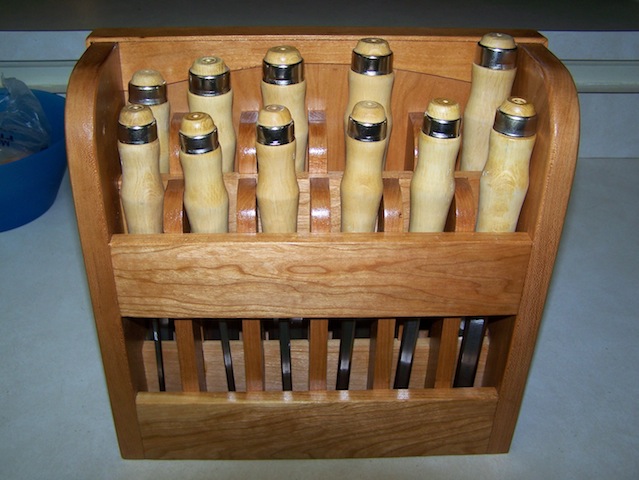
OK, Mike has a little bit to go until he gets to Wright brother status, but he’s doing some awesome work on the blog he has been writing since 2010. While he is known as the SawDustNewbie, his work is hardly amateurish. Check out the sweet hand tool cabinet he put together, and I think you will come to appreciate his work.
At this past weekend’s Woodworking in America conference, there were some totally great classes to take. Mary May showed her elegant carving techniques. Chris Schwarz showed how to make workbenches and tool chests from simple home center materials. Don Williams taught us how to determine the age of a piece of furniture based on evidence of how the wood was cut and milled.
And then, there was this one class that had nothing to do with woodworking technique. Not a mention about wood selection. No discussion of joinery, finishing or design.
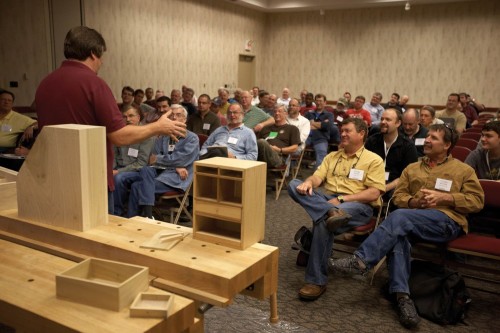
No, it dealt with online woodworking. Namely, it was a round table discussion about the online woodworking community, how people could use it and what goes into putting out content. The panel was an esteemed one… featuring some of the biggest names in online woodworking – and somehow, they managed to include me in the mix.
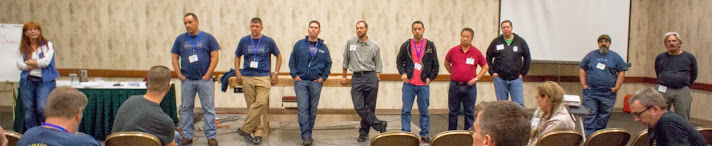
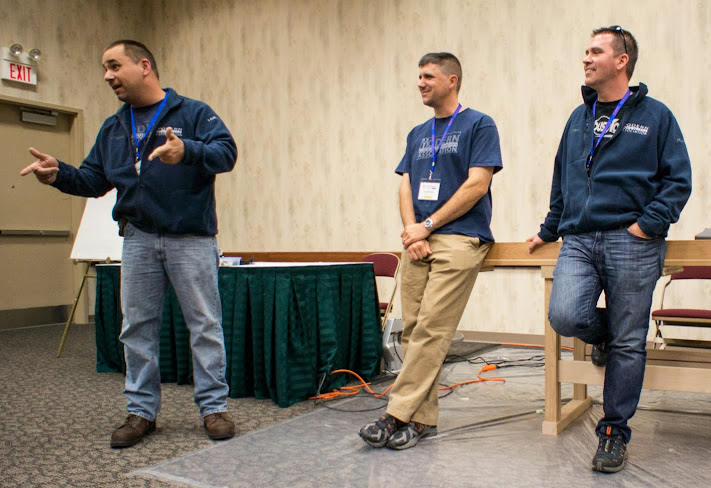
The panel in its glory
From left to right, there was Megan Fitzpatrick ,me, Dyami Plotke, Chris Adkins, Steve Schuler, Marc Spagnuolo, Wilbur Pan, Shannon Rogers, and Matt Vanderlist.
The discussion began with each of us giving our five-minute introduction (which, with the representation up there, took some time), and then the conversation was opened to the audience.
While there were a lot of questions (How much time does it take to do online video? Where do your ideas come from? How can I participate without having my own blog? ), there were just as many positive comments about how the Internet has opened many doorways to participation.
Think about it. Before online woodworking, there were a few ways to get your woodworking information. You could go to the library. Meet with your local guild. Check out the woodworking magazines. Watch some shows. Maybe, if you could locate one, you could attend a woodworking school. Other than that, it was a pretty isolated experience, with the average woodworker expected to overcome challenges in his or her shop with little or no help.
Today, the choices are endless. In addition to all of the traditional outlets, there are many more ways to reach out into the web to get content. The woodworking shows have websites, as to the magazines, woodworking schools and tool manufacturers. Getting answers to questions takes a matter of minutes, not days of research.
And, plenty of woodworkers are out there online, sharing their experiences and knowledge. Turning. Marquetry. Carving. Cabinetry, Chair making. Whatever your interest, there are blog posts, videos and podcasts out there, available to you on your schedule.
One of the more interesting questions came from an audience member who asked Popular Woodworking magazine’s editor Megan Fitzpatrick and the panel if the online woodworking community is ‘competition’ for her. This brought about some interesting discussion, but the best point was made by Wilbur Pan. The ‘piece of the pie’ analogy is great, but we are seeing it from the wrong perspective.
When you consider the ‘piece of the pie’ analogy from the point of view of a family sitting around a dinner table, yes, if dad gets the biggest piece of pie, there is indeed less for everyone to eat. And, unless you are into some bizarre penguin-like method of feeding your family, once someone eats their piece of the pie, no one else can get a chance to take a bite.
The other – more appropriate – perspective is from the point of view of the baker. “You guys like the pie? Great! I’ll have the crew start making more to satisfy your demands.” As content creators, we would be kidding ourselves to believe that the consumer would only be reading content from one of us. I’m positive that in addition to reading Tom’s Workbench, you are also reading a few other blogs, some or all of the woodworking magazines and taking in some of the woodworking TV shows. As long as you are doing this, there is a great incentive for us to keep cranking out the content to help keep interest in woodworking at a high level.
I am working on my pointing skills
There were a bunch of other great moments from the class, and I have been told that perhaps – just perhaps – I need to reduce the volume of my voice. Other than that, I hope that sessions such as the one we participated in – plus others to help guide people through the online woodworking community – will become an important part of other upcoming events.
Of course today’s post is late. I got back from the big Woodworking in America weekend about 1:30 a.m. my time due to travel, baggage claim, getting the car out of the parking garage and a big time pre-law-enforcement-issue OJ Simpson Hertz-style gate change at my layover in Atlanta…
But, enough of that. Once I got to Covington, we had our traditional meet-up at the Keystone Grill, and everyone was geared up to close down a few bars. But me, no, I had other important plans. I was going to run audio/visual for Roy Underhill’s first class on Friday morning. At least that was what I was told I would be doing…
As it turns out, when you work for Roy Underhill as an A/V guy, well, let’s just say you need to be ready for just about anything. So, after a late night – made later by a totally unexpected 1:30 a.m. fire alarm in the hotel which forced everyone to evacuate – I showed up to the room bright and early to get a start on the festivities of the day.
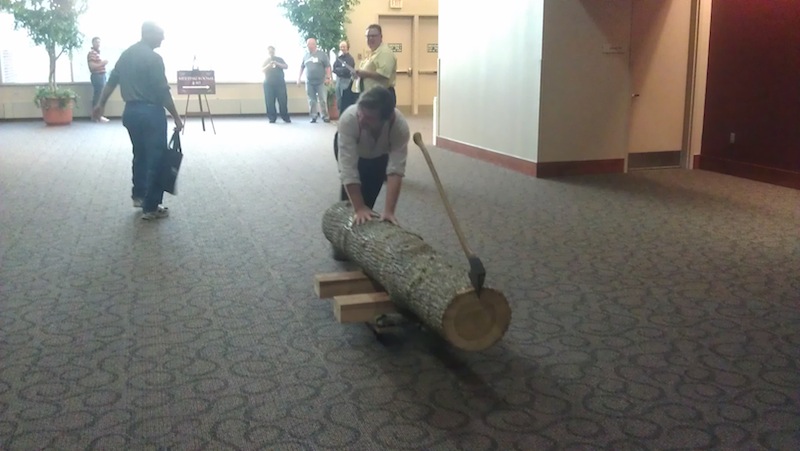
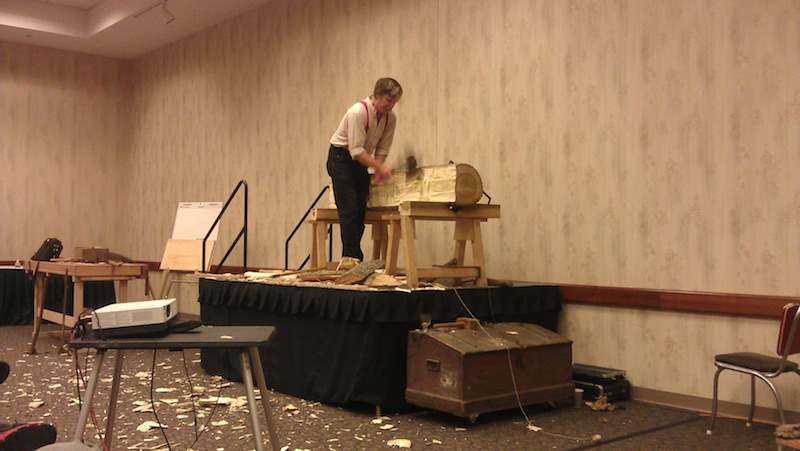
Fortunately, so did Roy. Ever the showman, he decided that he needed to get the attention of the event goers to get them to come to his class. Since it was a presentation on how a rough log is converted to a usable beam, Roy knew that wheeling the log down the convention center hallway – felling axe lodged in the front – would be a great way to get folks to come. And, it sure did.
With folks assembled, he took a few minutes to describe the importance of the process of preparing the lumber for processing, and led an interesting discussion about why German and Scandinavian immigrants built log cabins when they came to the colonies, but British immigrants squared up the timbers. It was a great history lesson.
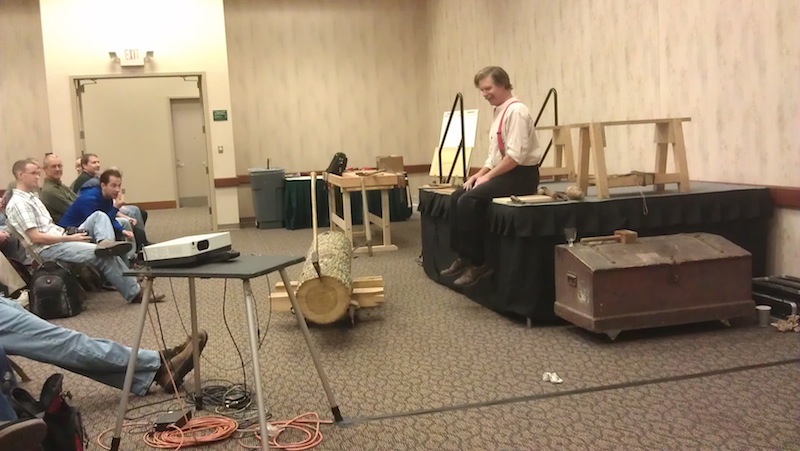
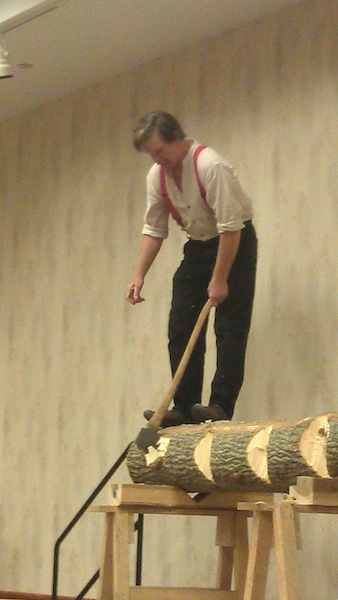
Enough of that… it was time then to get busy. And, did things ever get busy! Roy (with his able bodied assistants) managed to get the log up on top of the supports on top of the sawhorses on top of the riser. Trusty axe in hand – balanced precariously atop the entire stack much like an Apollo Command Module atop a Saturn V rocket – Roy swung mightily to begin the work.
Throughout the entire time, he had this uncanny ability to keep his sense of humor rolling while he did the tough work of chopping notches as deep as a marked line, and then splitting these large slabs off the sides to get the beam to rough dimension. The chips flew everywhere… as deep as four or five rows into the audience.
Continuing along, he moved to the broad axe to refine the surface, and then the adze to make the piece true enough to be used as a beam for a home, or to be hauled over to the saw pit to be turned into boards.
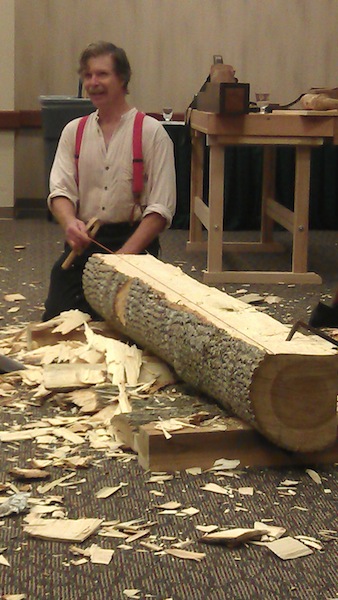
First side done, Roy (and his able-bodied assistants) were able to get the log down to the floor of the ballroom to begin working on the next two sides, giving audience members with the bravery and inclination a few whacks with the axes and adze. While I’m pretty sure I will never need to use this skill, it was fascinating to watch it happen in front of me, and everyone who attended the first class couldn’t stop talking about just how awesome the presentation was.
And, as for that beam, well that became sort of a touchstone for the entire weekend. Parked in the hallway, groups of attendees were able to pose next to this piece of work.
The only other challenge? Being part of the A/V Navy, I offered my assistance in helping to clean up from the effort. You have no idea just how many chips can be found in a log that size, and just how tough it can be to clean those out of a ballroom carpet…
That was just one example of why an event like this, bringing in experts, vendors and participants throughout the country is such a worthwhile endeavor, and why I’ll be looking to come back to this one and seeking out other opportunities.
In our shops, space is at a premium. We need to set tools, workbenches, lumber storage… the works, and fit that into the limited amount of space in our shops.
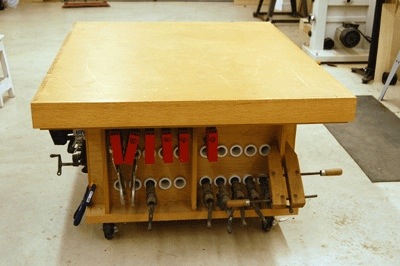
One of the things that often gets overlooked is a place to assemble those projects. Whether you choose to go minimalist by assembling on the floor, build a snazzy workbench with all the bells and whistles or go for a more elegant solution, we all have the same issues that need to be addressed.
This week, tell us about your assembly table situation. Do you have it all figured out, or do you make do with what you have?
In case you have been living under a rock for the past decade or so, there has been a huge renaissance in hand tool woodworking. Not just the tools themselves, but a deeper understanding of how they function in a workshop and what processes can make them more efficient.
One of the people in vanguard of this effort has been Chris Schwarz. The former Managing Editor of Popular Woodworking Magazine, Chris and company have been scouring libraries, private collections and other sources for old woodworking knowledge and reintroducing it to modern woodworkers. From reprints of books like The Art of Joinery by Joseph Moxon to Schwarz’s Anarchist’s Toolchest, there is a wealth of information available fort those who want to learn the venerable art of hand tool woodworking, and how it can be incorporated into today’s workshop.
During the last Modern Woodworkers Association podcast, Roy Underhill engaged us in an interesting discussion about hand tools. No, it had nothing to do about them being superior to power tools, although he did allude to that later on.
No, this part of the conversation was about their portability.
Think about one of the most commonly heard complaints by woodworkers. No, it’s not the ‘I don’t have enough clamps,’ one… Instead, it’s usually about the quest for more shop space, especially as it pertains to stationary power tools.
Add a table saw? You need more space. Adding a jointer? More space. Bandsaw? You betcha…
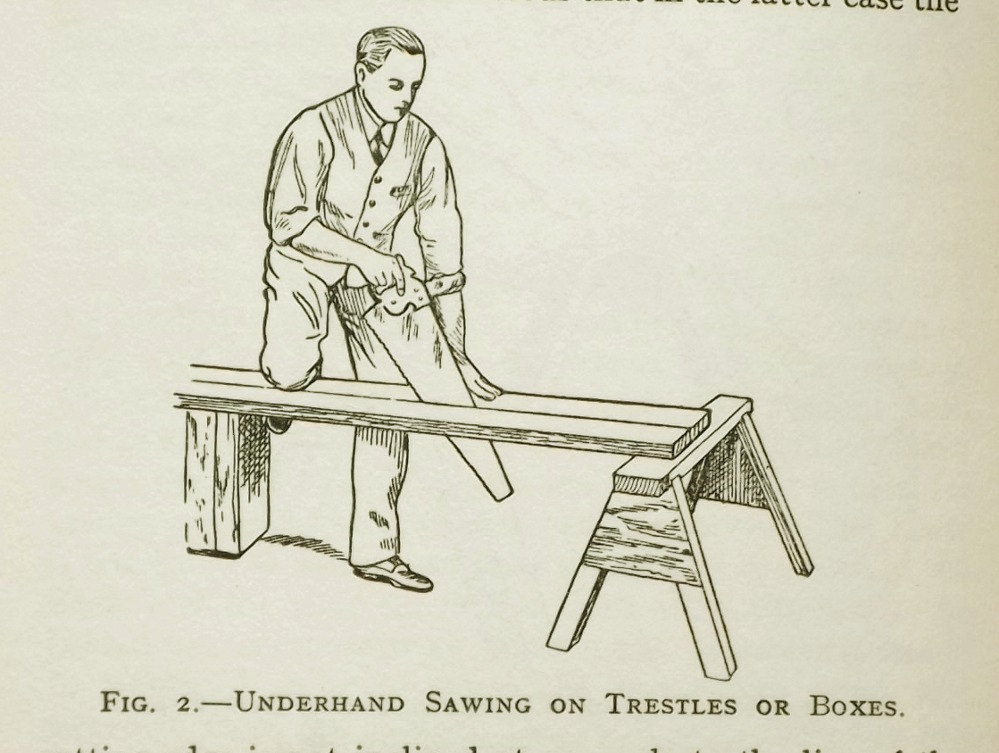
This can be avoided if you worked primarily with portable power tools, such as track saws, jigsaws and routers. Yes, you need some type of solid work surface – such as a workbench – to work safely and accurately, but you can limit how much the shop grows.
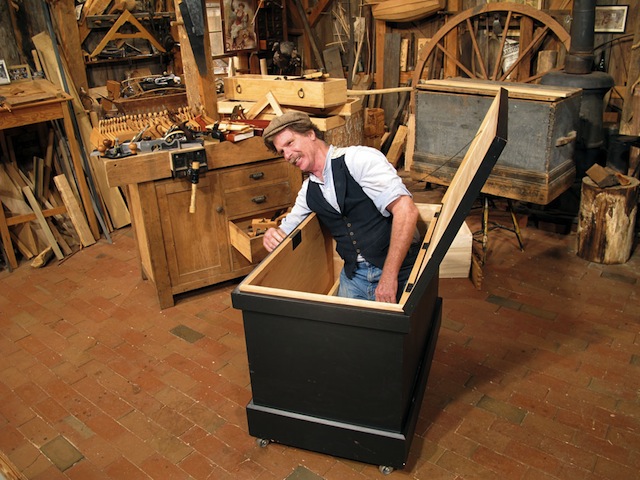
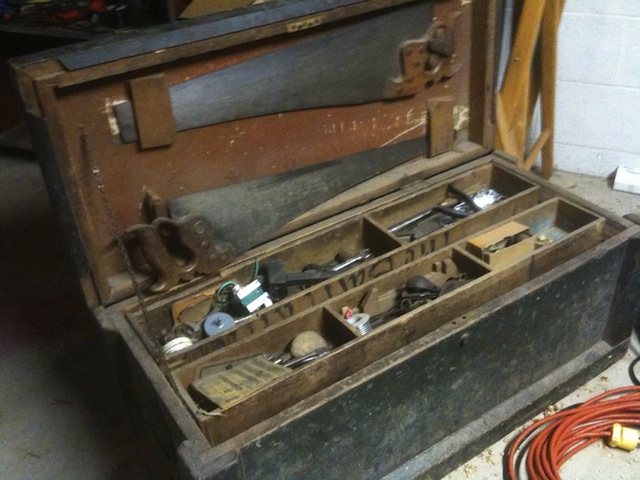
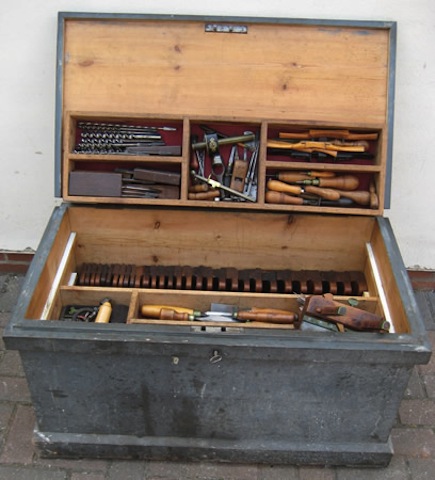
Hand tools – their very nature – don’t require much more than you would need to use for portable power tools. A solid work surface or two. Add enough space to place a chest of hand tools, and you are in business. Some of these hand tool chests, when well built and organized, could (and have) hold all of the tools that a skilled cabinetmaker would need in his or her lifetime.
Of course, when you throw in items such as pole or treadle lathes, the space requirement does grow, but it’s incredible still to think that woodworking can happen even in some of the most modestly sized places.
This week, at Woodworking in America, I hope to pick the brains of a few skilled hand tool woodworkers to see how they stock their tool chests. I’d love to see how they make their magic – and keep the tools to make it in a smallish tool chest…

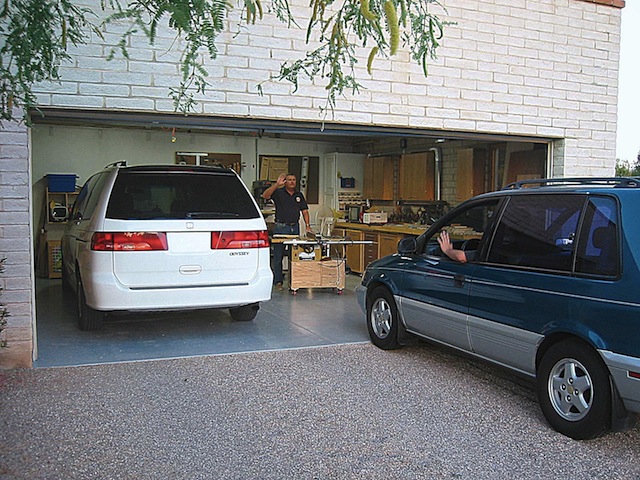 And, sometimes our shops are also our laundry rooms, recreation areas or garages for our cars. Yeah, that’s right, we have to share our space.