All posts by Tom

I'm the guy who writes the blog...

Quick Poll

Woodworkers can find lots of knowledge about the craft by reading books, watching videos and browsing woodworking magazines.

Ask me about my cabinet scraperHowever, when the goal is gaining wisdom, we often turn to other woodworkers for advice.  Believe me, I have asked question after question to anyone who with woodworking experience who would listen…

Later on, I noticed that woodworkers started asking me for advice.  Very strange.

This week, tell us if you have ever had the occasion to give woodworking advice… and if you took the opportunity.

Link of the week

MonkWerks

When you think about the lives of religious men and women, you will notice many common traits. A strong devotion to their faith, a peaceful outlook on life – and an appreciation for the beauty of nature.

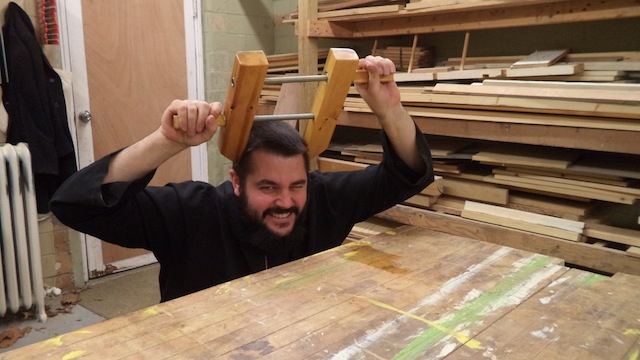
Fr. Tom, goofing around

So, when you swing by a site called MonkWorks, run by a Benedictine monk, well, you have to take a look. This is the blog run by Fr. Thomas Bailey, a Benedictine monk living in Missouri.

Fr. Bailey initially learned about woodworking by watching his father, and later went on to develop his skills as many of us did – by learning online and working in his shop. His work is exquisite, and his sense of humor… well… swing on by to give his site a read!

A primer primer

Sometimes, I like to paint my projects.

Holy smokes, someone call out the people with the butterfly nets!  Tom has lost his mind!

No, seriously. Sometimes, painted furniture is just what a room calls for. I have a number of pieces that I have painted through the years, and they look crisp against the walls and on the oak laminate floor I laid in my house.

And, when I want a nice, smooth, durable surface, I like to use primer on the project to set up my finishes for success. And, for years, I used a latex-based primer. And got OK results.

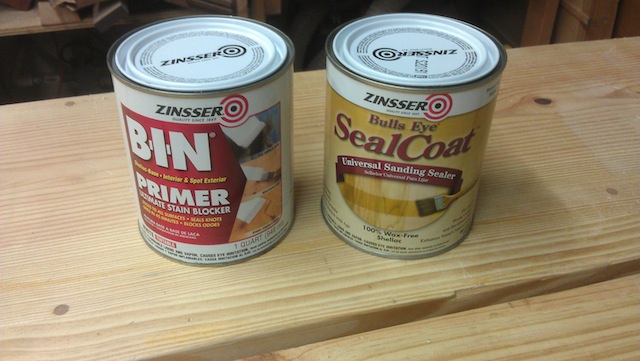
Zinnser's shellac and red primerBut, recently I saw a shellac based primer for sale at the local home improvement center. Since it is from the same company that makes the seal coat shellac I use for my finishes, I knew it would be a high-quality product. I also wondered if I could treat it like the shellac basecoat I lay down under my finishes?

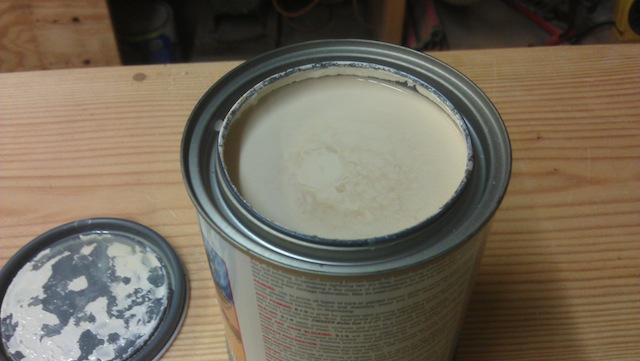
The unstirred primerSo, I thought I would show a little bit of what it’s like to use. When I pried the lid off the can, I could see that the pigment settled out of the solution, and the top layer was slightly amber shellac. I was also greeted by a similar warm aroma of the alcohol the shellac was dissolved in. The pigment was a little gloppy at the bottom of the can, but a few minutes of stirring got everything mixed up.

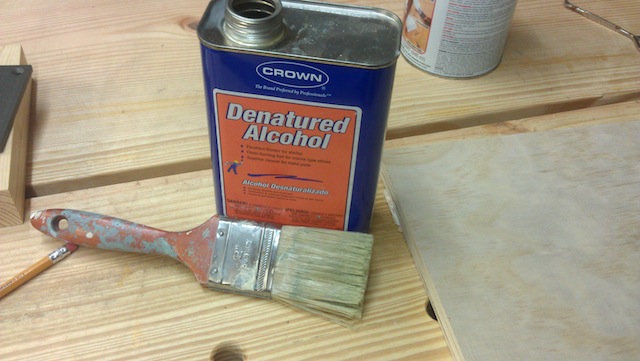
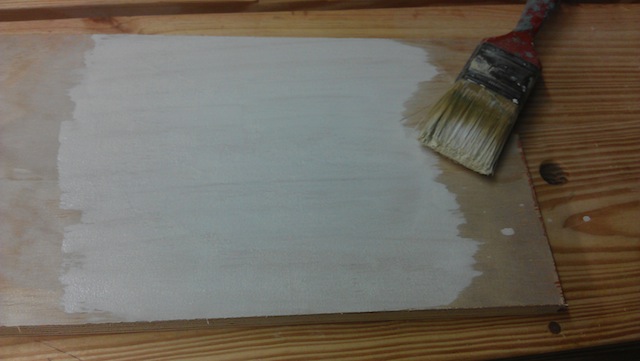
prepping the brushI was going to apply this test with a brush, so I took the extra step of splashing some denatured alcohol onto the brush to prepare it for the primer. I shook out the excess, dipped it into the primer and started brushing onto a scrap piece of plywood.

Applying the primerThe primer laid down very easily, covering the plywood with little effort. After cleaning the brush and resealing the can, I stepped inside to wash my hands and catch up on some Winter Olympic competition.

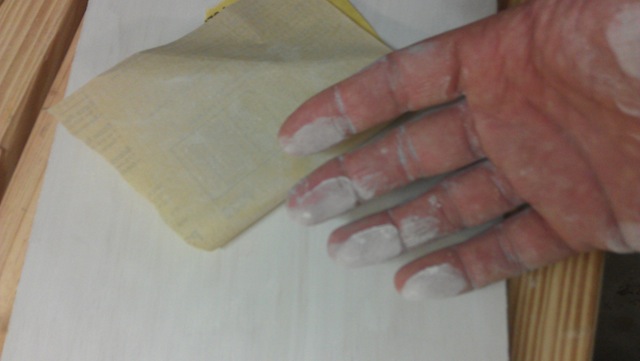
After letting the primer cure for half an hour, I got out a sheet of 220 sandpaper and scuff sanded the plywood to get a nice smooth surface. The excess primer cut cleanly, leaving the glass smooth surface I normally get when I sand down the seal coat on my clear finish projects.

Sanding up the dustWith just a little clean up for the dust, This piece is now ready for a finish coat of a latex enamel paint. Knowing that I can use the shellac based primer just like the seal coat means I can be pretty sure that the finish on my entertainment center is going to be something impressive.

A big piece of steel

At the end of January, I joined several members of the St. Petersburg Woodcrafters guild at Heritage Village, where we demonstrated some traditional woodworking techniques.

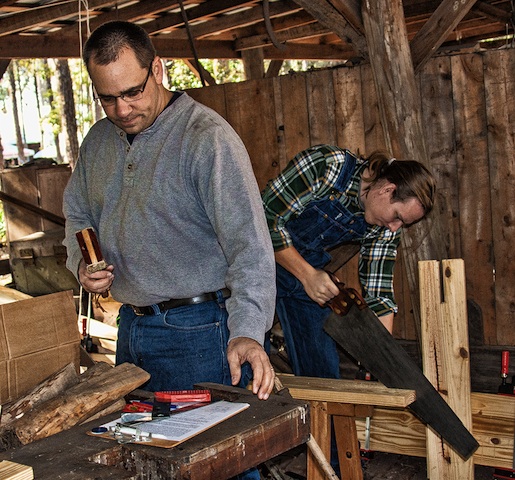
Tom and AndyOne of the things we were trying was cutting some three-sided tenons (basically, deep notches) using hand tools. Andy Gibson, the guy who put a new handle on my rip saw, was slicing and dicing with the best of them as he cut the two sides of the notch. But, to slice out the bottom of them, he was using a mortising chisel I had purchased a few years ago. Andy whacked the heck out of it as he cut into the wood, and remarked, “Dude, why don’t you sharpen your tools?”

Which got me wondering – have I ever sharpened my mortising chisels?  The answer is a resounding no.

Sharpen that chisel

So, my first thought was to turn to my Tormek with the standard straight-edge guide – the regular method for sharpening bench chisels. But, there is a slight problem…

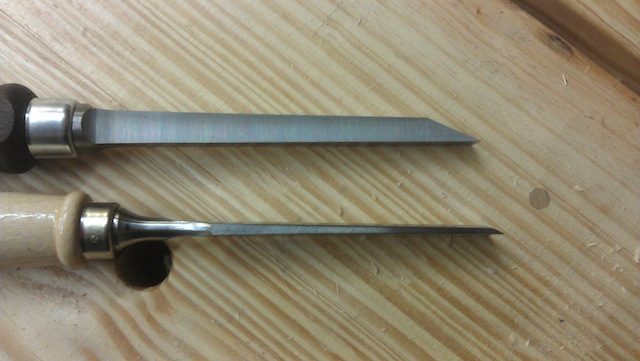
Cross sectionsYou see, mortising chisels are so much thicker than bench chisels. They are designed to be banged on with a mallet, driven into the cut. So, they have to be much tougher to take that beating. Which means, of course, they don’t fit in to the square edge jig.

Bummer.

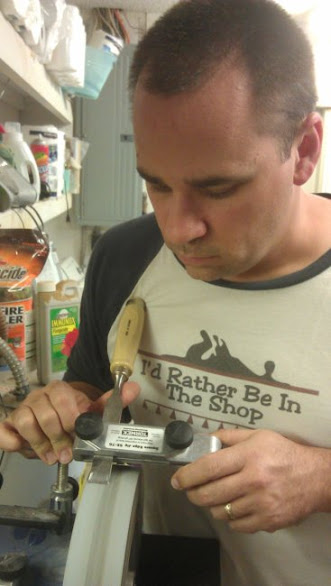
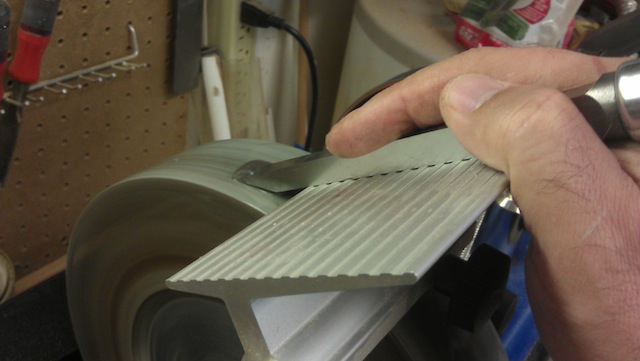
So, I started reading through the guide for my Tormek, and I thought it would be a good idea to use the universal platform for this. It is basically a piece you can adjust to any angles and clamp on the guide bar.

The platform

And, this worked OK. It was difficult to keep total control over the chisel, and I spent a lot of time concentrating on holding the bevel against the wheel and holding the chisel as straight as possible.

The results were OK, but not spectacular. My bevel ended up faceted, and I was afraid that my grip could have shifted during the session, leaving me with a non-square tip.

I will have to do some more research on this, but I’m sure that as versatile as this tool is, there is going to be a solution…

Quick Poll

Shop maintenance is one of those things you gotta do. The saws need to be aligned, the tools organized and the sawdust swept up. And, you know that the tools need to be sharpened.

Sharpening is a task that some people relish. They pull their tools off the sharpening medium and look at their handiwork with glee. They even demonstrate just how sharp their edges are by shaving the hair off their arms, legs or other body parts.

Others know it has to be done, but they dread the work. I mean, it time spend grinding steel off the edges of tools, not working with wood. Isn’t working with wood why we got into this craft?

Today, tell us how you feel about sharpening. Are you all jazzed about doing it, hate it, or feel indifferent about the whole process?


Link of the week

Making Wooden Olympic Rings

Sure, Steve Ramsey of Woodworking for Mere Mortals made these for the 2012 London summer games, but the rings are identical to the ones being used in the Sochi 2014 winter games.

Steve Ramsey's Olympic RingsAt first glance, they seem very easy to build. But, look closer at how the rings are interlocked, and you will want to know how Steve managed to pull these off. Fortunately, he did a how-to video filled with the techniques and tricks to pull off this complicated project.


The smooth sled

After years of listening to music stations on my ride in to work, I have discovered the joy that is sport talk radio. Sure, there are some big talkers out there, but I have found a great morning show on 98.7 FM – The Fan radio.

The Kirk and Dinger Morning Show

Two time Stanley Cup champion Chris Dingman and his co-host Kirk McEwen talk serious sports on the Kirk and Dinger Morning Show. In addition to the regular who’s-going-to-get-traded-who-do-you-think-will-win-this-weekend kind of sports talk, they frequently open the phone lines for listeners to weigh-in on a particular sports question. The other day, the pair and the rest of the crew posed an interesting question – are you a Summer Olympics fan or a Winter Olympics fan?

For me, hands down, it’s the winter games. It’s all the speed that really interests me. Watching the skiers tackle the downhill slopes, the ski jumpers sail through the air or the hockey players chasing down the puck in world-class competitions, that is pulse pounding.

My favorite event of all, however, is the four-man bobsled. I will drop whatever I am doing when I see the time trials begin in that. The start is just organized chaos as all four athletes try to get the speed of the sled up as high as possible to shave hundredths of a second off the fastest time. They scream down the track, hugging the turns, and then try to stop the massive sled at the end of the course.

They also universally have someone ringing a cowbell at the start of the race. I remember hearing this going all the way back to the 1980 Winter Olympic games in Lake Placid, New York.

Not only are today’s sleds impressive to watch race, they are models of safety and smoothness. Again, in a race where hundredths of a second mean the difference between gold medal and no medal, an incredible amount of engineering goes into each sled.

Another place where a sled is useful is on a router table. Oh, sure, many times a simple router fence or a bearing guide can keep your workpiece on track, but what about the times you want to rout a profile on the end of a workpiece – say, when making a cope cut on the rail ends for a set of doors?  What then?

Well, you could go freehand – and mess up your pieces, make a trip to the emergency room, or both. Or you could use your miter sled or a fixture that runs in a miter track.
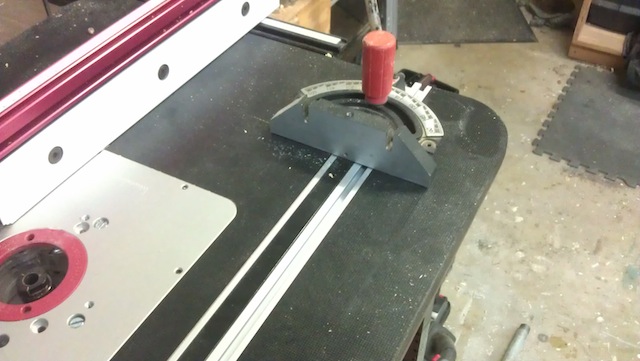
This could work.. a miter gauge

That’s a great idea, but the problem is that the router bit is a single point on the router table, meaning that the router fence doesn’t need to be parallel to the miter slot to get a decent cut. With this situation, you can see how trying to use both the miter slot and the router fence means the fence could either fade away from or pinch toward the track, making it a challenge to get a good cut.
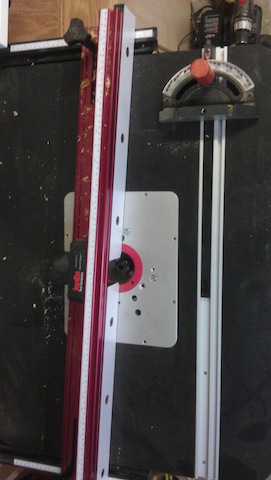
The fence fade

A better idea is to use a contraption that rides along the fence, making it easier to guide the work along only once reference point. Now, I have used something as simple as a piece of plywood with a handle nailed to it, but this sled I picked up from my friends at Infinity Cutting Tools is the bomb.
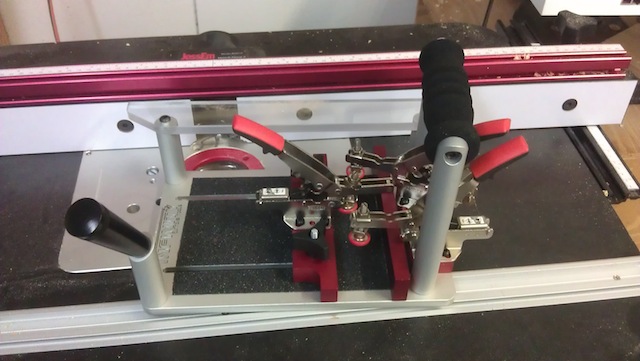
The pro coping sled First, it holds the workpiece tightly down to a base, preventing any movement away from the bit as it is fed through. These hold-down clamps are easy to use Bessey models, and they hold the workpiece – as well as a backer board to prevent blowout on the back edge.

What runs against the fence is the clear visor, which allows you a good view of the work going through the bit while preventing any chips from flying up to hit you in the face.  A great feature.
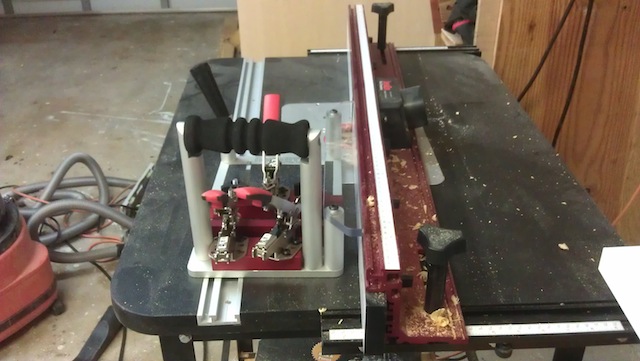
Check out the tail viewPlus, it has some great handles that afford the user a firm grip on the sled, helping to keep positive control over the work as it pushes across the table.

The real test comes when you have to make a coping cut. I put the coping bit from the set I have into the collet of my router and adjusted the height and depth of cut with the fence. From there, I put the sample piece and a backer into place and clamped everything down.

While I have successfully used this bit set before, I had always worried about the safety and precision of the cut on the cope ends. Well, the first test pass showed I had nothing to worry about.

The cut

I can see myself using this sled for years to come as I build new cabinet doors and chest panels. I’m going to say that using a coping sled gets a gold medal in my book.