All posts by Tom

I'm the guy who writes the blog...

Q&A About tail vises

I just noticed in your title graphic that you have a tail vise on the bench in the picture.  I’m starting to plan for building a workbench myself and I’m leaning towards a tail vise in the end vise position.  Do you have any thoughts/tips/advice concerning a tail vise, its construction/hardware/etc?

—–  Reader Torch02

That’s actually a picture from when Marc Spagnuolo and I were at a woodworking school up in Indiana.  That bench was one of ten bought from Garrett Wade for the students to work at.  Apparently, even though they cost a pretty penny when they were bought, the benches – particularly their tail vises – were pretty prone to damage.  Of course, they were getting a lot more use – and abuse –  than any bench would normally, as students were using them many times a day.


Now, what’s my own personal experience with a tail vise?  Well, let’s just say for my bench at home, it was an aborted attempt.  I was following the instructions that came with the hardware, and I got all twisted around.

My solution was to drop back and punt.  I replaced the boards that looked as if they had been chewed upon mightily by deranged beavers and just put in solid boards.  I drilled a row of bench dogs, and when I want to clamp something, I use the Veritas wunder pup and a bench dog.  It works pretty well

Of course that option does have its limitations… the Wunder Pup has only a 6″ throw on it and it is very finely threaded… so it does take a little patience to get the board clamped down.

If I had to do it all over again (I just might – I can replace the top and keep the base…) I would consider installing what’s known as a wagon vise.
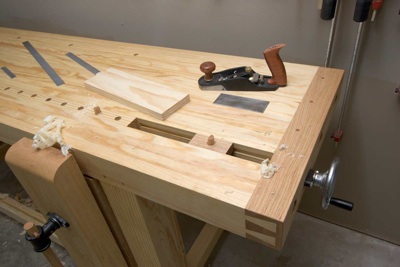
You don’t need any expensive steel running gear save a shoulder vise screw.  Those are a lot cheaper than a whole tail vise setup and are mostly made of wood.

Another option would be to just simply mount another steel fast acting vise on the tail and line up the dog holes with the vise’s built in dog.  Probably the easiest way to go, and a decent face vise can be had for about $80 or so.

I saw this plan in Wood.  It’s a way to create a vise  using only pipe clamps mounted to your bench. Great if money is short and you like to MacGuyver things together.

And, if you want to go even CHEAPER than that, get a pair of bench dogs and use some opposing wedges to snug the work between them.  You can make the wedges any thickness you want so they won’t interfere with planing thin boards.

I realize you asked me what time it is and I told you how to build a clock… but, hey, you asked!

Quick Poll

Cutting pieces accurately while building your projects is an essential skill to master.

Unfortunately, I have yet to truly master the task.  But, hey, a fire on a chilly December night isn’t the worst thing to happen.

When woodworkers want – and need – accuracy when measuring, they turn to some tried and true methods. Some involve a hand-held linear device that provides a visual readout comparing the depth of snow to a universally understood unit of measurement.  You know, a ruler.  Others involve marking the length directly from the project.

So, this week, when you need an accurate measurement, how do you get it?

[poll id=”103″]

Link of the Week

How It’s Made:  Godin Acoustic Guitars

A guitar may appear to be a simple instrument, but there are many steps involved in building one.  Even on factory made acoustic guitars, there is a tremendous amount of hand work that goes into crafting an instrument that can be played hard but still make beautiful music.

This week, we go back to the show How It’s Made to see how Godin Guitars crafts their acoustic models. Even with many skilled employees and specialized tools, it still takes nearly three weeks for a guitar to go from a rough stack of materials to a beautiful instrument.

‘Twas some time before Christmas…

Twas some time before Christmas, when all through the shop
I was just so darned busy, I thought I would drop!

The gift list was hung by the workbench with care.
“If we don’t ship these soon, they’ll never get there!”

I in my apron, glue bottle in hand,
was prepared to work hard, to make my last stand.

Sanding and planing, the dust it did blow,
covering the shop floor like the new-fallen snow.

I struggled and sweated as I wiped off my brow.
“I’m sure I can’t do this… no way or no how.”

Project pieces lay about, both tennon and mortise.
“If I progressed any slower, I just might be a tortoise.”

When what in my offended nose did I smell?
“I can place that aroma!  I know it so well…”

When in swang a monkey, hanging high by his tail.
“I’m here to help – together, we won’t fail.”

Of course, it was Iggy, the trained Shop Monkey.
He looked very dapper, his smell was quite funky.

With tool belt cinched tightly around his middle.
He looked young and  strong – as fit as a fiddle.

He was 20 inches tall, all covered in fur.
I guess it’s there so, if cold, he wouldn’t say ‘brrr…’

With eye protection on and boots on his feet,
his shop working outfit was completely complete.

“Now, what’s on this list? Something for father and mother…
We’ll finish this job, don’t you worry, my brother.”

But, raising my hand, I told the monkey to hush.
“They’ll all look simply awful if we get in a rush.”

“Not to worry, pal,” said the monkey with glee.
“We’ll get this job done, just you wait and you see.”

And, with fur and tools flying, working hard was a must.
“You know all these tools, in your skills you must trust.”

“Don’t overthink your joinery, lay out and do cut.
If you don’t get a move-on, I’ll just kick your butt.”

With motivation a-plenty, I set out to work.
“You do a good job, Tom, just don’t be a jerk!”

With project pieces cut, the work was quite simple.
I was happy it worked! You could just see my dimple.

The monkey and I, we worked at the bench.
I was no longer bothered by his terrible stench.

The tools sprung to life, and I was in awe.
Iggy shouted quite loudly, “On router and saw!

On sander and chisel! On spokeshave and plane!”
Our work was quite orderly, the pace was insane!

Together we worked, and with our combined project attack,
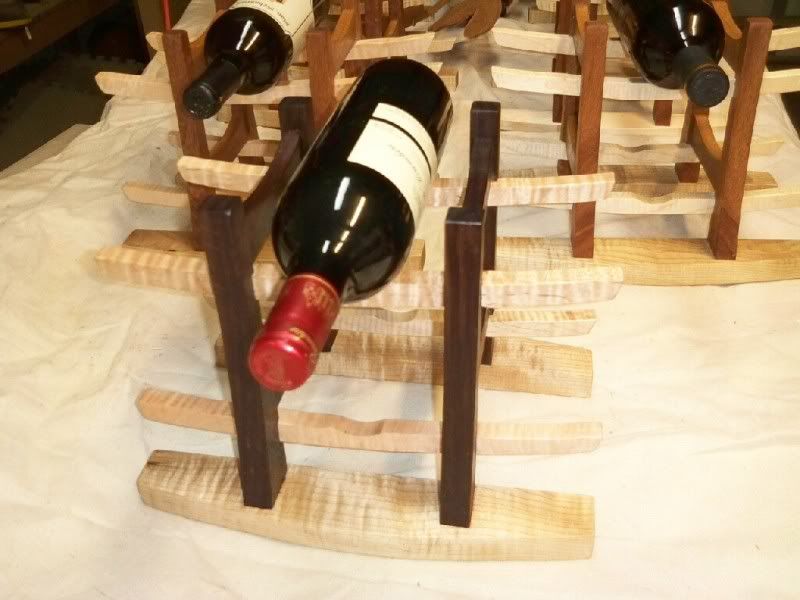
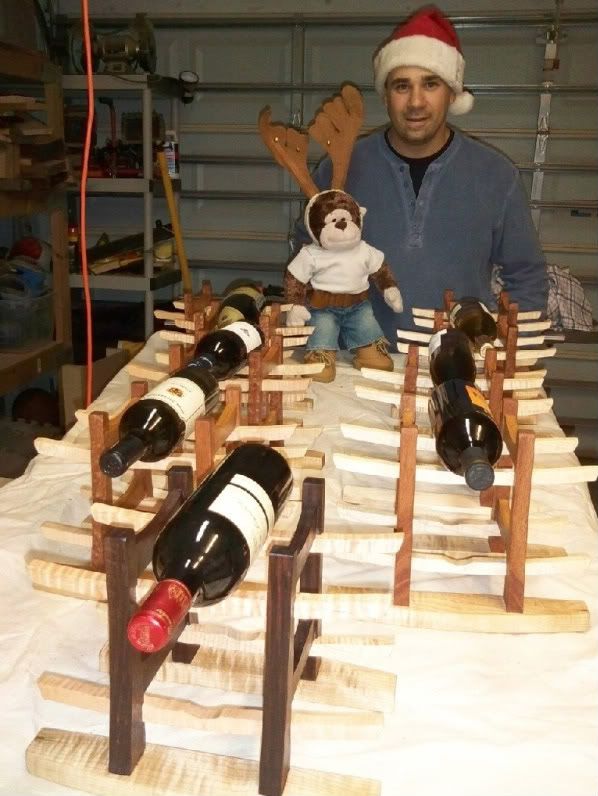
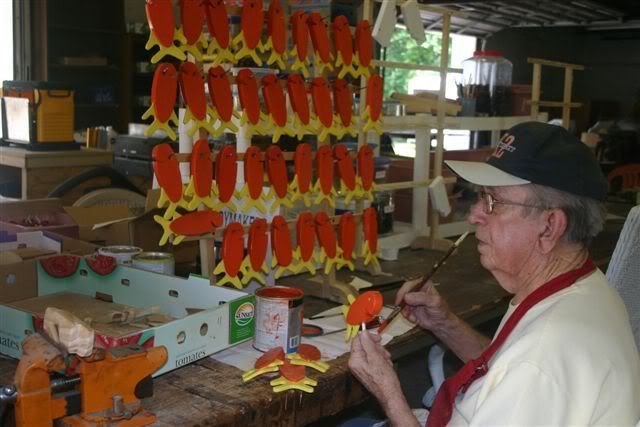
there, on the bench, sprung to life nine tiny wine racks.

(A note to my relatives: Right now, shield your eyes
or I will be blowing the big Christmas Surprise!)

The plans we had gotten from our friends there at Wood.
The project looked sweet, the fit was quite good.

From a stack of work pieces all perfectly milled,
from just a plain drawing, these projects distilled.

The frames are held fast with the mortise and tennon.
Try as you might, there’s just no way to bend ’em.

I sanded the pieces, then applied the finish.
Iggy said “You work faster than Popeye on spinach!”

A coat of shellac, a wipe on finish made them pop.
The look amazed both of us, our jaws they did drop.

Eight tiny wine racks, made of maple and sapele.
(That’s a wood from Africa, not Brazil or New Dehli)

Eight were the same, but there was this one
made of dark wood –  it  looked nice – I had some.

The bottle supports are all of curly maple.
In Iggy’s workshop, that wood is a staple.

And riding on each was a bottle of wine.
Most of them cheap, very few of them fine.

The eight sapele projects they lined up to follow
the dark wooden wine rack, with a red foil on bottle.

The scene it reminded me of old St. Nick’s Sleigh
with Rudolph’s red nose a-lighting the way.

Iggy said, “We got them together, of that there’s no lie,
just try not to touch them ’til the finish is dry.”

“We now need a cheesy photo… go get the missus!”
“What if she won’t?”  “Well, go ply her with kisses!”

And so, in a flash, she came with her camera to snap.
She took some pictures, then went back in for a nap.

Iggy looked pleased as I reviewed the shots on the camera.
“That was some hard work.  Now, how ’bout a banana?”

And as I handed Iggy a big golden bunch,
he said, “At least – this time – you fed me lunch.”

And, as he swung to a tree and disappeared from sight,
Iggy shouted, “Get  to the post office now, not later tonight!”

Woodworking Spotlight: Andrew Lunn

With care… always.

When people talk about the good old days of hand tools, they often cite the attention paid to the small details. Plane mouths that are machined to tight tolerances. Comfortable handles on chisels. The look and feel of a solid performing work of art.

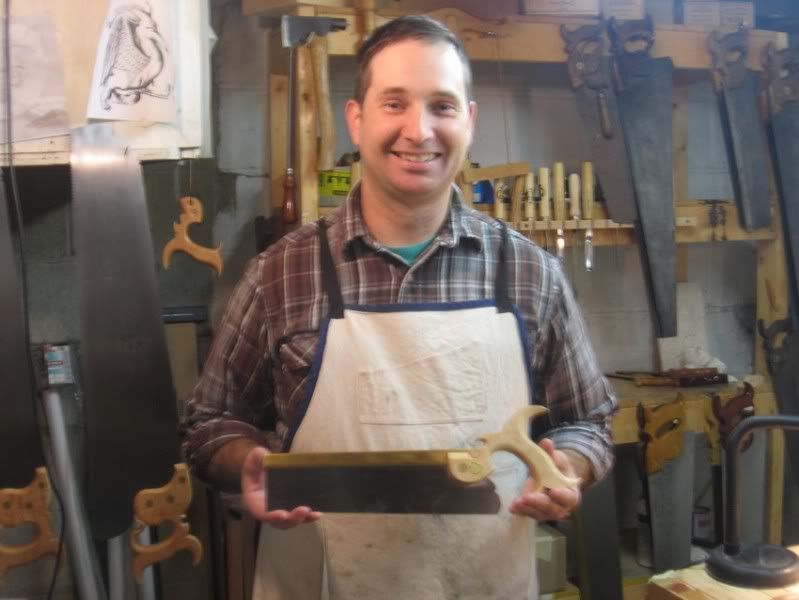
That’s why you might be surprised that one of the true artisans making new hand saws started out doing rough work.

Andrew Lunn, the owner of Eccentric Toolworks, got what some folks might call a late start in woodworking. “I did have a shop class in junior high school when I was 14 years old. But that wasn’t what really got me going. In fact I didn’t make anything after that until I was 27 years old! I was working in an office and started to get the feeling that I wanted to work more with my hands.” According to Andrew, this career change came totally out of the blue. “I got myself a job working on a construction crew, doing restoration work to fire damaged buildings. It was all really unfocused at first–I knew I felt drawn to working with wood, and that I felt drawn to working with my hands. But I didn’t know if that would mean carpentry, or furniture, or what. So I put together a modest hand tool shop in my garage and began making things by hand. That’s what really got me going.”

Over time Andrew realized he was attracted to the smaller, more skilled tasks that focused his attention. “Several years ago, I got the idea that I wanted to make myself a whole set of hand tools, and that I would in turn use that set of tools to make things. The prospect of making a saw felt particularly interesting so I thought I would start there–and basically I started and just never stopped!”

Today, Andrew makes some of the most comfortable, true cutting – and beautiful – hand saws available for sale. His saws are not mass-produced. Instead, just as a tailor would fit a suit to a customer, each saw is fitted to the individual client placing the order.

“Basically I start with a measurement or two from the customer then send them a poplar prototype of their handle that incorporates those measurements. I get feedback from them and incorporate their input into the actual handle. I also tune the saw for the particular woods the customer will be using.” Andrew ships the saw with the final handles made of beautiful curly maple, cherry, quartersawn beech, or walnut.

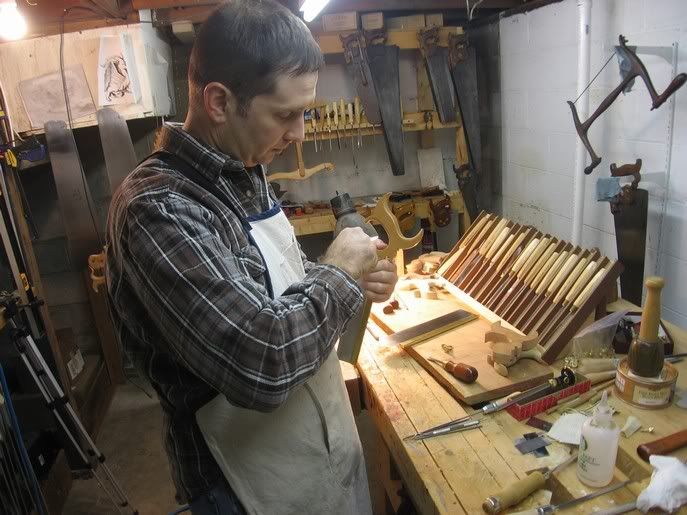
Yes, you are reading this correctly. Each saw is truly made by hand in his shop. The handles are shaped entirely by hand. Most of the metalwork is done by hand with files and other hand tools as well. “The saws are tuned and fussed over until I am totally happy with them.”

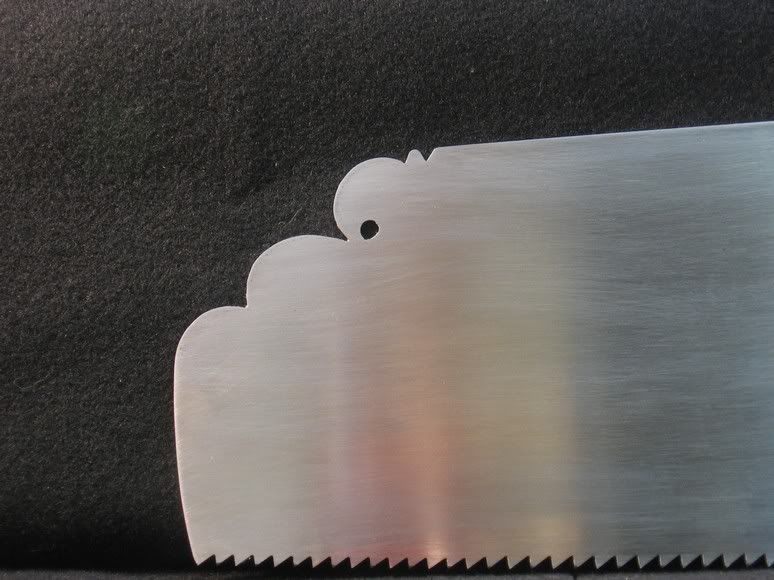
While Andrew could certainly just build some functional plain-Jane looking saws and call it a day, his signature on these tools makes his work truly stand out. Decorative cut outs at the front of the saw make what would normally be a shop workhorse a thing of beauty. “Saws to me represent a creative outlet, so the way they look reflects various openings or possibilities that I thought could be explored. I enjoy the entire design process, both with function and appearance, so as much as possible I try to meld the two into a single fabric.”

When I asked Andrew about his favorite aspect of building these beautiful tools, he had some difficulty identifying it. “I don’t know if I really have one. I like each part of it and get really absorbed while doing it. The metalwork is so important, and has a subtle art to it. The handles, those are a really big deal too. Saws are just very lean tools–there’s nothing there that isn’t important. It takes a lot of concentration and care. That’s why on some of the saws I etch the words, ‘With Care … Always.”

Quick Poll

‘Tis the season…

When we build projects for relatives on our gift list.

Sure, there have been years when Aunt Mable wants a cutting board, mom wants a picture frame and your cousin Vinny wants a cigar humidor… and you’ve built individual projects for each.

But, it’s so much more efficient to build one kind of project for everyone.  This way, everyone on the list gets the same item built in steps. You can cut all the pieces with the table saw fence set to the right width, cut mortises with the router bits set to the right depth…  It becomes production work.

So, this week, tell us if you have built multiple copies of a particular project and what the largest number of these projects you built at one given time.

[poll id=”102″]

Link of the Week

Ancient Egyptian Woodworking

Woodworking is a very ancient art.  How old?  Well, nearly 4,500 years ago, while stone workers were building the pyramids, Egyptian woodworkers were known as the best craftsmen to the world.

Using some local and many imported woods, these imaginative woodworkers created the mortise and tenon, dovetail and many other joints we use today.  They were using hide glue extensively in their work, building some impressive projects.

Once you read about the Egyptian woodworkers and their craft, you’ll understand what real throwback woodworking is all about.