A talented woodworker can make a saw sing as it slices through wood. And, then there are people who can just make the saw sing.
Yes, there are people who actually play their hand saws as instruments. By holding the handle, bending the blade and using a violin bow or your bare thumb, you can coax musical notes from the tool.
Sure, it takes practice, but it beats throwing away a hard-working saw at the end of its life…
Make a list of the things that a woodworker needs to do his or her craft. What would you put on it?
Tools would be up there. A place to work would be nice. A way to support and secure your work wouldn’t be bad. Maybe a few measuring devices…
Oh, and you need wood. Depending on the size of the project, sometimes, lots of it.
Maybe hard, durable woods like maple or hickory. Maybe woods that work well for carving like mahogany or basswood. Sometimes, you need inexpensive stuff that works well, like southern yellow pine or red oak. Veneers. Plywood.
Even the ubiquitous 2×4 whitewood stud to make push sticks and other shop jigs.
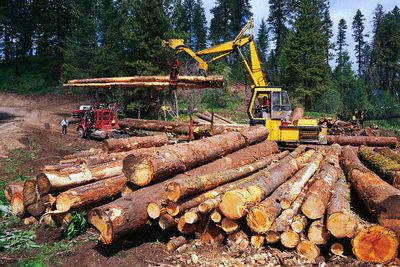
Wood is used in a wide variety of applications. There’s furniture making and construction for sure, but it’s also used in papermaking, chemical products – even food production. But, for many years around the world, trees were cut down with little thought to the impact on the existing forests.
In many western European countries, going at stands of trees with the axe was vital. Countries such as England plowed through their native forests harvesting timber for ship building, dwellings, bridges and other structures. It became an implied duty for the wealthy landowner to sow a handful of acorns on his property to help ensure there would be enough native wood to keep the Royal Navy afloat.
Then, the colonization of the Americas happened. Settlers were stunned by the incredible number of trees to be found everywhere on the continents. It’s been said that a squirrel could cross from the Atlantic Ocean to the Mississippi River by hopping from tree branch to tree branch, never having to set foot on the ground. Soon, axes were hard at work, harvesting lumber for domestic – and exported – uses. Millions of acres were also cleared to make room for the farms to feed the burgeoning population.
Click on image to enlarge
Fast forward to the early 20th century. Many of those lush forests were now nothing but an empty landscape, devoid of anything but the occasional ragged stump left over from the clear cutting operation.
Fortunately before all of the virgin old-growth forests were lost forever, government and industry sought ways to slow or reverse this alarming trend. “Without wood, there’s no woodworking. Period,” said Eric Poirier of Bell Forest Products. “That’s why it’s extremely important to everyone involved that responsible forestry practices are followed as we keep moving into the 21st Century.”
To that end, responsible lumber merchants are active partners in combating the illegal harvesting of domestic and imported hardwoods. “Wood is one of the most important renewable resources, but only if it’s harvested responsibly.”
How do retailers ensure their supply meets stringent responsible standards? “We only deal with lumber wholesalers and log dealers who actively combat illegal logging.” Eric was very candid about the company’s policies. “We make sure our suppliers have policies in place regarding planned felling, minimum tree diameters and felling rotations to ensure regrowth of the affected area. When we as retailers – and our customers – demand these practices, the wholesalers and loggers listen.”
How can a woodworker know if their lumber retailer works with responsible loggers? “Ask lots of questions when you go to your supplier. In today’s world of environmental consciousness, many retailers are touting their practices on their websites or at their stores. If they don’t – ask.”
One area of specific concern for many woodworkers is the questionable logging practices of developing countries. “Some of the world’s most beautiful wood comes from South America and Africa. Unfortunately, some of those species we love so dearly – ebony and rosewood – were logged extensively and today are very rare.” To help preserve these important trees, organizations such as the Forest Stewardship Council were created. This international body’s mission is to slow the overharvesting taking place around the world, with a specific focus on tropical woods. Founded in 1993, the organization has seen some success in trying to slow the overharvesting. But, much remains to be done in order to preserve these resources.
After all, it’s not just today’s woodworkers who can be impacted by our actions. “I have two young children. When they get older – and should they want to woodwork – it’s up to all of us to take our responsibility seriously so they can supply us for generations to come.”
Music is cool. I keep my iPod strapped to my arm most every day, listening as I go about my business. If I’m writing at work, it’s classical. On the bike? Something with a driving tempo to help me keep my pace. And then there is my favorite.. anything with a kickin’ bass groove.
Regardless of the style of music, there’s one thing that all musicians have in common: They know that their instruments are worthless for making music if they are out of tune. Even if you don’t have a musically-trained ear, when a piano hits a note that’s not quite right, you will notice that something’s out of whack. Same thing with a guitar, a violin – whatever.
That’s why before a performance you can watch band members spending time in a sound check, tuning up their instruments to give the right sound during the show. Pluck the string, tune the string, pluck it again until it’s just right.
Unless you are woodworking in front of a camera or a group of woodworking students, there’s a very good chance that you will be performing for an audience of just yourself. But, the same principles apply.
Tuning your tools is a critical part of the building process. Not only do well-tuned tools perform better – they are also safer to work with. They give superior results for the project you are working so hard to complete.
But, where to begin? For power tools, the best bet is to crack open the owner’s manual or a book or website dealing with your brand of tool. This will give you the know-how on how to tackle this task.
In many cases – especially for your power tools, just getting all of its internal parts clean and free of sawdust is a critical first step. All of the sensitive gears, tool blade and bit holders and sensitive electric windings perform much better when not jammed up with crud.
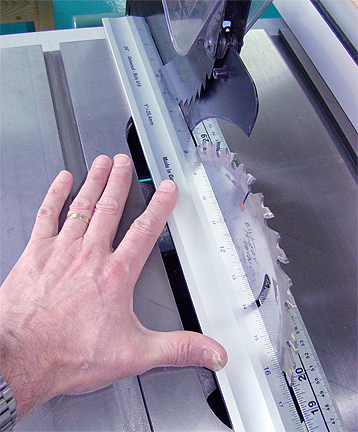
Alignment is another critical part of this tuning up process. Lining your rip saw parallel with the miter slots and blade on your table saw gives superior results and helps to reduce the likelihood you will see a kickback. Getting those band saw wheels coplanar will increase the life of your band saw blade and how well it tracks. A few moments doing these tasks can save lots of time and trouble later.
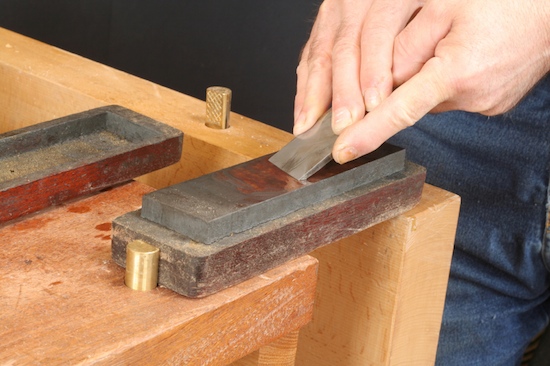
And, when it comes to bits and blades, you can’t beat clean and sharp. Get the gunk off your table saw blades and router bits. Plane irons, chisels and hand saws, properly honed to a razor sharp edge, make hand work a breeze.
Does this take time away from woodworking? You bet. You won’t be able to jump headlong into building. But, just as with any musician, if you don’t take the time to tune your instruments, your work could very easily hit a sour note.
What part of the newspaper do you read first? Sports? Business? Local news?
Many woodworkers – and others looking for a deal on products and servicees – will often pull the classified ads out of their local paper and go through them first. There, people who are looking to get rid of their old stuff list their items at what usually is a bargain price.
This week’s question – have you ever purchased a tool through classified ads? These can either be in the paper or – now that we are in the 21st century – online at a service like Craigslist.
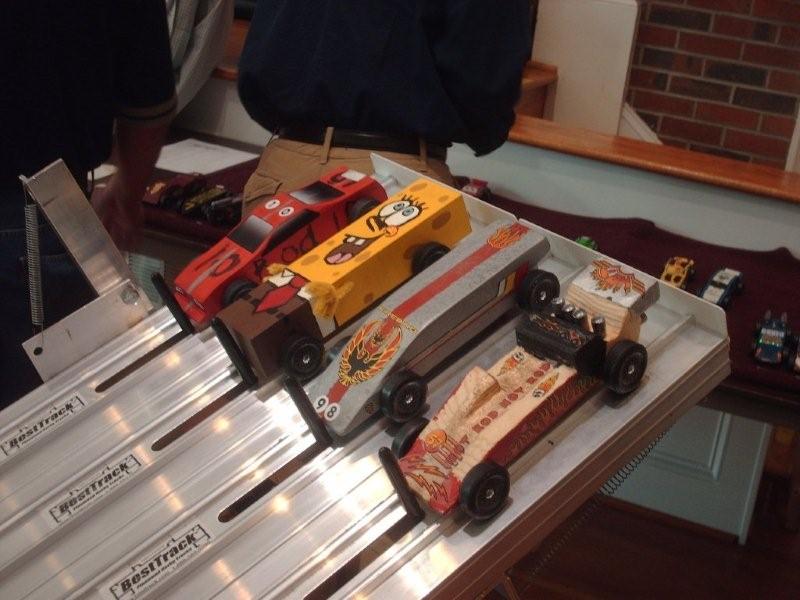
Called one of the celebrated rites of spring by Reader’s Digest, the Pinewood Derby has been an annual tradition for the Boy Scouts of America since 1953.
With just a block of pine and four plastic wheels, scouts are encouraged to let their imaginations run wild. Carving, cutting and shaping the plain wooden block, each scout’s creation is a unique reflection of their creativity.
Of course, these cars aren’t just for show. By building their cars with care and precision, each scout improves his chance of rolling faster that the opposition. Of course, the idea is to have fun!
If you are interested in trying your hand at building one – even if you aren’t a scout – many sites offer the official kit for you to purchase and try your hand at building a racer of your own.
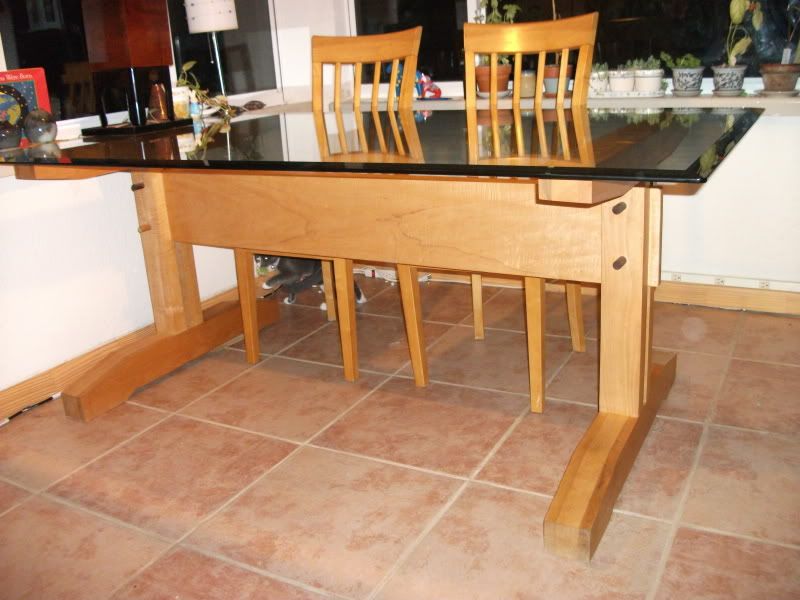
Before our neighbors had their daughter and son, they had a very cool all-glass dining room table. A glass top and two pedestals each made of 12″ wide glass strips joined at a 90 degree angle with two screwed together brackets. It was stylish. It was striking.
And, after they had kids, and those kids started to walk, they discovered just how unstable it was. In fact, after one energetic evening of their son and daughter running near the table, our neighbors ended up holding the heavy table top once a little one slid into one of the table bases.
To help get the dining table issue under control, they asked if I could build a sturdy wooden base for the glass table top. Something that would be a little heavier, a little wider and a whole lot more stable.
Since the husband of this couple was born in Japan, I thought I would go with an Asian-looking trestle table base. Something a little more graceful, something a little more muscular and something out of maple.
I built a pair of trestles starting with a massive base built up from three strips of maple. The middle strip was cut and glued into the sandwich allowing spaces to make ready-made mortises. The same process was done for the top trestle. Rather than build the upright support in the traditional manner, I glued two uprights into place, using the space between them as a mortise to receive the crosspiece. The uprights are glued and through doweled into the trestle base and bracket to ensure they don’t go anywhere.
And, what a crosspiece it is. A solid piece of maple – 8″ wide by 2″ thick. Planed and sanded, the ends are tenoned to fit between the uprights. I drilled 1″ diameter holes in the uprights and drove dowels through the uprights and tenon to hold it in place. I think it gives the piece a nice accent.
I sanded and scraped the piece smooth and finished it with a coat of 1# cut of dewaxed shellac sanded smooth with 600 grit paper. Then I applied several coats of wipe-on poly to give a tough finish.
Today, their family has grown to also include a dog, two cats and their much older, bigger, faster and stronger children. And, the glass table top sits firmly on top of the table base, unmoved by the commotion and evening dinners.
What a great 16 days of Winter Olympic games in Vancouver. From the snow boarder jumping through the Olympic rings to kick off the opening ceremonies to the very classy selection of Neil Young singing Long May You Run as the flame was extinguished, it was one whale of a show.
My family would gather every night after dinner and watch the athletic drama. The frenetic pace of short-track speed skating. The grueling endurance of the cross country skiing. The confusion of curling…
It wasn’t just the competition that caught our imaginations. The courage of the Georgian Olympic delegation pressing on after the loss of their fellow countryman Nodar Kumaritashvili during a practice luge run. The grace of bronze medal winning Canadian figure skater Joannie Rochette who took to the ice mere days after the passing of her mother. Gold medal winning bobsled driver Steven Holcomb who, just two years after an experimental eye operation to save his vision, piloted the United States four-man bobsled to its first gold medal since 1948 at the St. Moritz games.
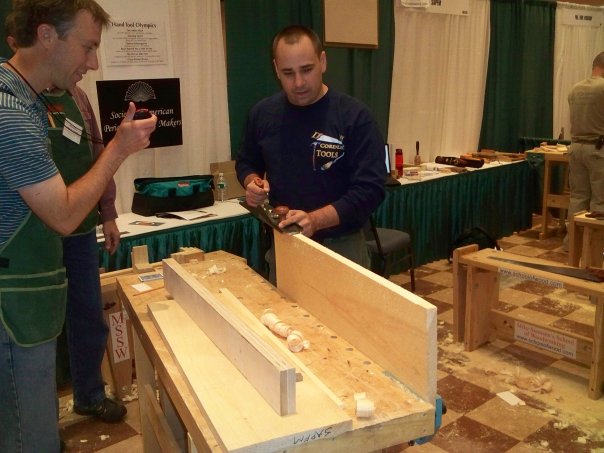
While the Vancouver games took place during the last two weeks of February, other Olympic competitions took place four months earlier in Valley Forge, Pennsylvania. No, IOC president Jacques Rogge didn’t stand at a podium and declare them open. However, the Hand Tool Olympics did take place at the Woodworking in America conference last October.
Mike Siemsen and a cast of volunteers conducted two solid days of competition, which included the one meter dash (rip cutting a three-foot-long board), Greco Roman tenons, boring, crosscutting, hand planing and – the toughest of them all – the two-tailed dovetail challenge.
Not only where contestants judged on their speed, but their accuracy as well. By stuffing a number of playing cards into the joints or under a straight edge, the accuracy judging was tough, with running commentary offered as part of the enjoyment.
Those were some tough and challenging games, and I really don’t want to go into how well (poorly) I did.
I understand that there’s a possibility that Mike might be bringing back the Hand Tool Olympics for this year’s WIA conference. Maybe I can improve my Jamaican bobsled team performance and get a little closer to the podium this year…