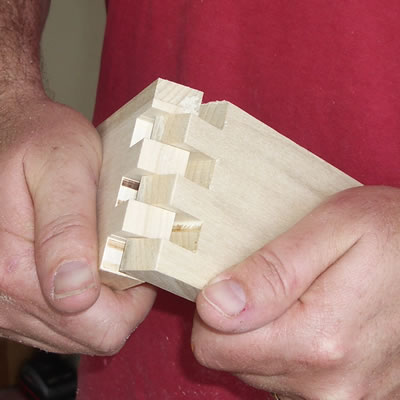
Dovetail joints are a classic way to join the corners of a project. They look timeless and offer great strength.
As mass production of wooden pieces came into play, manufacturers found it easy to lose the slope on the pins and tails and modify the joint into a box joint. This was used on utilitarian projects as well as finer furniture and still remains an option for woodworker today.
Just as with the dovetail, there are many ways to make a box joint. Table saws, routers and even hand tools can form the interlocking fingers and make a strong and attractive joint.
This week, let us know what is your preferred method of cutting box joints.
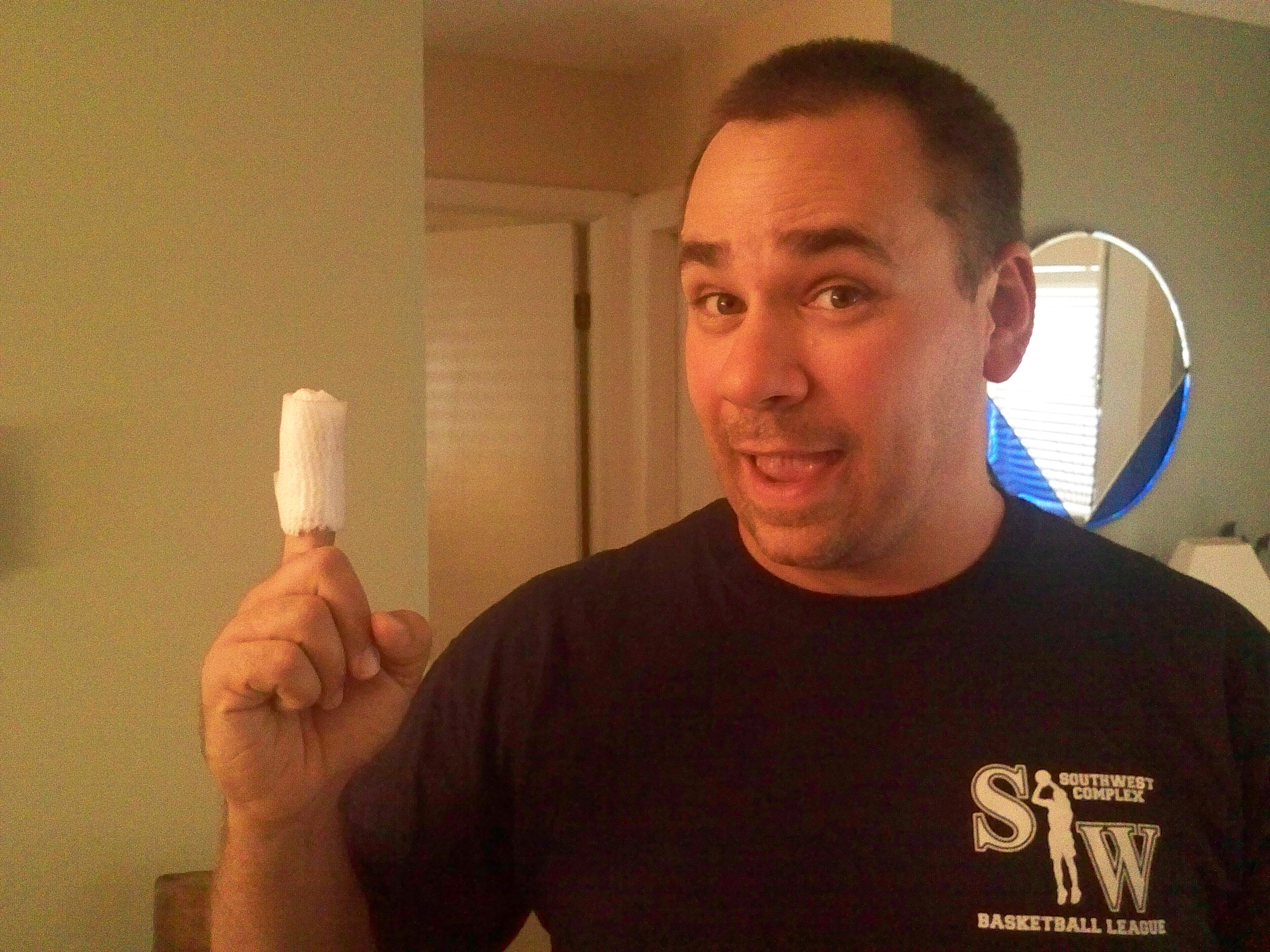
When I went to the immediate care clinic last Saturday, a lot of things happened in very short order. My finger was cleaned. The doctor numbed the finger with a local anesthetic. He stitched up the finger and applied a pressure bandage. He even wrote a prescription for an antibiotic.
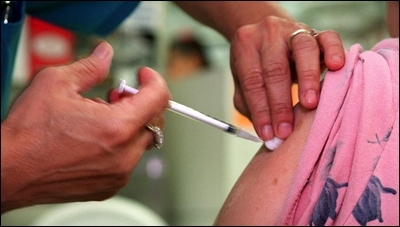
But, the most important thing he did was give me a tetanus booster shot. And I’m very happy he did.
Tetanus is a very insidious disease. The bacteria that causes it can be found just about anywhere, and if it gets implanted deeply into a wound, things can go badly in a hurry. Within eight days the bacteria has grown enough to start emitting a powerful neurotoxin which short circuits signals in the nervous system. Spasms and muscle rigidity are very common, giving rise to the more common name of lockjaw. Eventually, even the diaphragm can be affected, disrupting breathing.
In fact, 30% of tetanus cases prove fatal – even in a hospital setting.
The best defense against tetanus is a good offense. Every ten years, it’s a good idea to get a tetanus booster.
The Web MD site has all of the background information for your reading pleasure.
Since I’ve been on reduced duty this week recovering from my run in with the hedge trimmers, I’ve had a lot of time to watch movies, play games with the kids and read. And, boy, have I read. The librarians are getting tired of seeing me.
Libraries are great places to go. There are tens of thousands of books on the shelves on all different kind of topics. Wine. Travel. Woodworking. Music. You can’t go wrong…
And, there are some of those books you want to borrow again and again.
C. Keith Wilbur’s Home Building and Woodworking in Colonial America (ISBN-13: 978-1564400192) is one of those books. Lavishly illustrated throughout, Wilbur takes readers through the process of home building from the selection and felling of trees for the timber frame to the plastering and white wash on the walls. Each step is shown in the kind of detail that will leave the history minded woodworker intrigued for a good long while.
For instance, the action starts right on page one… Wilbur begins with a one page description of how the European settlers had over harvested the trees back in the homeland and the feeling of joy they experienced when they saw the enormous tree stands in North America. The page also explains how the Royal Navy surveyors branded with the King’s broad arrow every single white pine with a diameter of two feet or greater for use as masts on new ships.
Later pages describe how the Colonists improved on the British trade axe to design a more efficient chopping design. The proper way to select and fell a tree while using just an axe. The tools and processes used to buck the longer logs to more manageable sizes. Hauling them out of the forest. Squaring the timbers. Stacking and seasoning the timbers to get them ready for construction.
And, that’s all by page 15…
I was amazed by the way Wilbur constantly illustrated how conditions in the American Colonies dictated the construction techniques and designs in order to address local climactic conditions. For example, homes built in New England were primarily built with a central chimney stack in order to retain as much heat as possible during the brutally cold winters. In southern colonies, it was a better idea to move the chimney stack to the outside of the house in order to better control the heat gain in the milder winters and while cooking during the summer months.
As an unexpected bonus, Wilbur throws in a chapter dedicated to the evolution of common woodworking tools. From prehistoric times through Egyptian, Greek, Roman and medieval times until the colonial American era. Axes, adzes, chisels, planes… they are in there.
I have only scratched the surface of what’s offered in this book. If you are a fan of old school woodworking, you can do a whole lot worse than picking up a copy of this book. And, after I change my finger dressing this morning, I will be reading more during breakfast.
By the way… In case you are counting… this makes post number
Pretty cool, eh? I had no idea back in 2007 that I was going to get this far. I hope that during my run so far at Tom’s Workbench that I am able to provide you with a few laughs on our journey into woodworking. Thanks for reading!
Iggy the Trained Shop Monkey here, and, boy, do I have a howler for you today.
But, first, I wanted to share with you a quick definition that I found online:
i·ro·ny
/ˈaɪrəni, ˈaɪər-/ [ahy-ruh-nee, ahy-er-]
noun,plural-nies.
1.the use of words to convey a meaning that is the opposite of its literal meaning: the irony of her reply, “How nice!” when I said I had to work all weekend.
2.Literature.
a.a technique of indicating, as through character or plot development, an intention or attitude opposite to that which is actually or ostensibly stated.
b.(esp. in contemporary writing) a manner of organizing a work so as to give full expression to contradictory or complementary impulses, attitudes, etc., esp. as a means of indicating detachment from a subject, theme, or emotion.
5.an outcome of events contrary to what was, or might have been, expected.
6.the incongruity of this.
7.an objectively sardonic style of speech or writing.
8.an objectively or humorously sardonic utterance, disposition, quality, etc.
Now that we have that out of the way, I want to share with you something that Tom, the supposedly more ‘advanced’ member of this pair, did over the weekend.
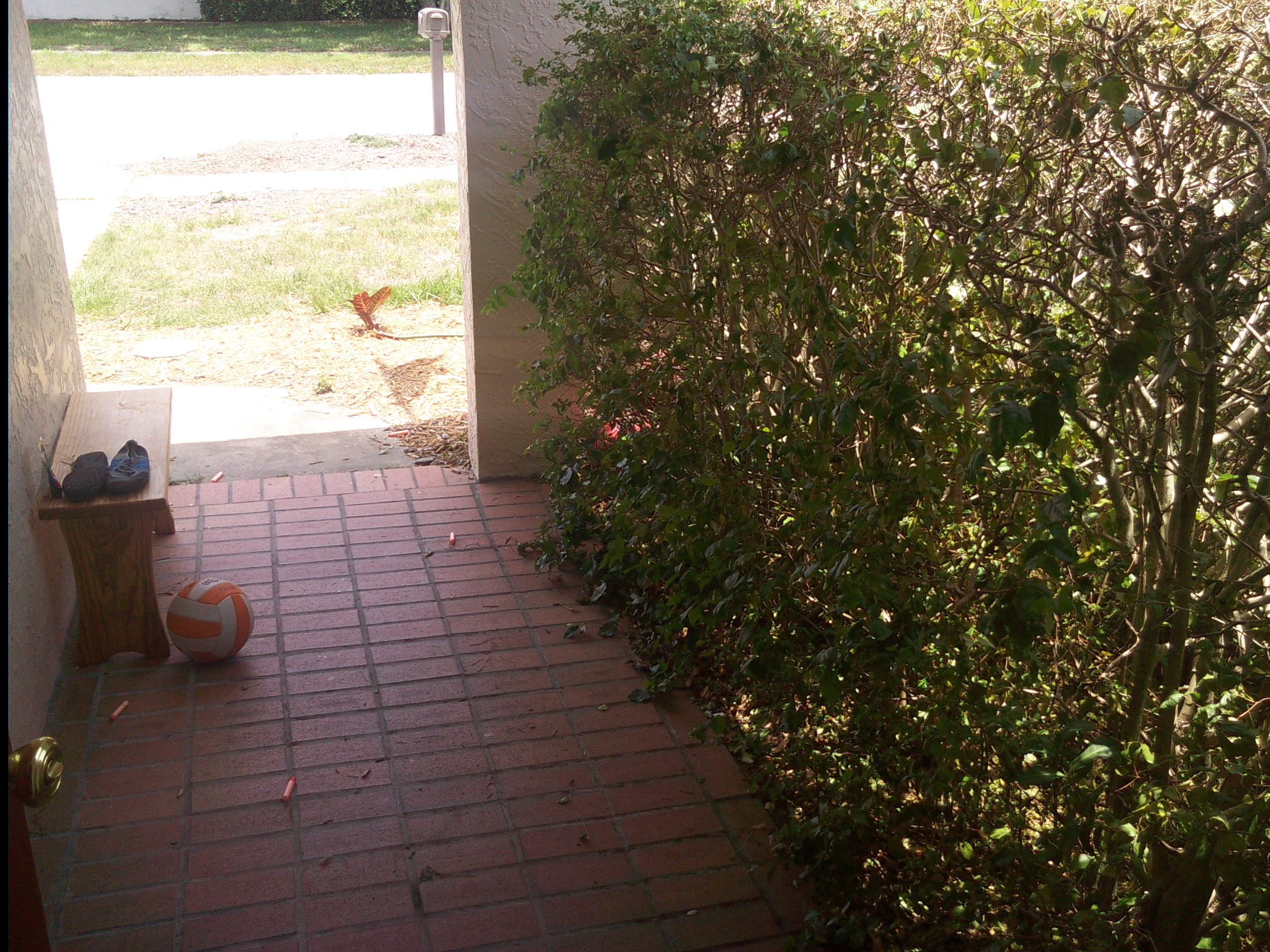
About 30 hours after posting his link of the week this past Friday – you remember, the one about what to put in your first aid kit – he was out playing around in the yard with his brand new spiffy hedge cutters. This was taking place after a busy morning of using a pole pruner (chainsaw on a stick, basically) to trim back some trees. With that long and arduous task behind him and the pole pruner returned to the rental center, he moved on to other yard work. While shearing back the suriname cherry hedge in front of the house with his new hedge trimmer, he proceeded to use his right hand to sweep some cuttings out of the way.
While his left finger was on the trigger.
An 8" x 10" glossy color photograph of the quote SCENE OF THE CRIME unquote...
Let’s see if you can fill in the blanks…
Since I was watching from the shop, I saw it all. He dropped the trimmer and began the ‘Ouch this hurts’ dance universally performed by people across the globe when bad stuff happens. With blood flowing freely from his finger, he pounded on the door for his poor, long suffering wife while I raced outside with the first aid kit from the shop.
No, we didn’t have to go looking in the shrubs for his missing digit. It was – fortunately – still firmly attached to the rest of his hand. He said he had feeling in his fingertip and could still bend the joint. Good boy. So, with direct pressure on the injury and his two kids safely at the neighbor’s place, we took off for the immediate care clinic.
The doctor was a nice fellow and took some pity on poor Tom with a quick lidocane injection to dull the pain. If I was the doc, I would have given him a stick to chew on, but that’s just me… Six stitches and half a mile of gauze later, and the boy was on his way home.
All this at the end of Woodworker’s Safety Week, to boot.
How ironic, don’t you think?
This got me thinking. After questioning the lovable galoot for a few minutes, I found a disturbing pattern developing. All morning, he was hyper-vigilant about safety while using the pole saw. A spinning chainsaw above your head dropping huge laurel oak limbs to the ground has this way of waking you up and paying attention.
But, later on in the day, this happened. He said since this tool was a light-duty $40 model trimming a bush, he let his guard down. If the trimmer had a little more oomph, it may have taken the whole finger with it. He thought the worst he could get was a nip.
And, that’s exactly what he got. A six-stitch nip.
Now, he’s been put on light duty for the rest of the week. No woodworking.
I just hope that the big guy uses this time to think things over before he does any more work. Even the tools that can’t hurt ‘too badly’ can really do a number on you.
Most of today’s lumber you can buy is pretty narrow when you compare it to the stuff pulled out of the virgin forests more than 100 years ago. Entire table tops could be made from one board.
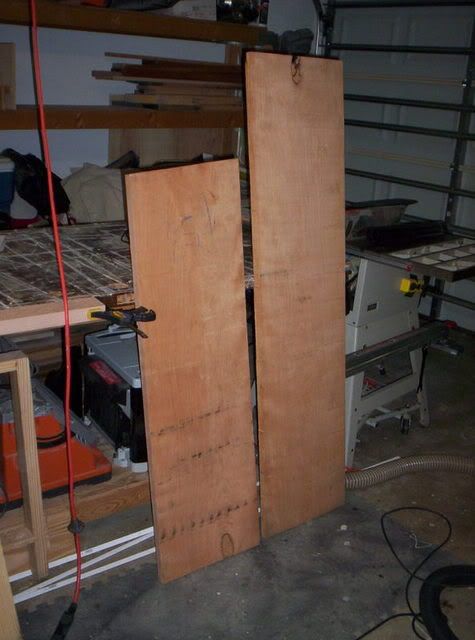
That’s what makes wide boards such as these two 16 ” wide cherry specimens something very special.
When it comes to using them, there are two schools of thought. One is to use the board as is in all its glory. The other us to rip the board into smaller widths and glue it back together to reduce the likelihood of warping.
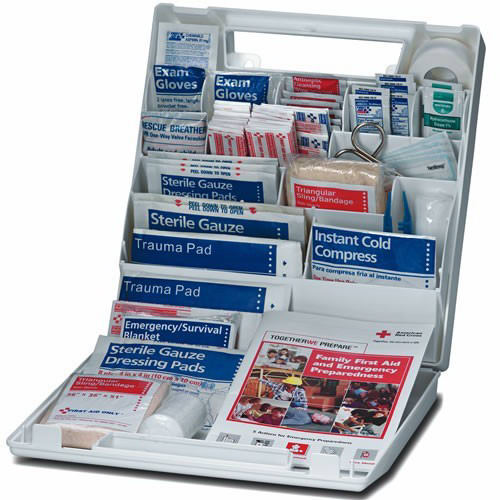
It’s a piece of equipment we need to keep in our shops, but we hope we never have the opportunity to use it. A well-stocked first aid kit is a necessity, and most woodworkers will dutifully go to the largest big box store and pick something up off the shelf.
But, do these pre-packed kits have everything you might need?
Accidents in the shop can be very severe, requiring more than a few band aids and an instant cold compress. How about a bottle of Betadine wash, so you can sterilize deep cuts? A bottle of sterilized water should you get something in your eye? And, for the very worst case scenario, a one gallon zip top bag should you have to bring a severed body part with you to the hospital.
This comprehensive list goes into some incredible detail, but, hey, when you need it, you need it!
I guess I knew I was in trouble when I found myself on the emergency room gurney with the EKG sensors stuck to my chest.
After a hard day of planing in the shop a few years ago, my left shoulder was feeling a little uncomfortable. Through the night it went from uncomfortable to painful to downright unbearable. My wife suggested that perhaps we pay a visit to the hospital. So, she helped me pack my shoulder in ice and off we went.
When I got there, the triage nurse noted my situation – 38 year old male with a family history of heart disease presenting with pain in his left shoulder… well, they had to rule out a heart attack. And, that’s what they did and later discovered that my great pain was due to bursitis caused by repetitive stress from the day of woodworking. I was given pain killers, a shot of cortisone and a prescription to see a physical therapist.
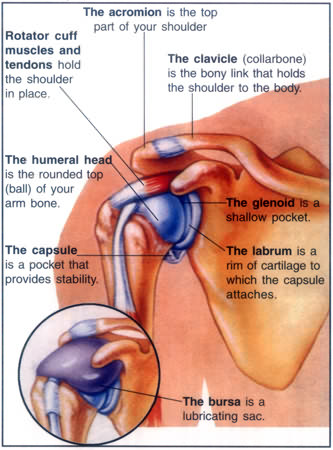
That’s where I learned a lot about one of the most vulnerable joints in the body. The shoulder is an amazing structure. Unlike a hip – a true ball in socket joint – the shoulder is kind of like a ball on a golf tee joint. The cup of the shoulder is very shallow and relies on a very complex system of muscles, tendons and ligaments to hold everything together. All of these parts are cushioned by little structures called bursa sacs. This arrangement gives you tremendous flexibility, but makes the shoulder prone to all kinds of problems not seen in other joints.
To help build strength and flexibility in my shoulders, the physical therapist gave me a few exercises that have helped me avoid another visit to the hospital.
Now, I’m no doctor. I don’t play one on TV. So, before you even consider doing anything, please consult with a doctor just to make sure you don’t do something terribly wrong and end up coming after me with an attorney. Seriously…
However, I do own a Richard Simmons-esque sweatband, so I can look totally boss while showing my awesome skills.
To begin, you have to stretch the muscles, ligaments and tendons in the shoulder before you can do anything. I do this quick exercise every time I head into the shop for a session.
First, you have to find something to hold on to that won’t move on you. For me, I grab the handle on my bench’s vise. The first thing I do is gently lean away from the bench until I feel a slight stretch in my shoulder and hold this for a count of ten. The next thing I do is turn my body away from the bench while holding the handle counting to ten. This stretches the front part of the joint. I then turn my body toward the bench, which moves the stretch to the back part of the joint and hold this for a count of ten. I do all three moves a few times on each shoulder, which really feels good and gets me loose for a day in the shop.
The next two exercises help strengthen my shoulders and are very easy to do.
The first one involves a common bungee cord. I hold it in my hands with my thumbs pointed out and my arms extended in front of me. Keep them about shoulder’s width. Then, I slowly stretch the band by moving both arms out, making the cord taut. Hold that for ten seconds, then bring your arms back to the starting position. I do this five times, but have since moved up to ten.
The next exercise involves a hand plane. If you are doing this for the first time, you might want to start with a No. 4. You can move up to a No. 7 jointer when you get a little more advanced. Hold the plane at your side by the tote, then extend your arm until it is parallel to the floor. Hold it there for ten seconds and then let the plane come back down to your side. Again, do this five times for each arm to start, but move up from there.
No, I’m not trying to get you to build a beach body, but by doing some simple exercises, you may not have to make that trip I had to a few years ago to the emergency room.





 I guess I knew I was in trouble when I found myself on the emergency room gurney with the