
I live about ten minutes away from the beach. My wife and two sons are off for summer vacation. The beach is one of their favorite destinations to spend some time on a hot, lazy summer day. This means that both of our cars are filled with sand. Sand on the floor of the cars. Sand in the trunks. Sand on the seats. Sand in the living room.
It’s a constant effort to keep on top of the sand situation. Sweeping. Vacuuming. Shaking rugs out.
But, hey, I keep my sanding contained to one part of the house!
I’d like to introduce you to the sanding team:
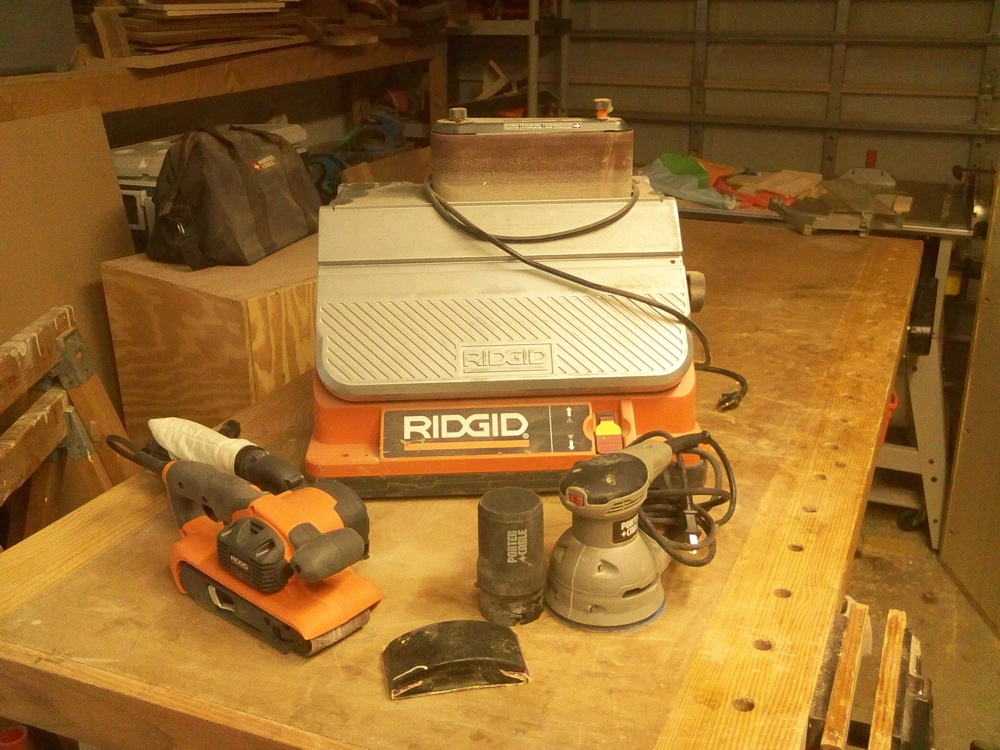
Starting in the back is one of the most frequently seen sanders in home shops – the Ridgid spindle/belt sander. This is one sweet little unit, easily converting from a belt to a spindle sander. It has plenty of muscle to sand all kinds of wood – maple, hickory, oaks… the works. I’ve been able to get inside some tight curves and do some long tapers with it. If you are looking for a small bench type sander, it’s hard to go wrong here.
My new (refurbished) Ridgid belt sander that I recently picked up. This has the potential to be a very blunt instrument, stripping away wood and digging divots. However, with a careful hand, this can carefully refine a curve or even out the top of an end grain cutting board. I never thought I’d get much use out of it, but boy, was a I wrong.
My Porter Cable random orbit sander. I’m torn when it comes to this sander. The rotating pad does give a very nice finish that typically just needs a little scraping to perfect, and it can work around corners. The only problem I have with this model is the dust collection cup. It is held with two plastic clips onto two lugs on the dust outlet port. For the first six months, I would twist it on and hear a satisfying snap. That meant that the cup would stay on regardless. Unfortunately, since those first six months, the plastic clip hasn’t held on worth a darn. I keep trying to bend things back into place, but it’s a lost cause, and I usually have to end up sanding with a fan on and my garage door open to vent the dust.
Finally, up front I have a sanding block I picked up at a local home improvement store. Even thought I have the power sanders, I know that for many situations, nothing beats the versatility and control of hand sanding.
For me, I always wear a dust mask, eye protection and hearing protection. Even though it’s just sanding, I’d much rather not inhale the dust, get it in my eyes or kill my hearing.
Yes, one day I would love to give up on power sanders and be able to finish all of my projects with planes and scrapers, but as long as wood has its peculiar workability properties, there are just some times when power is better.
