
Category Archives: Shop Talk

The results are in!

I’m sure that most of you are on tenterhooks, anxiously awaiting the results of the Great Wood Movement Experiment of 2009.  And, yes, I did promise that about two weeks ago, I would have the results.

However, a little thing called ‘Life’ got in the way.  My timing was terrible.  My two confederates in this project  – Dave Campbell and Marc Spagnuolo – both had things that kept them away from measuring the sample boards I had sent.  For Dave, it was a family camping trip that set him back a day or so.  For Marc, I must have been clairvoyant.  I sent him the boards smack in the middle of a move between houses. No wonder it took some time to get the results back.  Dealing with power, phone and cable companies takes time!

Anyway, just to recap what had happened:

I had prepared some samples of commonly used boards in cabinetmaking – cherry, poplar, hard maple, ash, red oak and a mystery board which looked a lot like elm.  All were 5″ wide by 8″ long and were shipped to my victims – errr – volunteers by USPS Express Mail.

Dave Campbell is the deputy editor of Wood Magazine, and calls the Des Moines, Iowa area home.  Marc Spagnuolo is the Wood Whisperer himself, and has bounced between two homes in the Phoenix, Arizona area for the past few weeks.

Both of these guys let their packet of sample boards aclimate to their shops for  about two weeks. I kept a third set of boards here in my Tampa, Florida area shop in the stifling heat and humidity.

Now for some notes about the experiment…  First of all, I discovered that I really need to tune my table saw.  I was having some discrepancies across the width of the board.  For instance, my sample of ash had a difference of .006 in the width of the ‘top’ of the board and the ‘bottom’ of the board.  Guess it’s time to haul out the operator’s manual and get busy on that…

Also, none  of the boards had appreciable expansion along their length.  This was the expected result because wood doesn’t expand dramatically along the length of the fibers.  Of course, the next time I do something like this, I will cut the boards 5 inches square, so we can fit calipers across both dimensions….  Live and learn, right?

The width measurements were all taken in decimal inch measurements on or about June 8.  Just for your reference, the weather readings from the three cities on that day were:

  • Tampa, Florida – Mean temp: 79; Dew Point: 69

Tampa was its typical summer-like self.  The weather was exceptionally rainy at the start of June, and the added humidity made going into the shop a challenge.

  • Des Moines, Iowa – Mean Temp: 66; Dew Point: 65

Des Moines saw the passage of a frontal system which not only brought rain, but severe weather as well, with the touchdown of at least one confirmed tornado.

  • Phoenix, Arizona – Mean Temp: 84; Dew Point: 36

As with Tampa, Phoenix was enjoying – if you can use that word with a straight face – its typical hot and dry weather, with a dew point which seems just way too low for someone living in Florida.

The results were pretty interesting:

Cherry:

  • Tom –   5.014 inches wide
  • Dave –  4.995  inches wide
  • Marc –  4.938 inches wide

Poplar:

  • Tom – 5.007 inches wide
  • Dave – 5.004 inches wide
  • Marc – 4.938 inches wide

Maple:

  • Tom – 5.003 inches wide
  • Dave – 4.990 inches wide
  • Marc – 4.906 inches wide

Ash:

  • Tom – 5.002 inches wide
  • Dave – 5.001 inches wide
  • Marc – 4.875 inches wide

Red Oak:

  • Tom – 5.008 inches wide
  • Dave – 4.985 inches wide
  • Marc – 4.938 inches wide

Uhh, Elm?:

  • Tom – 5.003 inches wide
  • Dave – 4.996 inches wide
  • Marc – 4.875 inches wide

Since Des Moines’ dew point was higher that its normal levels due to the increased rain, Dave’s samples had considerably less movement than I had expected.  In many cases, the difference between widths was mere thousandths of an inch – something which could easily be accounted for given my faulty saw setup.
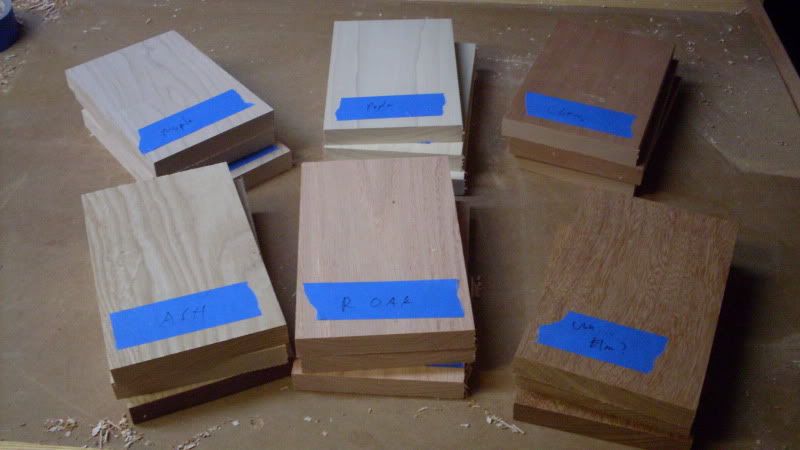
However, Marc’s numbers were considerably smaller than the samples kept in my shop.  Going from the near tropical conditions in Florida to Phoenix’s desert, the boards gave up their moisture content to equalize with the surrounding environment.  The ash sample was dramatic, shrinking nearly 1/8 of an inch across a five inch wide board over the two week period.

Even with my faulty science and measurement techniques, hopefully you have been able to see that yes, there is definitive evidence to suggest that wood does move over its width with changes in humidity.  This expansion and contraction does have to be accounted for in your construction methods, or the boards will crack or push apart the joints.  Floating solid wood door panels and table fasteners are some of the time-honored techniques for handling these expansions and contractions.

Will this be the end of the Great Wood Movement Experiment?  No way.  There are so many other aspects to check out… For instance, will boards of the same species expand and contract at the same rate if they are finished?  Will quartersawn or flatsawn boards expand the most?  Oh, so many wood samples to cut, so little time…

All I can say is that the Great Wood Movement Experiment of 2009 has been a moving experience for me.  I have to move myself out to the shop to get that saw tuned up!

A questionable collection

This year, my family and I are not making our annual pilgrimage up north.  Bummer.

The fact that we live in Florida means that – as with many of our friends and neighbors, we didn’t start here.  We have family stretched along the length of the east coast of the United States.  North Carolina.  Maryland.  New Jersey.  Keeping those family ties strong is the prime mission on these trips.

During the summer break, we typically load the kids into our minivan and begin the epic odyssey.  By the end of the trip, we have logged nearly 3,000 miles, slept in six different homes, two hotel rooms and eaten countless dinners out.

No wonder I needed a vacation after those vacations…

Chain restaurants on the highways are our friends during these trips.  Subway and McDonalds get a decent chunk of our change on the highway, but, for breakfast, it’s hard to beat the Cracker Barrel.

If you want down-home kitch, Cracker Barrel has it in spades.  From the offerings on the menu (that’s where this New Jersey boy first ate collard greens) to the rows of rocking chairs out front, the restaurants attempt to exude the whole country cookin’ theme.  That follows through to the decorations up on the walls.

That’s where I have issues.

During last year’s trip, we had just crossed the Florida/Georgia state line on I-95 when we pulled into the parking lot.  We were seated in the dining room and had just placed our drink orders when I took the opportunity to scan the items up on the wall.  Sure, there were the various antique signs, family portraits and various farm implements from bygone eras.  But, up near the front of the restaurant was a collection of old woodworking tools.  Saws.  Chisels. A nice old brace with some bits.  And a large wooden jointer plane.

I got up to stretch my legs and check out the display.  The plane caught my attention.  It was in gorgeous condition, complete with its wedge and iron.  The body was in perfect shape, with only a few very minor checks in the end grain at the heel.

And, it had been screwed to the wall through the body.  Ouch.

Part of me was tempted to go out to the van and get the screwdriver, remove it from the wall, sharpen the iron and show the restaurant patrons what a plane like that could do.  Many tools from that era are exceptionally serviceable and with a little TLC can outperform many modern models.

The question that ran through my mind was, “Are the things on these walls real?”  Once I got to an internet hot spot, I did a little research. According to an article written by Cecil Adams of the Straight Dope, the answer is yes.  Restaurant chains such as the now-defunct Bennigans, Cracker Barrel and other establishments do have buyers who scour the country looking for these old bits of Americana. They do attend auctions, yard sales and other events to find the elements to add to their restaurants.

While displaying old items in itself is not a terrible thing, my concern is about they way these tools are handled. Screwing through the body of an antique plane is certainly not the best ending for something as noble as a properly built hand tool.

Remember, these are the tools which helped to build our country.  Artisans toiled for for years with these tools in their hands.  These tools were their livelihood.  They were part of their identity and should be treated with some care.

I have held and used some very old woodworking tools over the past decade.  There is a connection with the craftsmen and women of old when you swipe a properly fettled plane across the surface of a board, raising a fine fluffy curl of wood.  These tools are more than just ‘stuff’ from the past.

Should every old tool be refurbished and used in the workshop? Nah.  If you have a sentimental attachment to a tool – say one owned by a grandfather – there’s nothing wrong with putting that tool up on display to show off the family heirloom.  Other planes could have major defects – shot soles or cracked castings – and not be salvageable.  That’s what happens when you work with old tools.

And, since I don’t own these old woodworking tools hanging on the walls, I really have no say in how they are handled or displayed.

I guess I’m just a firm believer that these old tools should be treated with the utmost respect and given a new life in a woodworking shop, not screwed to a restaurant wall.

Try the ply…

When my brothers and I were young, we got some tremendous thrills out of playing with our Hot Wheels and Matchbox cars.  Those race cars, army jeeps and tractor trailers had some tremendous adventures.  Some were involved in epic battles. Others were involved in rescuing people from tremendous disasters.  Still others met their ultimate fates at the end of a hammer or with a firework stuffed inside the plastic interior…

Hey, we were boys.

While rolling the cars over the carpet in the living room was fun, the scenery never really changed.  Sure, we could imagine that the carpet was a snow-covered tundra or a steaming jungle, but we wanted more realism.

That’s when I decided to grab a piece of plywood from the garage near my dad’s workbench.  I painted it up really well and glued cacti made of twisted up tissues to the board.  I even spray painted some cotton balls brown to give the impression of tumbleweeds.  In my mind, it would have made George Lucas blush…

That was until dad came home.  Apparently, I was using a piece of cherry veneer cabinet grade ply for my scenery, and dad wasn’t too amused.

That was my first experience with really sweet quality cabinet grade ply, and since then, I have come to appreciate its value.  Well made ply is stable, nearly ready to finish and beats the heck out of gluing up solid wood to make large panels for projects.

What is plywood? Basically, thin veneers of wood are sliced from a log and then glued to each other.  In the vast number of cases, each layer is glued perpendicular to the next, giving tremendous strength and rigidity to the panel.  Some plywood is glued with all of the layer parallel to each other, and this plywood can be used to build bent pieces of cabinets.

I did learn the hard way that not all plywood is made equally.  First, cabinet grade ply is not the same as construction grade ply – regardless of what the home improvement center signage tells you.  Sure, you can grab a piece of AC fir or southern yellow pine plywood and try to build something, but, if it’s going into fine furniture, you will be disappointed with the results.  That construction grade stuff is great for shop shelving and furniture, but it’s too rough for building bookshelves.

For that, you want to look for plywood with a larger number of plies which are more finely cut.  while construction grade material may have five plies for a 3/4″ piece, the cabinet grade stuff usually starts at nine.  The cabinet grade stuff also has a much more refined face than the construction grade stuff.  So, if you want to paint your piece, there’s a whole lot less prep work and you will get a superior finish with cabinet grade stuff.

The most commonly see ‘entry’ level cabinet grade panels are usually faced with birch, however I have seen some other kinds of woods.  Some are faced with a generic ‘tropical hardwood’, while others are faced with a South American hardwood called Gutambu.  These low-end panels are often hit or miss – some are beautifully built, others will have their glue fail and the layers separate if you look at them funny.  Buyer beware!

From there, you have scores of choices available to you.  Some, such as Baltic Birch or Russian Birch, is made of many very fine layers of wood veneer – maybe up to 15 or more – and is exceptionally stable – perfect for jigs and as a substrate for veneers.

Other sheets have similar cores as the birch plywood, but can be faced with veneers as plain as red oak or cherry to to as exotic as teak or zebrawood.  These pieces can be cut as impressive parts of a cabinet, table top or other project.  And, yes, the standard wood finishing regimens you use on solid wood will work on plywood veneers.  Lacquers, varnishes and oils all work well on the plywood surface.

While plywood is durable, strong and relatively easy to work with, there are some warnings which should be heeded.  First, plywood is very heavy stuff.  A sheet of 3/4″ cabinet grade ply can tip the scales at 60 pounds or more.  Sure, you could muscle the sheet around by yourself, but wow, you could end up with a serious backache – or worse!

Secondly, it’s very awkward.  Standard sheets of plywood are 4′ wide by 8′ long.  That’s taller and wider than most folks, so you have to be careful when handling.  Again, a friend is always appreciated when working with plywood.

The veneers which face the plywood are often beautiful, but they are also very thin.  Extreme care should be used when moving sheets (to avoid damage) and when sanding them (you run the risk of sanding right through the veneer into the core!).

This also means you have to be very careful when cutting plywood, so you don’t chip up the facing when you cut the sheets.  Some tried and true methods for reducing or even eliminating chipping include taping the cut line with masking tape, using a blade with the highest number of teeth available and scoring a line along the cut line with a utility knife.  The new track saws made by Makita, DeWalt and Festool also do an outstanding job of preventing chip out when they cut.  If you plan on working with a lot of  plywood, one of those saws might not be a bad investment…

Finally, when you cut plywood, you have the ugly exposed edge to deal with.  Edge tape, molding and setting the panels into frames or a rabbet are three ways to hide the unsightly edge from view.  Of course, if you like that kind of look, just refer to your pieces as post-industrial modernism and enjoy the compliments as they flood in.

While those days of playing with my toy cars are distant memories, I can look into my sons’ rooms and see the plywood bookshelves I built stuffed to the gills with toys and books.  What memories will those pieces of plywood will my sons bring with them into their adult lives?

What time is it?

For those why may remember the Howdy Doody show (no, I’m not that old, but I am hep on cultural icons), the only answer that could possibly work is “Howdy Doody Time!”

Unfortunately, that’s not the answer I am looking for.  We are saying ‘howdy’ though, it is the start of the Atlantic Hurricane Season.

Yes, I know those of you who live anywhere along the coast from Maine to Texas (or those of you who are fortunate enough to call Bermuda, the Bahamas or any of the Caribbean Islands home) know what this means. It’s that time of year to check that you have your hurricane shutters, get your survival kit together and remind yourself what your evacuation zone is.  I usually do that stuff, and then go have myself a Hurricane at one of the local drinking establishments to give me the courage to keep on planning…

June 1 also reminds me how important it is to check the tools I have in my shop.  Yes, I do a quick inventory to ensure that I have everything listed.  Names and model numbers of tools, manufacturer’s serial numbers, descriptions of tools that don’t have model numbers or serial numbers.  I try to cover it all on a list I keep on my computer.  It’s not too tough to maintain once you get it started, but it can be a bear to get started in the first place.

Why have the list?  Well, should the unimaginable happen, I want to make sure that when my insurance company comes calling, I can produce a list of what I own.  This way, it will be easier for them to value the tools I have in the shop and cut me a check to replace those items.

I also take the opportunity to snap a few photos of the collection.  This way, I can show the insurance claims adjustor what kind of tools I have.  Sure, I can’t just lie and tell them I have a brand new Delta Unisaw… but, hey, honesty is the best policy.

Do you need a separate rider on your insurance to cover your more valuable tools?  How about flood insurance?  What other kind of documentation do you need?  These are all great questions.  And, since I’m not an insurance agent, I’ll ask you to give yours a call.  Ask all of the questions now, and not after standing over the wrecked shell of your shop… it will save you some stress.

There is a great organization here in Florida called the Insurance Information Institute, and they have an outstanding page on how to conduct a home inventory.  Definitely worth a look.

Oh, by the way, if you don’t live in hurricane country, there are still earthquakes, ice storms, tornadoes, tsunamis, lightning strikes, flooding from heavy rains, fires, thefts… well, you get the idea.  Getting your tools covered properly will help you get back to the shop afterward.

Just think, only six months to go until the end of hurricane season…

A moving experience

Wood moves. As temperature and humidity levels change, wood’s cells will absorb and emit water to reach an equilibrium point. Sure, it can be slowed down by a wood finish, but it can’t be eliminated.

This is a universal truth that all woodworkers need to understand when they build a project.  All too often,  woodworkers need to learn this lesson at least once the hard way before it truly sinks in.

Sure, there are lots of tables and charts that will tell you exactly how much wood will move, but to get a real life idea, I’ve decided to set up a little experiment.  My shop is in the Tampa Bay area, and I’ve enlisted the help of two talented woodworkers who live in different areas of the country with wildly different weather conditions.

First is the Wood Whisperer himself, Marc Spagnuolo.  Marc lives in the greater Phoenix, Arizona area.  The other woodworker helping me out is Dave Campbell, deputy editor of Wood Magazine.  Dave calls the greater Des Moines, Iowa home.

While this is a wood-based article, it also gives me a chance to strut my weather geekiness in the name of woodworking. It’s obvious that changes in latitude will have a dramatic effect on the weather, but geography and location from the nearest large body of water will also play a part in the picture.

To help you understand the differences, I will reference the mean daily temperature and dew points for each city.  Why these two readings?  First, the mean temperature is an average temperature of the air as indicated by a properly exposed thermometer during a given time period, usually a day, month, or year. This way, we don’t have to wonder about abnormal cool snaps or heat waves – the data will be a little more smoothed out and better representative of a typical day.  In this case, we’ll look at the mean temperature of a given day – May 25 – for each of our cities.

The other reading is the dew point, which is the temperature at which the air becomes saturated and produces dew or – if it’s cold enough – frost.  Why not use relative humidity?  Well, relative humidity is – errr –  relative to the temperature, and will rise as the air cools off overnight and drop as the air warms.  The dew point produces a better apples-to-apples measurement for our purposes.

Here are some of the stats from the cities:

Tampa, Florida – May 25 mean temperature 79 degrees F, Dew Point 69 degrees.
Lying in the humid subtropical zone, Tampa’s prevailing winds pull hot, moist air off the Gulf of Mexico and the western Caribbean Sea and push it ashore.  This leads to exceptionally hot and humid conditions, with frequent thunderstorms throughout the late spring and summer.  Basically, you can take a shower and, unless you are in an air conditioned building, never truly dry off.

Des Moines, Iowa – May 25 mean temperature 65 degrees, Dew Point 55 degrees
While Des Moines is at a much higher latitude than Tampa, the prevailing summer winds will still push hot humid air from the Gulf of Mexico.  However, at this time of the year, both cooler and warmer air masses are still battling for possession of the region, which leads to variability in the conditions until the summer pattern truly sets in.

Phoenix, Arizona – May 25 mean temperature 84 degrees, Dew Point 30 degrees
Phoenix is in a very hot, arid climate,  It’s too far west to be affected by Gulf moisture, and the Rocky Mountain complex to the west cuts off Pacific moisture.  I’ve heard it described as standing in front of a giant hair dryer…  This is not to say that Phoenix doesn’t get rain.  In fact, by late July, a monsoonal flow will come off the Gulf of California, leading to a rise in humidity and thunderstorms.  So, we’re hitting Phoenix at an ideal time for this test.

The wood samples for this test have been cut from plain old boards that have been acclimating in my shop for – I dunno – as long as five years.  I chose a series of samples from frequently used cabinet woods to give a good representation of what most woodworkers will use.  They include; maple, poplar, cherry, ash, red oak and a surprise board.

Yes, it’s a surprise to me, because I picked up what I thought was ash from my hardwood supplier. Got it for a steal – rough – at $1 a board foot. However, once I started planing it for this experiment, well, it’s not ash.  I’m going to guess from the photo that it’s red elm, but I could be way off base. Maybe one of my esteemed panelists will be able to put a better ID on it.  Hey, at least it’s a different species!

I planed, ripped and crosscut the boards to exactly 5” wide and 8” long.  I will be shipping the boards by US Postal Service tomorrow  (today is Memorial Day, an official federal holiday) to Marc and Dave with a copy of the steel ruler I used to measure the boards.  I took the time to ensure the measurements on each rule lined up to give as accurate a reading as possible.

I have asked both Marc and Dave to let the boards sit in their shops for two weeks, then measure the board samples on June 8 to see what kind of changes have occurred.  How will the boards react to the changes in temperature and humidity?

Stay tuned…

It Figures…

Forrest GumpIf you can remember the big Tom Hanks’ 1994 hit movie Forrest Gump, no doubt you will recall one of the movie’s most repeated lines:

Life is like a box of chocolates. You never know what you are gonna get.

If you have ever received a box of chocolate candies as a gift and had to negotiate it without the help of a map on the lid (those are for cheaters!), the first bite into a piece pulled from the box is always a surprise. Will it be one of the tasty caramels, or will it be something you just don’t like?

In many ways, when a sawyer slices into a log of a maple, cherry, walnut, ash, elm or hundreds of other species, it is a very similar experience. More often than not, you get exactly what you were after – beautiful boards of exceptional character.

But, every so often, there’s a big surprise.

A very pleasant one at that.

Bell Forest ProductsSometimes the boards will display a wavy pattern known as figure. This is not the same as the wood’s grain. According to Eric Poirier of Bell Forest Products, an online wood supplier that specializes in figured lumber, this distinction is very important. “Grain and figure are often confused with one another. The easiest way to differentiate between them is to understand that grain occurs in every board because it is how the tree actually grows. Figure occurs independent of the grain and is actually a defect, which happens to be very rare and sought after.”

Of course, there is an exception to every rule. A ray flake appearance in white or red oaks is actually part of the grain, but it is considered figure by the National Hardwood Lumber Association (NHLA). Go figure.

Bird's Eye MapleFigure can occur nearly anywhere in a tree. According to Eric, “It varies from tree to tree and is different with the different types of figure. In bird’s eye, the whole log might be full of bird’s eye or just part of one side of the log might have it. Sometimes the bird’s eye can even start and stop at different points in the life of the tree. There may be some sort of defect in the log that also causes the figure to start or stop at a certain point in the log.”

While figured lumber is beautiful, it is considerably more difficult to work with than non-figured lumber. Curly, tiger, fiddle back, pecky, burl or other beautifully figured woods tend to tear out more, and demand exceptionally sharp tools and care in their milling.

VeneerSupplies.com logoThe number and variety of species exhibiting figure can be tremendous. Another great way to add these dramatic woods to a project is through veneering. Joe Goreleski, Jr. of VeneerSupplies.com, has seen a tremendous variety of figured veneers move through of his shop. “To the best of my knowledge, most domestic and exotic woods have the ability to display each type of figure. In my stock, I have some truly rare combinations of species and figure that some would think do not exist.” How rare? Think of such odd specimens as bird’s eye walnut and bubinga burl.

Tamo Ash VeneerWhile working with figured hardwoods can be a challenge, Joe says going the figured veneer route takes some practice, but is not very different than working with regular unfigured veneers. According to Joe, “some burls may require grain filler, but the basic veneering skills should be able to get you through with no problems.”

Looking at an unfishished figured board or sheet of veneer may not be impressive. However, once a finish goes on the piece, you’ll immediately understand why woodworkers search out figured boards. These imperfections in the log translate into lustrous whorls, stripes and other features that appear nearly three-dimensional under an oil-based finish.

One issue many woodworkers have during finishing is that boards tending to be splotchy are even more difficult to get finished perfectly. A sanding sealer of a one pound cut of dewaxed shellac applied and sanded down with some 320 grit sandpaper helps to control the blotchiness. Again, these rare specimens require care in all stages of woodworking.

While both Eric and Joe get some incredible specimens through their shops, each has his own preference for his favorite.

Eric leans toward curly maples. “I love the way that the figure runs from the flat-sawn to the quarter-sawn grain. I use it whenever I can in different projects around the house. It is my favorite wood to use because I love seeing the ‘tiger’ stripes when the sunlight hits it just right!”

Joe is more of a tamo ash and walnut burl kinda guy. “But, I have not yet found a figured veneer that I didn’t like.”

Momma always said to keep your options open…

The Sharper Image

A close shaveWhen I turned 14, my dad had a surprise for me.

He handed me a new razor, a can of shaving cream and showed me how to shave.  Even though I was using a safety razor, I still managed to cut myself.  Ahh, the joys of inexperience.

Since then, I’ve had a love/hate relationship with the male rite of shaving my face.  Some days, I walk away from the sink in the morning with a perfect shave – feeling fresh and ‘kissably smooth’ according to my wife.  Other days, I swear I took my belt sander to my face – all red, irritated and scraped up.  Since I’m not sure which kind of shave I’ll get, I tend to avoid shaving if at all possible.  Sure, it’s tough to get moving on a Monday morning, but at least my face had a weekend’s rest from the blade.

Later on, when I became a hobby woodworker, I ran into another group of folks who liked to shave – a lot.  And, not just to keep up appearances.

Some of the woodworkers I spoke with had an extreme fascination with sharpening and honing their plane irons and chisels to razor-sharp perfection.  And, with a salesman’s zeal, these folks will call friends and neighbors over to demonstrate how well their blades can clear their arm or leg hairs.  It’s a stunning trick, and I have to hand it to them.  They do have persistence.

But, is sharpening to that keen of an edge really necessary for woodworking?

One Sharp PlaneNo one is going to argue with the fact that sharp tools are a pleasure to use.  They are safer, cut more cleanly and make your shop tasks a whole lot more pleasant.  Dull tools will ruin more boards – and hurt more woodworkers – than we can ever fully account for.
But, when should you say ‘when’ during the sharpening process?

Hey, I used to fall into the trap of  meticulously sharpening my chisels and plane irons.  There were times when I used to fuss for half an hour over each edge, honing until the back face of the bevel was reflective enough to signal rescue planes if I was marooned on a desert island.  Then I would flip the blade over and work on the bevel, building a lustrous shine before tipping the edge up enough to create the perfect one degree microbevel.

And, yes, I would then shave arm hairs to prove to myself that the chisels were ready for use.

While sweating over a sharpening job in my shop one hot Florida summer afternoon, the little voice of reason in my head started screaming at me.  “Can we get this over with?  It’s hot, and I want to go inside!  Besides, how much better can that edge really get?”

It was that afternoon when I changed my sharpening procedure and added an important step.  I went to the scrap bin and pulled out a piece of hardwood and  clamped it in my bench vise.  I took the chisel – still far from its mirror-like destiny – and started paring the edge.  The wood yielded.  Easily. In an end grain cut.  With little effort on my part.  Wow.

I was stunned to see how much earlier in the process I could stop with minimal – if any –  effect on the cutting ability.  Not only could I save myself quite a bit of time while sharpening, this result also convinced me that I could sharpen my tools more frequently, without having to take the tool through the onerous process of honing to that fine degree.

My mind then turned to previous episodes of the Woodwright’s Shop, hosted by Roy Underhill.  I have watched Roy for years, working with his planes and chisels in his throwback workshop.  Sure, his tools are plenty sharp, but not so reflective, if you catch my meaning.

While I was reading the Woodwright’s Companion, I noticed that Roy also touched on the fact that woodworkers relied on quarried stones to bring their edges into true.  No, these old masters didn’t get into a heated debate about the micron size of the abrasive they were using – they used the best stones possible to get their blades sharp and then returned to the bench.

And, when they shaved their faces, they didn’t use plane irons – they used straight razors made with much finer and more flexible blades.

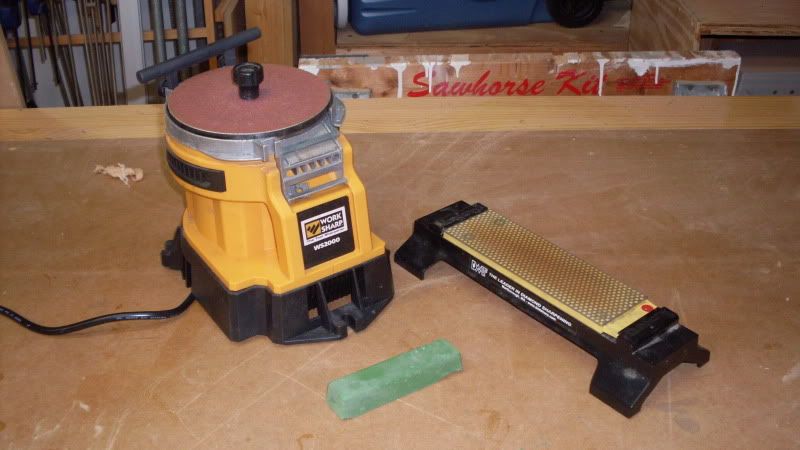
The Sharpening ToolsWhen I buy an old plane or chisel, I will regrind the bevel on my Work Sharp 2000, and then either use the Scary Sharp method (sandpaper glued to a piece of float glass) or the DMT Diamond Stone my wife gave me a few birthdays ago.  I’ve gotten so I can regrind and hone an old chisel in about five minutes, and have it cutting easily through wood.  It takes even less time to hone blades that just need some touching up after a project.

I will also use a piece of MDF with some of the Lee Valley green honing compound to put an even finer edge on the edge, but that’s it.

Will woodworkers still hone their irons and chisels to a mirror finish? Of course they will.  There are also people who will shop for stereo systems that faithfully reproduce tones well outside of the normal range of human hearing.  Hey, to each his or her own, and if leaving bare patches of skin on their arms is an outward sign of their sharpening prowess, more power to them.

I already have a mirror in my bathroom so I can see what I’m doing when I pick up my razor to get ready for work in the morning.