Category Archives: Tools

Tools I use: My shaping tools

Not all wood projects need to be square and flat.  In fact, curving edges and surfaces of a project adds drama, movement and a certain artistic flair that helps bring a project from ho-hum to WOW!

While many woodworkers may think first of routers and band saws when they consider adding curves to their projects, but unless you are very careful and use jigs or other hold down devices, your project can go from whoa to D’oh! in the blink of an eye.
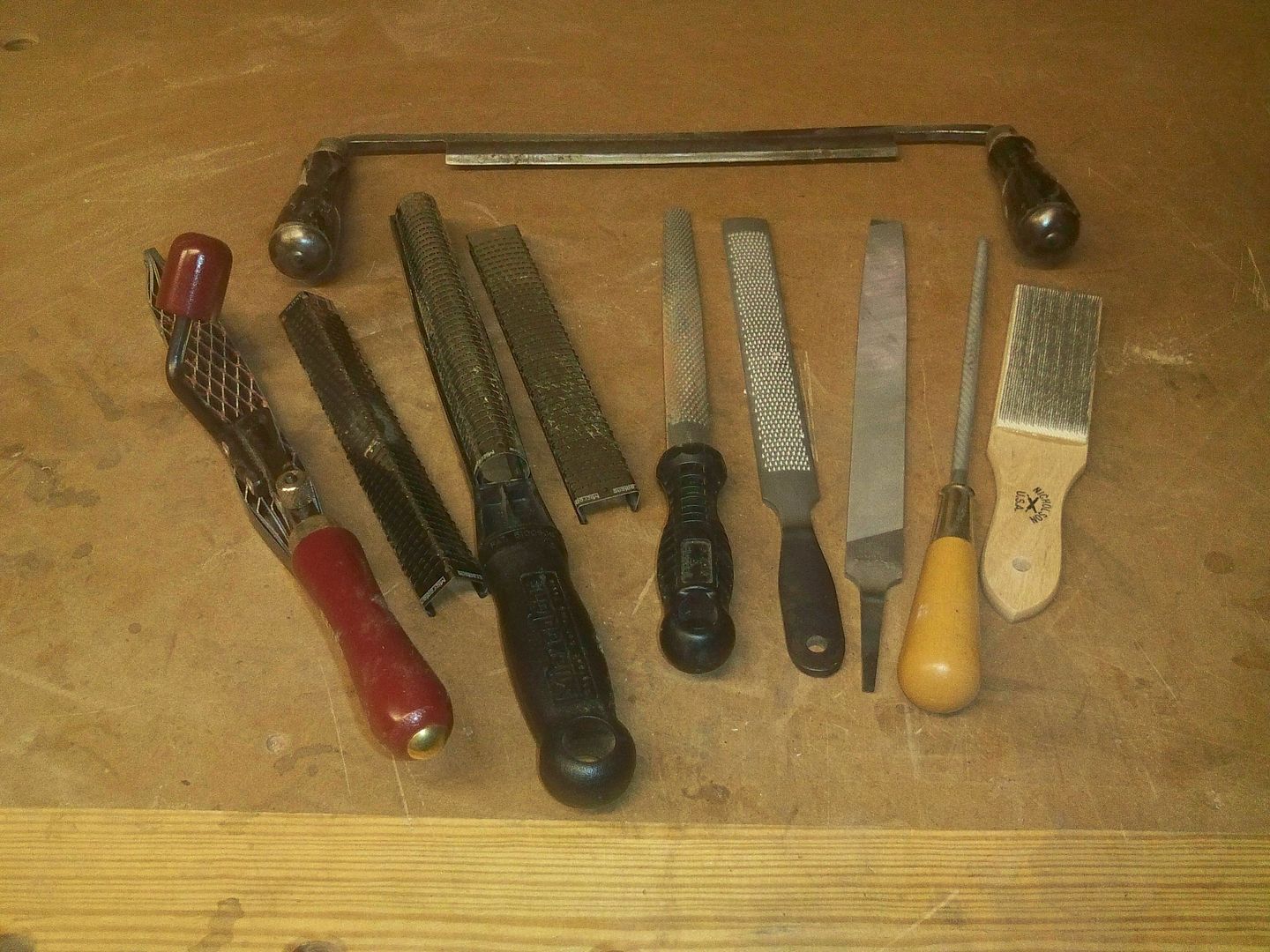
That’s why when I need to add delicate curves to a project, I will reach for some pretty scary looking tools.  Meet the shaping team.

From left to right, I have:

A Shinto rasp.  This is one of the newest tools to my collection, and I am growing to love it more every time I use it.  Basically, it is a series of what appears to be hacksaw blades bolted together to form a boat-like shape.  It has a coarse side and a fine side, and a comfortable handle that allows for a firm two-handed grip on the tool.  This sucker can remove waste wood like nobody’s business, yet allow for extremely fine passes and great control.  I like that I can also shape up to the edge of a leg or other obstacle on a  project because the sides of the tool are smooth.

A Microplane interchangeable rasp kit.  Now, we are talking.  This baby gets the most work in my shop.  Basically a plastic frame with three different interchangeable inserts, the Microplane tools shave the wood rather than tear it.  I can get a very heavy cut with firm pressure, yet get an exceptionally smooth cut with much more care.  The interchangeable inserts allow me to work on  a variety of different shapes with ease.

My rasps and files come next.  From left to right, I have a second cut cabinet rasp, a Nicholson rasp/file combo with an integral handle, a flat bastard cut file that is primarily for metal work, but can also do very fine work on wood and a round rat tail file.  Great for working on tight radii.  Of course, I also need my file card, the brush like device all the way to the right, to get the sawdust out of the teeth of these tools as I work.  I find I have incredible control with these tools, but they can be a little rough when shaping across the grain.  That’s why I find myself using the Microplane tools more.

At the top is my draw knife.  A pain in the butt to sharpen (I’m getting better at it) but a real joy to use.  The draw knife can take off mighty chunks of wood in certain circumstances, yet, when wielded with care and finesse can take off shavings as thin as you can with a smoothing plane.  Right now, I hold the work I’m working on in my bench vise when using this tool, but one day I will have to build a shave horse – or at least a little shave pony – for my shop to use this tool to its fullest potential.
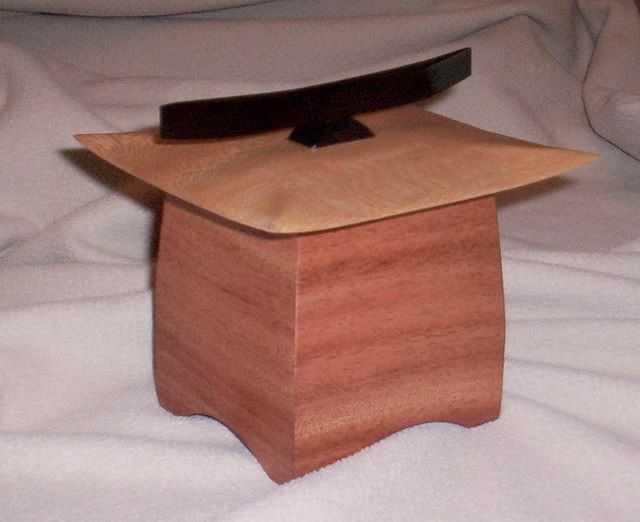
To give you an idea of what can be done with these tools, here is a pagoda style box with a gently sculpted lid.  While the original plans to built the lid involved a delicate balancing act on a band saw and drum sander, I found the task easy and immensely rewarding with just a rasp and a little bit of layout work.  The process is an enjoyable, quiet and much safer way to spend an hour or so.

What kind of care do these tools need?  They are pretty rugged, but will serve you a whole lot longer if you store them so they won’t bump up against each other.  Of course, I am always looking to upgrade my collection with some premium rasps and maybe a few exotic tools, but I have this feeling I have yet to truly tap the potential of the tools I already have in my collection.

But, hey, who wouldn’t like new tools?
One tough sucker

I have this friend on the Woodworker’s Website Association named Jim.  He’s a now-retired grizzled veteran of the competitive northeast construction and cabinet trades.  He’s seen it all, heard it all, tried it all and shoots straight from the hip. Ask a question, you get an honest answer with Jim. He’s that kinda guy.

But, that’s not who this article is about.  It’s actually about something he dropped off for me this past March when he was down for a visit.

Now that Jim is retired, he has time on his hands to travel and to tinker.  Before his trip this spring, he called me and asked if I was interested in looking at something he had built.  One Saturday morning, I drove to the travel trailer park Jim was staying at, and after our greetings and some shop talk, he showed me something that looked like Rube Goldberg himself had created. Old plumbing fittings, waferboard, 2 x 4’s and weatherstripping had been cobbled together.  It looked as if it had been picked over in a rubble heap.  MacGyver would be proud of this…

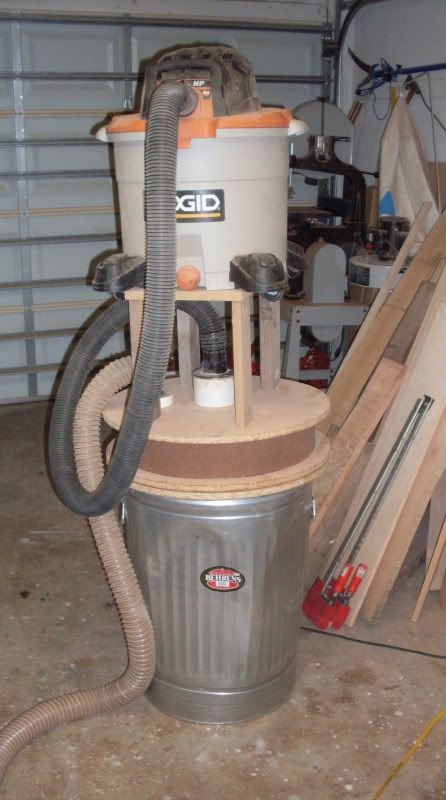
The total stackWhile it did look nasty at first, it may prove to be something that will change how I work in my shop.
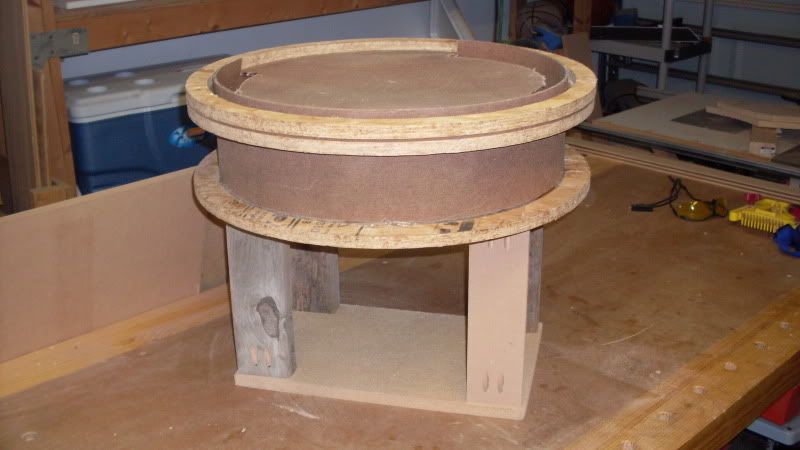
Jim had created a modified cyclonic dust collector. He started with the plans drafted by Phil Thien.  Phil’s plans show how to create an inexpensive dust collector which fits onto the top of a metal garbage can.  A shop vac and an intake hose to suck up the dust is everything needed to create your own dust collection system.

Jim’s improvements include extending the cyclone separator in a compartment above the trash can, which Jim says improves the airflow by removing any potential debris interference.

Since it was nearing the start of hurricane season, I had left the collector in the corner of my shop to – err – collect dust.  Finally, this past weekend, I was able to run to Home Depot and pick up an old-fashioned metal trash can to affix the collector to.

Jim had routed a groove to fit over the rim of the can and had sealed the bottom of it to get an airtight fit.  I hooked it up as described, and I was initially thoroughly unimpressed.  The collector didn’t seem to generate enough suction to lift even the finest of dust.  I fiddled with the collector for a while, and then I discovered my problem.  I hadn’t fit the lid deep enough into the groove.

A quick shove down on the offending side,  I got that sealed up and WOW…

The suction generated by my standard issue shop vac was impressive. Planer shavings, sawdust, small animals – what couldn’t this thing pick up?  Jim had also warned me that if I drew a vacuum by sealing off the intake hose, the trash can could collapse due to the air pressure.  Well… sure enough, the silly thing’s sides did buckle when I put my hand over the intake hose!  I’ll also have to follow his advice and cut a brace for the inside of the can to give it extra support.

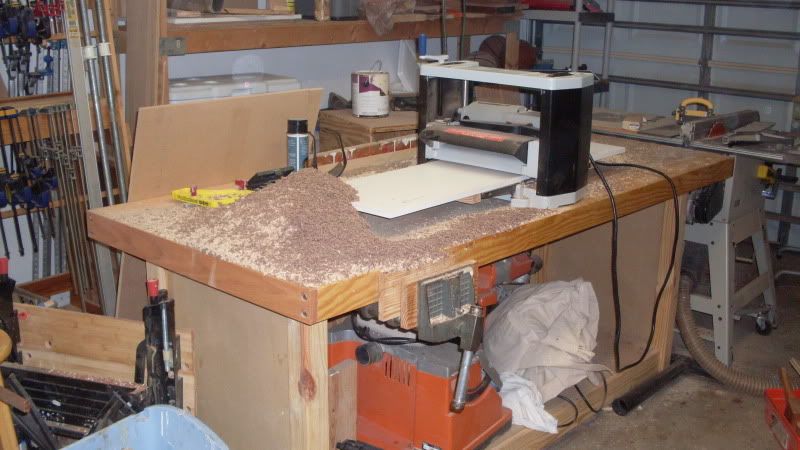
To put this unit to the test, I set up a field experiment.  I had been planing strips of ash and walnut for a project, and I had a good pile of shavings there ready to be cleaned up.  The shop was a mess.

I took my shop vac outside and emptied it.  I banged out the filter – the works.  It was as squeaky clean as I dared make it.  I stacked the empty shop vac on top of the unit and hooked up the hoses.  That’s when I went to work, sucking up everything.

The suction worked as I had expected it to for a dust collector.  There was a large rush of air headed into the hose, and everything was sucked through into the can.  I love clear hoses on my collector…

After working the hose for a while, cleaning up the mess of a long day in the shop, I stopped the shop vac and took a peek inside.  There was some fine dust in the vacuum’s tank, but that was it.  None of the larger shavings made it to the vacuum.

A peek into the trash can showed me why… there’s where I found all of the planer shavings, silently resting in the can.  A quick trip outside, and the can was clean once again.

The collector was extremely effective.  I have a 1 hp 500 cfm Delta model in my shop, and I rarely use it.  The system gets clogged up frequently and it doesn’t have the ‘oomph’ to get the planer shavings.  Then, there are the bag changings… something I never look forward to.  That metal ‘belt’ I have to snap in place rarely goes on the first – or second – try.

This system exceeded all my expectations. In fact, I will be looking into getting a dedicated shop vac to mount on top of the collector on a semi-permanent basis.

Hey, Jim, I gotta hand it to you.  You are one tough sucker after all!

P.S. – If you are interested in seeing Jim’s plans, I can forward the messages to him

A great E-Bay find

There’s nothing quite like stumbling upon a great old hand plane at a flea market, a garage sale or online.  What’s even better is if that plane can fill a void in your collection.

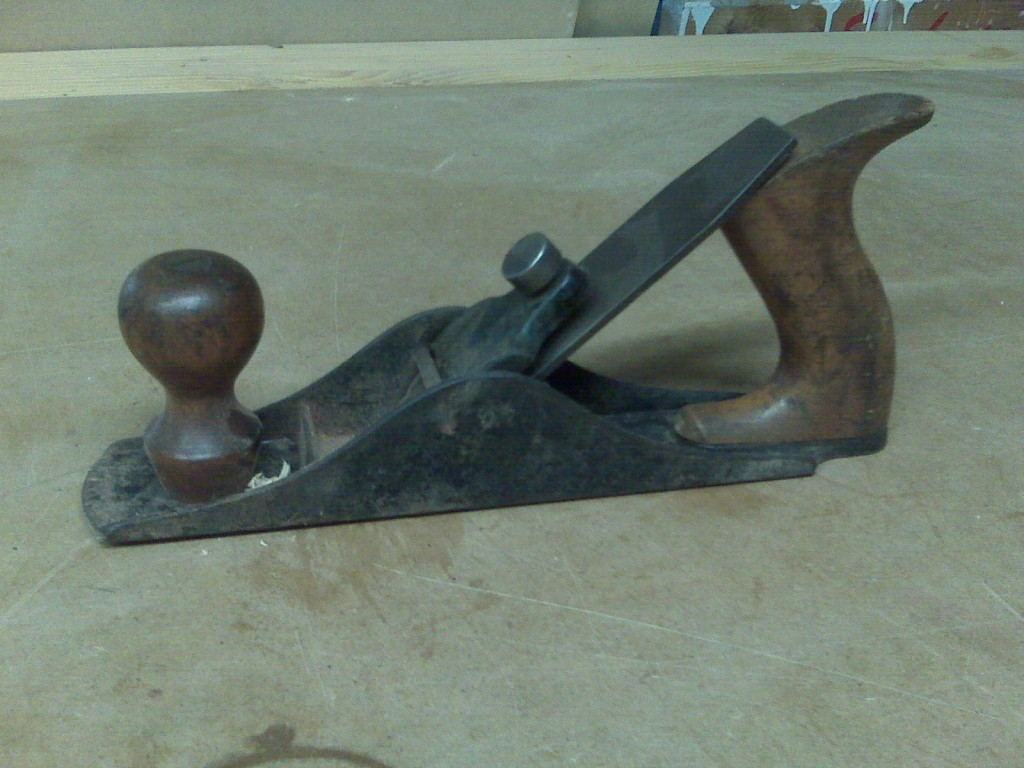
And, that’s just what I recently found.  While cruising the collectible woodworker’s tools category on eBay, I came across this great little scrub plane.IMG00087

The description was exactly what I had been seeking to add to my collection:

Fresh from a recent barn sale here on Cape Cod a Stanley scrub #40 plane complete with an about full Sweetheart blade. Good wood no cracks or repairs just minor wear from use. Being sold as pictured & found uncleaned, please note there are a few minor rubs in iron bottom sole that could be buffed out if desired by new owner, not bad & clearly shown but needed to mention.

I put in a bid, and the seller accepted it.  As I always do after buying something on eBay, I restlessly waited for the plane to arrive in my shop, counting the minutes until the UPS delivery guy showed up.

I really do need a hobby…

Wow.  It was in great shape – exactly as described.  What surprised me most once I had removed it from the box was the outstanding condition it was in.  There was some minor rust down on the cap iron, but nothing a little buffing with steel wool couldn’t remove.  The handles were in superb condition, and besides a wipe with some paint thinner to remove the dust, the plane was ready to roll.

IMG00089

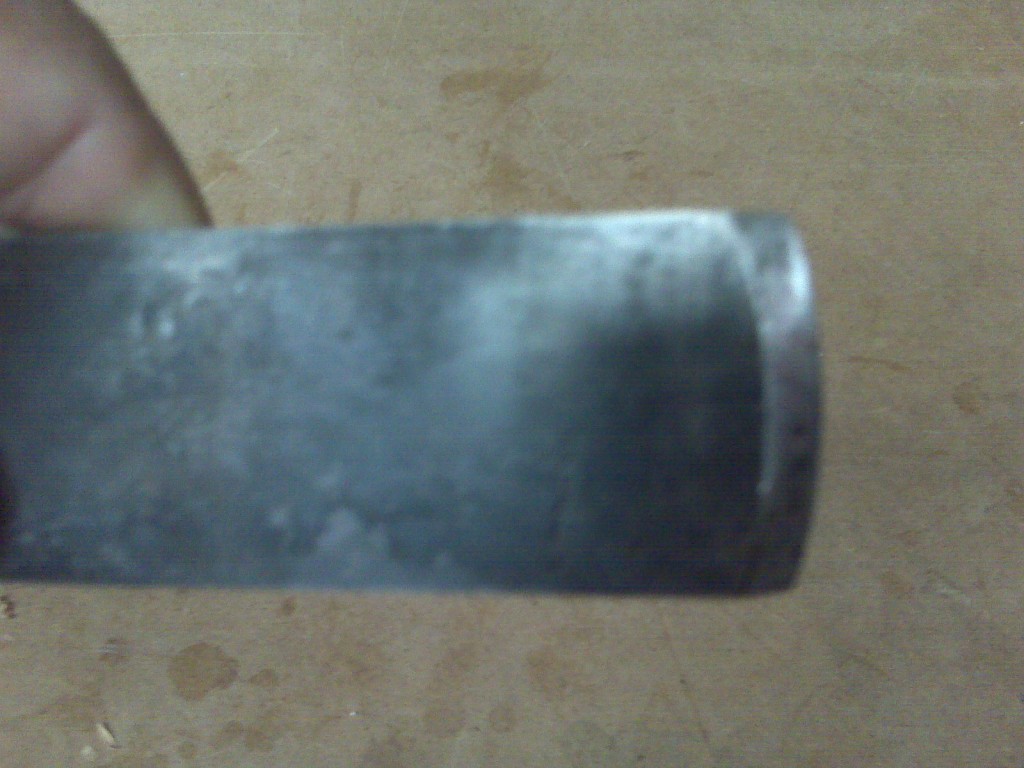
It took the iron out and inspected it closely.  Indeed, this was a 1930’s era Stanley Sweetheart plane with its distinctive mark. I was stunned to see the shape of the working end – it was definitely rounded.  This is, of course, to help hogging off the wood in the roughing phase a whole lot easier.

The Japanning on the plane body is in outstanding shape, and the sole was very flat.  Again, for a hard working plane such as a scrub, this one is in outstanding shape.

Once I had touched up the blade a bit (it still needs a more advanced sharpening) I was very surprised by how light and small the plane was.  I had been hogging off waste from boards with a No. 5 jack plane, and this thing was nothing like the jack.  Small, easy to grip, manuverable.

Then it dawned on me – what a clever idea to make it lighter… I was wearing out my shoulders and back hogging off the waste with a much heavier plane.  The scrub  would make quick work of the high spots without wearing me out.  And, in a day when EVERYTHING was hand planed, well, lighter was better!

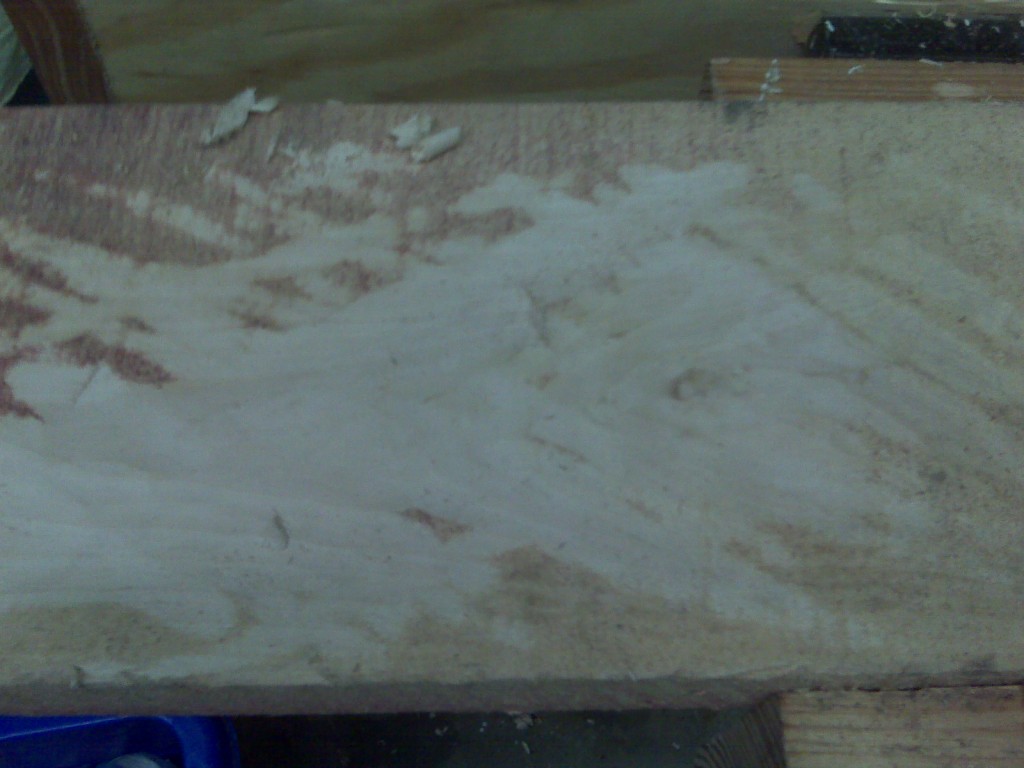
The cut on the scrub plane is definintely something you have to get used to.  You are certainly not making whisper thin shavings.  This is a rough tool for roughly surfacing a board, and does it ever leave a rough surface.  I ran the scrub over this piece of birch to give you an idea of what the cut looks like.

IMG00088

Of course, you will need to use the heavier follow on planes to perfect the surface.  But, with all of the grunt work done with the scrub plane, that smoothing process will be a lot faster – and a lot more pleasant.

Pulling out the stops

Hand planing has been a zen-type experience for me in the workshop.  Sure, I could have plunked down some dough to buy a powered jointer, but I do enjoy using a sharp jack, smooth or jointer plane to get a board into shape.

The rhythm… the sound… the whole experience takes my mind to a new place, making me appreciate my shop time that much more.

The only problem I was running into was that I was spending quite a bit of time securing boards to the bench top.  I would clamp the  board between a bench dog and a Wunder Pup or a pair of wedges, plane, then have to reposition the piece.  Surely there is an easier way to do this?
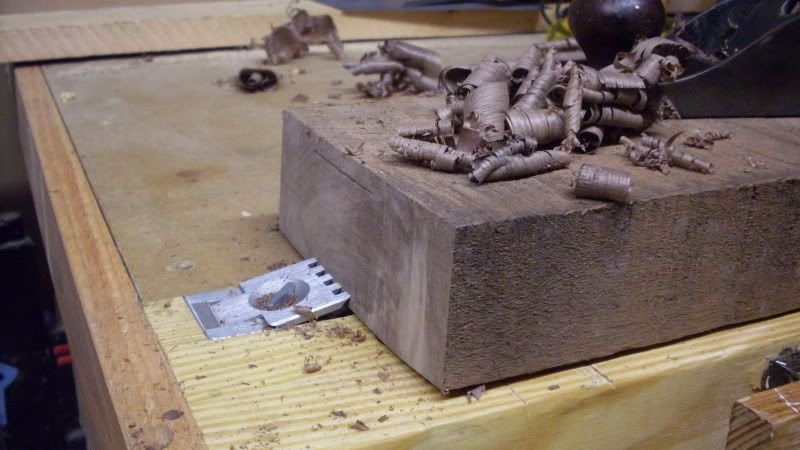
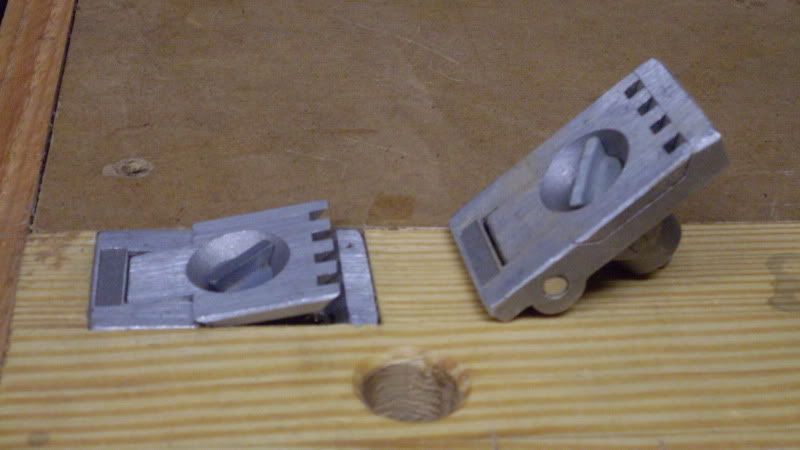
Turns out I had the answer back in my shop.  When I was planning for my bench, I had bought two of these planing stops from Lee Valley.  They were cheap, and I had planned on installing them when I completed my bench this past January.

Well, I never got to installing them.  They just sat in a bag on my side workbench, collecting dust.

Finally, this weekend I was starting to do some planing and thought, “Why not just go ahead and do it?” It was settled, I was moving ahead with it…

As I got started, I discovered that a 1 1/2″ chisel was the perfect width to mortise the stop into the benchtop.  I carefully scribed the outline of the stop top and began chiseling out the cavity.  Once I got the face place fully recessed, I marked the other contours of the stop and chiseled and drilled them to the right depth. Finally, the stop secured to the bench with two screws for extra support.

Believe me, it took some guts to take a chisel to the wooden sides of my bench…

The stop is easy to use and works very effectively.  Turning the dial allows the toothed spring loaded top to pivot up, giving solid support to the board being planed.  With a few minute’s practice, I was able to effectively and quickly plane a thick walnut plank smooth on the face side.  It was easy to reposition the board against the stop as necessary to keep the stop in line with the force of the plane.

The new stop did show I had to improve my technique a little.  For instance, I discovered that I tend to drag the plane backward as I do my return stroke. A minor hitch in my technique which was easily overcome.

Was this a good addition to my bench?  You had better believe it!  This will help make my planing faster and more effective… guiding me further down the path of woodworking enlightenment…

The good booklets

I like to post on a few woodworking forums.  They are great places to connect with woodworkers from across the world.  You can ask questions, share your successes and get a few words of encouragement when things go wrong.

Oh, yes, things can go very wrong…

Beyond the terrifying tales of accidents and woeful recollections of projects gone bad, there are always a tremendous number of questions about tools.

Which are the best to buy?  Can I use this tool to complete that task?

And, quite frequently, there are questions about machine set ups and calibration.

Let me start of by saying that questions like these are very valuable.  Woodworkers with years of experience can weigh in with sage words of advice, pitfalls to avoid and shortcuts that can help ensure accuracy.

Unfortunately, what many of the original posters don’t realize is that they have the answers to many of their questions right at their fingertips – their owner manuals.

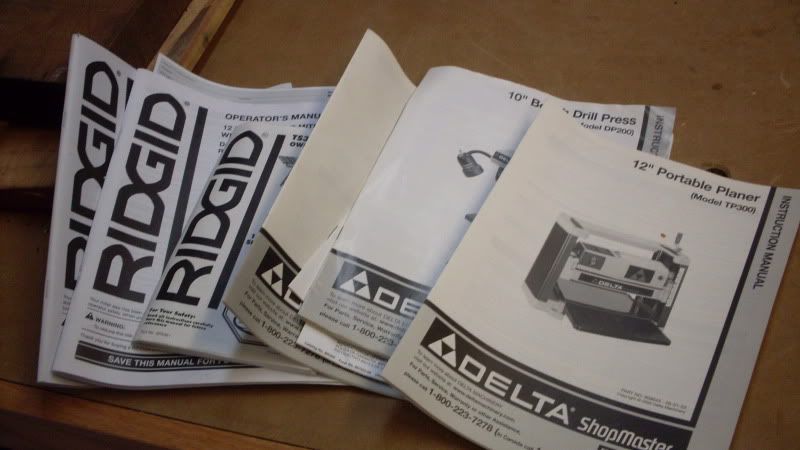
You remember what those are, right?  The usually black and white booklets proudling featuring a photo of the tool you are working with.  Believe it or not, those babies are a gold mine of information – if you know how to use them.

First of all, all manuals have valuable safety information printed in them.  Yes, do take the time to read through it at least once.  There may be some safety features on the tool you are using that aren’t intuitive and may require special care during set up.

Speaking of set up, the manuals also have step-by-step instructions on how to assemble the tool.  Again, it seems to be a no-brainer, but the instructions also give you important tips on when and how much to tighten screws and bolts.  Overtightening a table saw’s trunnion bolts can crack the cast iron casting… leaving you in the lurch.

Need help dialing in the accuracy?  Owner’s manuals give step-by-step instructions on how to tune your tool.  This way, you don’t have to rely on someone to give you the instructions on – say –  tuning your Jet table saw if he or she owns a Grizzly.

Finally, once you get the tool set up, that’s a great time to sit  down and review the manual one more time.  Believe it  or not, many manufacturers offer tips and tricks on how to make your tool more useful.  The  manual for my Ridgid table saw offers plans for cutting push sticks, feather boards and other useful shop jigs.

If you are the more organized type, it’s a great idea to staple the receipt for the tool and record the tool’s serial number in the manual, and tuck it away someplace safe yet accessible.  This way, you can get to it for warranty work and as evidence for the insurance company should something happen to your shop.

And, yes, I do break out my tool manuals to review them from time to time.  I’ve discovered that in the back of many manuals there is a troubleshooting section with frequently seen problems and ways to correct them.

This is great if you have a brand new tool, or you bought a used tool from someone who kept good records.  But, what if your tool is older, or the previous owner chucked the manual?

You are in luck!  Most manufacturers have their manuals online where you can download them.  To find the manuals for older tools, check  out the Old Woodworking Machines website.  Many of the manuals from older tools have been scanned and uploaded to this site for your review and can provide valuable assistance in restoring and tuning a classic tool.

Will reading the owers manuals for your tools make you a better woodworker?  Nah, only practice can do that.  However, for safer and more accurate tools, it’s hard to beat the manuals as a starting place.

Bits ‘N Pieces

You can learn a lot about people when you are shopping for a home.  While it’s been about a dozen years since my wife and I bought our house, the memories of walking into people’s homes on our short list still live vividly in my mind.

There was the smell of the home of an avid cat lover, the sight of burnt orange and avocado appliances of people who chose not to update their 1970’s kitchens and the strange perceptions of being in a home where the owner had hung several overhead lights for decoration.  Yes, that’s right. Several of these light fixtures were just screwed to the ceiling, not even wired to the home’s power system.

The home we eventually bought was owned by an avid shot glass collector.  She had big shot glasses, small ones, ones printed with logos from big cities and small towns. Colleges.  Hospitals.  Even a sheriff’s office. She must have had three hundred, all on display around the home.  It was quite the impressive display.

I wonder when my wife and I eventually put our home up for sale if people will have an opinion about my router bit collection…

Routers are extremely versatile tools.  They can cut joinery or profiles.  They can help you joint a board’s edge or trim a shelf edging flush. They are useless paper weights without bits.

My mom gave me my first router for my birthday many years ago.  It was a fixed base Craftsman light duty model.  She asked me what I needed to go along with the tool, and I told her I needed some router bits.  She was stunned to see the vast array of bits available – and the variety of price points.  Eventually, she settled on a small starter kit that served me very well for the first few years.

A quick perusal through a woodworking catalog will show scores of profiles available for sale – from the plain straight bit to the most exotic multi-profile bit.  They are sold individually or in large all-encompassing sets. Do you need all of them to woodwork?

Hardly.  However, you do need some basics to get the ball rolling.  A set of straight cutting bits.  A flush trim bit with a follower bearing mounted at the bottom.  A chamfer bit.  A few different styles of round over bits.  Maybe an ogee profile to put a decorative edge.  That should get you started.

For me, I bought a set of 20 bits to start – the green ones in the wooden box.  Some conventional wisdom says that buying sets of bits is a waste of time.  You will use a few bits a lot and most of them very rarely.  My experience has been a little different.  The set I bought actually has several bits I love to use, and the entire kit does get a workout.

After I purchased my kit, you can see I got my hands on a few other individual models and sets.  I have two rabbeting sets – one does larger rabbets, the other smaller.  I have a set of slightly undersized plywood bits to cut slots to fit modern cabinet grade plywood.  Dovetail bits to work on different jigs.  Cope and stick bits to create frame and panel doors…

Wow, that’s quite a collection…  I had no idea I had added so many bits.

When you do buy your bits, look for carbide models.  Sure, you can modify your high speed steel bits’ profiles to make custom models, but carbide cuts so much more nicely without the need for frequent resharpening.  Also, don’t be afraid to pay some money for quality router bits.  Sure, you could go to eBay and buy a set of 100 bits for $39, but what are you getting for your money?  You will probably be disappointed with the results.

And, never be afraid to experiment with your router profiles.  You may have your eye on a fancy profile bit, but break the design down to more basic round overs, coves and chamfers, and you may discover you can use two or three bits you already own to make an exact match.

In order for me to keep my collection – and you to keep yours – in tip top shape, it always pays to follow the standard advice:

  • Don’t let the bits knock together.  Carbide is tough stuff, but it’s also very brittle.  Allowing the bits to knock together while in storage or on your workbench can cause the cutters to chip or shatter.
  • Keep ’em clean.  Just like saw blades, router bits can get gunk build up on them.  Your best bet to keep them clean is to first remove any bearings (if the bits are so equipped) and wipe them down with mineral spirits. You can use an old toothbrush to help scrub the stuff off, but nothing more abrasive than that.
  • Tighten them properly.  Your router’s collet does a great job grabbing the bits – when it’s properly torqued down.  To install a router bit properly, don’t let it bottom out in the collet – pull the bit up a fraction of an inch to keep the bottom of the bit off the router’s spindle.  Then, snug up the collet nut and gently twist it to make sure it sets firmly.  Don’t crank down on the wrench – you might damage the collet or make it nearly impossible to release.
  • Store them where you can see them.  If you don’t know which bits you have, how will you now they are available for you to use?  Store them out of harm’s way, but someplace where they are easy to get to and put them to use.

Have I bought my last router bit?  Not by a long shot.  I’m sure a new jig, a new application or a classic molding profile will be announced, and a new Uber-Bit  will be promoted which will be capable of joinery, decoration and establishing world peace.

And, when I do buy it, I’ll proudly add it to my collection.  It will become a new conversation piece in my living room.

April Fools!

In case you were wondering, the Veritas Variable Gang Saw mentioned in yesterday’s post was part of the company’s annual April Fools gag.

Veritas has been running this popular April Fools joke on its customers for the past six years, unveiling more and more bizarre and unique-looking tools every year.

While the Variable Gang Saw was impressive, other offierings, such as the pouchless tool belt and the Dodeca Marking Gauge have been stellar offerings.

While the do seem a little crazy after the fact, knowing that Veritas is seen as a leader in tool innovation.. one does have to wonder…