
[poll id=”16″]
All posts by Tom
Link of the Week
Woodcarving Tutorial
 Imagine being able to look at a plain block of wood and turn it into a gorgeous work of art. Interested, but not sure where to begin?
This site, hosted by the Sculpture Studio in East Aurora, New York, gives the budding wood carver an excellent starting point to try his or her hand in the craft.
Which wood works best for carving? Wood choices from the expected to a few surprises are covered in detail and reviewed for workability, color and ability to hold detail.
What tools do you need to get started? Well, the site goes into detail about hand tools, power carving tools and even common woodworking tools that can be pressed into service.
There’s even a step-by-step instruction on how to get started with hand carving tools, how to carve safely and how to achieve a great look with fine detail.
Sure, carving may not be for everyone, but it’s a great place to start if you want to give it a whirl!
Woodworking Spotlight: Luc Rousseau
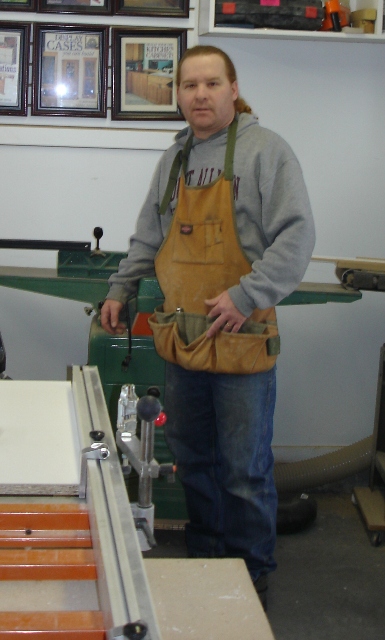 There is nothing quite as noble and enriching as teaching others. It’s something that motivated people do so their students can go on to discover their own path to achieve great things.
Luc Rousseau, owner of Rideau Cabinetry, has learned from one of the best, and now is helping educate other woodworkers through his efforts. If the name Rideau Cabinetry sounds familiar, keep reading.
Luc’s woodworking education started at home. His dad was an upholsterer, so young Luc was always around tools and the woodworking craft. “I was good with tools and I noticed the little details that set quality woodworking apart.”
Eventually, Luc enrolled at Algonquin College in Ottawa, Canada, to become a student in the outstanding cabinetmaking classes offered there. That’s where he met one of his most important mentors – Danny Proulx.
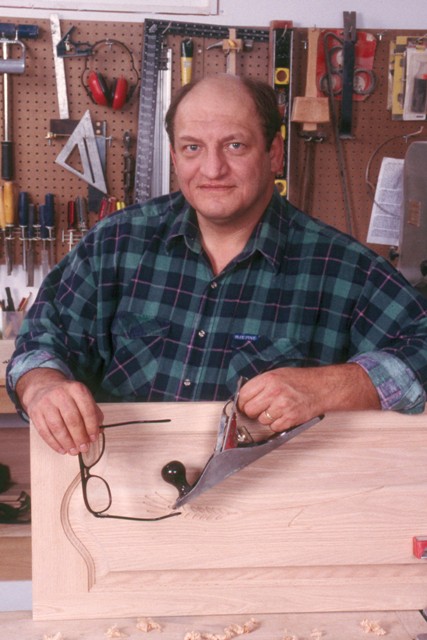 Danny immediately recognized and appreciated Luc’s skill and work ethic. After graduation, Danny offered Luc a few jobs, as well as the motivation and guidance to continue his growth. “One kitchen, then two, then projects for his books and magazine and so on. Apart from my parents, he is the first one that really took the time show me and work with me as a friend and a partner. We got along really well.”
Work in the shop with Danny was marked by a great partnership and outstanding cooperation. “The day always started with an extra large coffee at his desk talking about hockey. Then we would plan the day or days ahead. Danny always had four or five things on the stove and ideas for years to come.”
Always busy, Danny and Luc were working on some articles for magazines and a new book, 50 Shop-Made Jigs and Fixtures in the autumn of 2004. Work was progressing nicely, and, with Luc’s help Danny had gotten the first two chapters written.
Sadly, on November 26 of that year, Danny passed away. Fittingly, he was on his way to a woodworking seminar to help teach the craft to others when he passed.
The news hit Luc and Danny’s wife Gale hard. “She went through the hardest thing someone has to endure in life, losing a loved one.”
 After a month of intense grief, the two sat down to talk about the projects that were left incomplete. “I finished a lot of projects over the winter. Then in June, Jim Stack, the editor from F&W Publications, and I sat down and planed the other six chapters of 50 Jigs.”
The work proceeded slowly at first. Luc remembers seeing the notes and sketches Danny had left, and feeling overwhelmed by the work ahead. After all, Luc couldn’t simply ask his partner what he had intended. He had to rely on his experience of working in the shop with Danny decipher some of his ideas. Four and a half months of hard work later, and the manuscript was finally ready to go to print. “The day I mailed everything to the editor, it hit me like a ton of bricks. Danny was really gone.”
While some people may have one personality when dealing with the public and another in private, Luc says that was not the case with Danny. “He was the same guy in the shop, in the classroom, or his office, the same guy you folks saw on the forums. He was patient, relaxed, fun to work with. I never saw him panic or get mad or scream. He was always looking for solutions, new ways, new tricks. He was a great listener and not the kind of guy who would try to put one up on you guys.”
Today, Luc owns Rideau Cabinets and maintains the company’s online presence. He’s revamping the ordering system for books and hardware to make shopping at the site easy. “Hey, it’s 2008. I have to keep up with the times!”
As far as writing his own books? “Well, this might come later since I am only 43 and Danny started about 48. I think I have a few years to practice my writing before I start getting my own books published.”
As if he wasn’t already busy enough. Luc also took over the woodworking classes Danny had taught over at Algonquin College. No doubt, his students are being introduced to their own dedicated, knowledgeable mentor.
Tools I use: my table saw
Ridgid model 3612
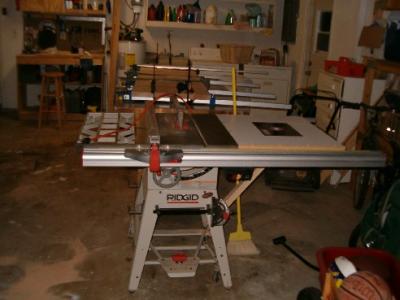 My first table saw was a Delta benchtop model. It worked OK for a year and a half, but, as I quickly discovered, a 12″ rip capacity is really too puny to get serious work done. So, back in 2001, I upgraded to the Ridgid table saw I had been drooling over at the Home Depot. Some of the features that caught my attention were:
- A 36″ rip capacity – larger than most contractor saws.
- A beefy rip fence with t-track built in.
- The saw came with with the Herc-u-lift caster system. I work in a two car garage and have to move the saw frequently to get it out of the way. Without a caster system, I couldn’t easily use such a big saw in my small shop.
- The Ridgid uses a very easy-on, easy-off blade guard and splitter. This is a VERY IMPORTANT feature of the saw. Obviously, you can’t use a splitter when you dado or rabbet, so it has to be removed for these operations. I can have it off in about five seconds, and right back on again – perfectly aligned – in the same amount of time.
- The saw has micro-adjustments for blade alignment. Rather than unbolting the entire trunnion assembly and wrenching it the very small distance to get the blade parallel with the fence, you simply loosen a bolt where the manual tells you to, and you can inch everything into alignment – no fuss, no muss.
- The saw came with a lifetime warranty.
- The saw’s motor is built by Emerson Electric who used to build Craftsman motors back in the day.
- The saw easily handles a 8″ stacked dado blade.
- The saw always seems to rate well in magazine reviews.
There are a few downsides to the saw.
- It is a contractor’s saw with the motor hanging out the back and the cabinet open, so dust collection can be a problem. In fact, my most effective dust control scheme is to open the garage door when I cut and blow a fan outside…
- The saw can bog down on rip cuts in thick hardwoods due to it’s 1.5 horsepower motor. I have overcome most of the problems by using a 24 tooth rip blade, dialing in the blade parallelism and feeding the stock carefully while listening to how the saw is performing.
- It does take quite a few turns of the handwheel to raise the blade. This is great if you are trying to nudge the blade up to make a slight adjustment, but it takes more time to get the blade to the right height for other cuts.
Of course I have tricked out my saw. Besides building many panel cutting, tapering and other shop-made jigs, I added an Osborne EB-3 miter gauge. That sucker really cuts spot-on angles, has a flip-down stop to allow consistent cut lengths and allows a lot of support for stock while cutting.
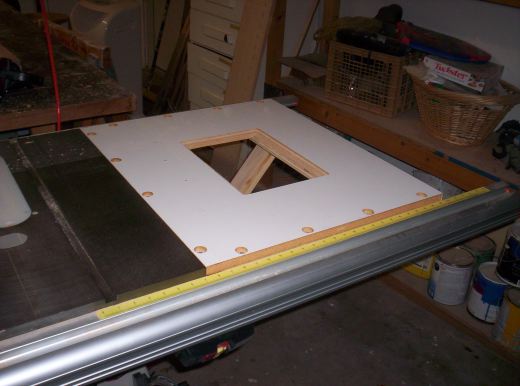 I also replaced the left cast iron wing with a home-built router table. I routed it out to accept a Rousseau router plate (which supports a Freud FT 2000 router). I can use the saw’s rip fence as a fence for the router table, which allows me the same micro-adjustability that benefits me using the saw blade.
Since I may have to rout and rip moldings, I also have an auxiliary router table top that I can set up on a Black and Decker Workmate so I can dedicate a station to each task.
While you can no longer buy the saw brand new from Home Depot, you can get the follow on model – the 3650 – which has many of the same rock solid features found on my saw. While I do dream about upgrading to a high-performance cabinet saw, I have found my saw to be an effective performer that has yet to let me down.
Quick Poll – 3/30 results
[poll id=”15″]
Link of the week
Drawer Building Basics
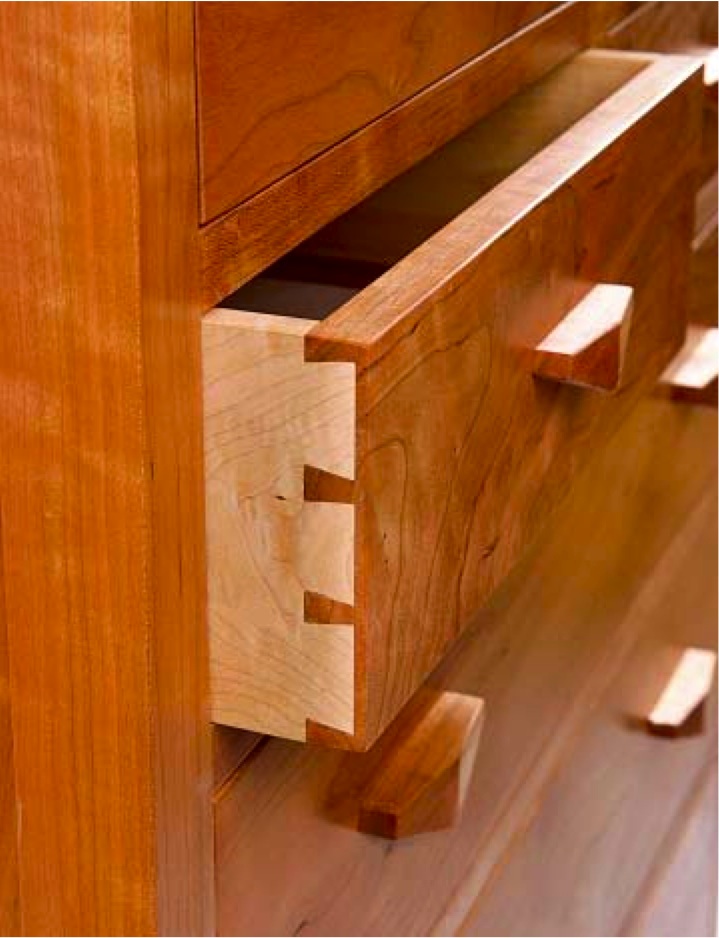 It’s just a box inside a box. So, why is building drawers such an unnerving challenge for beginner woodworkers?
Fine Woodworking magazine offers this .PDF excerpt from Bill Hylton’s Chests of Drawers book.
This exceptional primer walks woodworkers through all the basics – parts of a drawer, joint selection and wood choices are covered in great detail. The best part of this article is that Bill covers options that appeal to woodworkers no matter their skill level. From the most challenging hand cut dovetails to the basic pinned rabbet joint, there’s something for everyone.
If your next project involves building drawers, don’t be intimidated – check this link out first!
Woodworking Spotlight – Doug Stowe
 All woodworking is a matter of scale. Some woodworkers build in huge dimensions – entire libraries of bookshelves, complete room paneling systems and kitchens full of cabinets. Others work on the small side – boxes, clocks and other small items such as toys.
While working large has its challenges, the small scale stuff can be even more intimidating. After all, it’s highly unlikely that someone will pick up a bookshelf and turn it in their hands, examining every small detail. In this small scale realm, one woodworker has made a name and reputation for himself.
Doug Stowe, a woodworker from Eureka Springs, Arkansas, is widely known for his books and magazine articles on building awe-inspiring boxes from what many cabinetmakers would call scrap.
 Doug has his father to thank for his woodworking roots. “My earliest remembrance of my father is being instructed by him how to hold a hammer and how to avoid hitting my thumbs.” While young Doug was honing his skills, his father recognized the potential he saw, and presented Doug with a Shopsmith for his 14th birthday. “The Shopsmith and I are both 1948 vintage,” said Doug, “and still going strong.”
The second part of his career – the writing of woodworking books and magazine articles – took a little more time to perfect. “I had studied creative writing in college and got some encouragement to go on with it. But I knew very little of enough interest for me to write about. Then I read James Krenov’s Cabinet Maker’s Notebook and realized that there was a lot more to say about woodworking than how to cut wood. So, I knew early what I wanted to write about, but also knew the depth of experience necessary to have anything meaningful to say. My first writing for magazines came at the invitation of Woodworker’s Journal in 1994, and my first book about boxes came in 1997.”
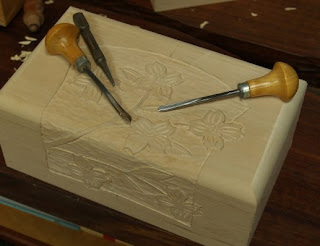 Doug has built a number of outstanding larger pieces, but his work with the smaller boxes is his calling card. His boxes are seen universally as creative, innovative and drop-dead gorgeous. While these masterpieces may seem beyond the abilities of an average home woodworker, they can serve as an excellent starting point for acquiring new skills and breaking out from beyond the norm. “Making boxes takes so little material, and so little space compared with larger work. You can learn so much from them. Nearly every technique associated with larger work can be learned through making boxes. You can more easily take risks in design making a box, so you get to be more experimental. When you make a box, you don’t have to think of the whole room setting the piece will compliment or dominate.”
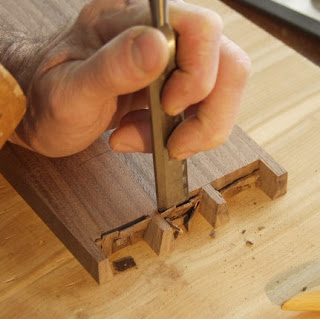 While his boxes are striking and dramatic, his preference for materials actually brings his interest closer to home. “I have a very strong preference for using Arkansas hardwoods. I seldom find Arkansas woods with very dramatic figure like you may find in exotic woods, but that is not a problem. Nearly every piece of wood is suitable for box making. If you have plain wood, you have to apply more craftsmanship to come up with something striking. And what’s wrong with that?”
Given the small scale of these boxes and the outstanding results Doug demonstrates in his writing, woodworkers might stumble a while before they truly master the projects. “We all make mistakes, and we get better at things through practice. If your toddler takes his or her first three steps and then falls, you celebrate the steps, not the fall. Your toddler gets right back up and goes again. When we make a box, we know the first won’t be the best, but each will bring new skill. Don’t worry about your finished product. Learn something from each one and celebrate the steps.”
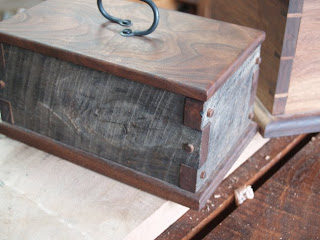 Besides the immense satisfaction Doug takes from building these boxes and teaching the craft to thousands through his writing, he also sees the big picture what people will take from these pieces years down the road. “We each can leave an important legacy in the things we make that tell more clearly than our words about caring for each other and for the planet. In the meantime, we become more potent, more creative, and more alive when we are engaged in making things from wood.”
To read more about Doug’s thoughts on woodworking, visit his Wisdom of the Hands blog.