
If I had read James Krenov’s work the Impractical Cabinetmaker when I started woodworking, there’s a very good chance I would be writing about golf right now.
How do I come to this revelation more than a decade into my woodworking hobby? Easy. I don’t throw things away when I make mistakes. In fact, mistakes should be considered opportunities to stretch your skills.
When I first read Krenov’s master work, the one thing that really stuck with me was his passion for perfection. Krenov lavishes time on the board selections, the stock preparation, the jonery and the finishing, and he encourages other woodworkers to rise to the highest level of craftsmanship. There’s nothing wrong with that – we should all be working to make our work shine.
Krenov, however, made clear his dislike for mistakes in the workpiece. He hates them. He’d rather see you as a woodworker get rid of a piece of wood than continue, trying to repair or undo what you had done.
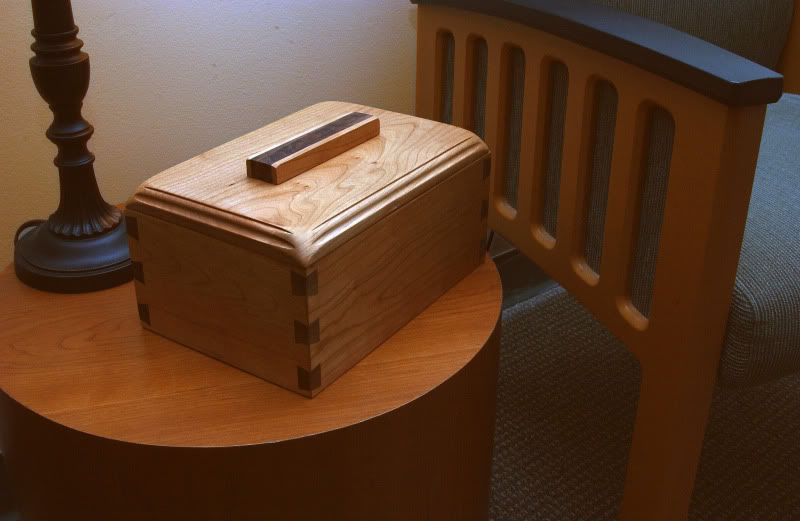
I disagree, because if I didn’t, my scrap bucket would be overflowing with some pretty nice pieces of wood. Case in point – this is the box I was building a few weekends ago – the one I put the stopwatch on. It’s a nice little box, and the couple who will receive it will be pretty darned happy to have it on display in their home.
While I could have just documented the extra 40 minutes of work (or six hours of work plus drying time) to put the final touches and finish on the box, there was a much more valuable lesson to be learned when I built the top.
In order to dress up the edges of the top, I decided to route an ogee profile. A simple yet elegant way to make the top look nicer. The only problem is that I was routing it with a hand held router, and when I got to one corner, the router wobbled, leaving a gouge in the profile. Ouch.
According to Krenov, I was looking at a piece of chiminea chow, suitable for use when keeping warm on a cool night. And, for a few days, that’s all I thought I had.
That was, until I had an idea.
Since I was only working on a piece of junk, I thought I would take a chance, break out the rasp and try to round the corners over. Just to make them look a little nicer.
At first, I wasn’t sure what I was doing, but after a while, I fell into a rhythm, slowly grinding away the edge profiles. Then, I turned to a sanding block with 100 grit, then 150 grit sandpaper. Before long, I was left with an interesting looking box top with a pretty cool looking design feature. The lines of the ogee on the edges die into the curved corners, giving a unique and quite handsome look to the box top.
And, to think, I probably would have just chucked the piece and started over again…
In my opinion, it looks so nice that I may try making that profile a signature feature for some of my other upcoming projects.
Funny – all that from what other learned woodworkers would call trash.
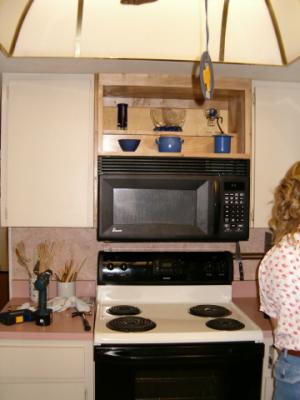 My neighbor Chris is a handy guy. He’s been a sushi chef, has rebuilt carburetors and today cleans rugs for the local school system. He’s a hustler, never allowing grass to grow under his feet. So, it came as no surprise that he was installing a new range in his home for his wife as a Mother’s Day gift.
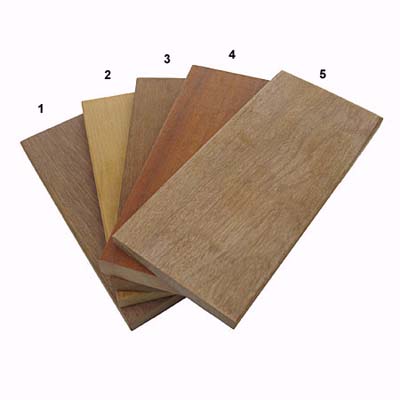 While local hardwoods can be a pleasure to work with and can leave you with a gorgeous project, tropical hardwoods can be eye-poppingly beautiful. Whether the vividly colored bloodwood or purpleheart from South America, the highly desirable bubinga or wenge from Africa or the hard wearing teak or rosewood from Asia, these boards from the planet’s tropical areas can be a woodworker’s dream, giving your projects a style all their own.
 When it comes to places to find information to keep employees safe, there are few better resources than the the US Department of Labor’s Occupational Safety and Health Administration (OSHA). There are resources for employees in many different industries at the OSHA website, including a page for woodworkers.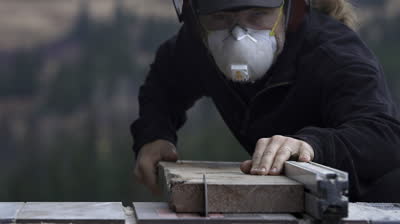


 Uhh, no. I was, however, tasked to go and assist our local health department with the public education effort in response to the 2009 Swine Flu outbreak. Yup, when there’s a crisis, I typically get called in. It makes my job a little more interesting.
 Finally, while you may be working with the right equipment, it still won’t hurt to use a dust mask or respirator when doing very dusty jobs – sanding comes to mind. Even with highly-efficient dust collecting sanders, enough of the fine stuff is produced and can affect your health after prolonged sanding sessions. It’s always a good idea to put on a dust mask and just be sure you are covered.
 Welcome to Woodworker’s Safety Week 2009 where we will start by taking a look at one of the most dangerous tools in the shop – the table saw. All saws come with two basic pieces of safety equipment – a splitter or riving knife which keeps the wood being cut from closing behind the blade or being accidentally pushed into the back of the blade should you make an error in feeding and pull the board away from the rip fence.