All posts by Tom

I'm the guy who writes the blog...

Species Spotlight: Flame Birch

Yellow birch is one of those woods you see quite a bit.  It’s been used as the veneer of basic cabinet grade plywood.  It’s been one of the go-to woods for kitchen cabinets for decades.  And, any boy scout or girl scout worth their merit badge will tell you the bark is an excellent tinder for starting a fire.

But, have you truly seen the flame?

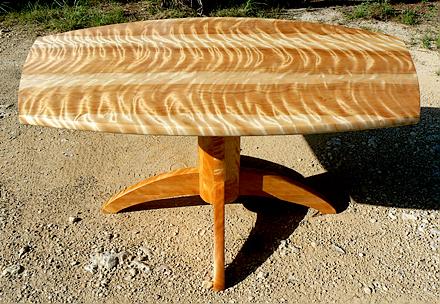
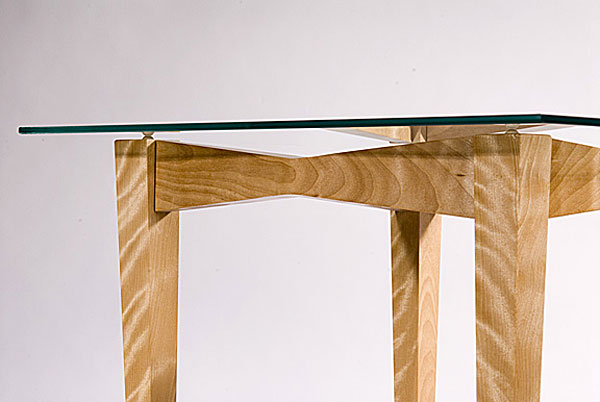
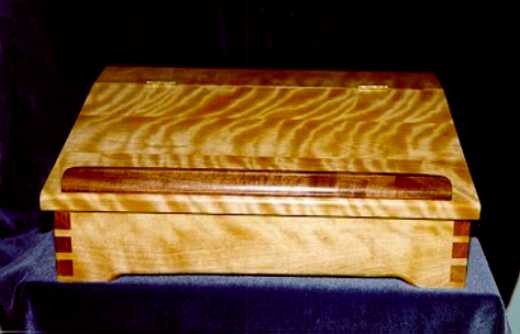
Flame birch – also known as figured or curly birch – is seen very rarely in this valuable species.  Just as with curly maple, the board exhibits quite dramatic waves through the sawn boards.  The only difference is that it is much wider and bigger than curly maple. According to Eric Poirier at Bell Forest Products, “It looks more like figured cherry with wider bands of curl.  I also love the color variation you see in the timbers.  Birch sapwood is quite blond – similar to maple – and the heartwood is rather red like cherry.”

Because flame birch’s figure is over a much larger scale, it shines in big projects such as tabletops, bar tops and other flat surfaces. In smaller projects, you aren’t going to get the same effect. “In those cases, curly maple will give you a much better result, as the figure works in a much smaller scale.”

As with other figured woods, flame birch does require a great deal of care when it’s worked with. “It is very susceptible to tear-out and does not respond well to production milling.  Slow speeds, sharp bits and grain direction all play an important role in milling this stuff properly.  Drum sanders work great for thickness planing. Sharp hand tools are also very effective.”

The stresses that helped make the figure in the first place also tend to make the boards more prone to warping.  “We’ll see most of the warping take place during the kiln drying.  However, once it’s dry, the movement is going to be minimal. Even so, it’s best to adjust your plans to accommodate this kind of movement.”

While the wood does have its frustrating moments during construction, once you apply the finish all will be forgiven. “Just about any type of finish will bring out the figure in wood, but some are said to work better than others.  Boiled linseed oil is supposed to be one of the best.  Some types of finish will bring out the figure and give the wood more of a yellow or amber color – shellac, oil-based polyurethane or lacquer, and penetrating oils.  If you want to keep the wood as close to the natural color as possible, I would recommend using a water-based polyurethane or lacquer.”

Finding flame birch does take a bit of detective work on behalf of the sawyer. “There are graders in local log concentration yards that look for and set aside these figured logs. They go through millions of board feet per year, so with that huge volume it makes sense that they find all the good stuff!”

Once the exceptionally figured woods are discovered and local sawmills are notified about the product, that’s when Eric and company will travel to these yards and bid on the logs. “We want to find the best to ensure woodworkers have plenty of this stuff for their projects.”

Currently, Bell has quite a bit of 4/4 flame birch on hand.  But, a recent trip to one of these log auctions netted them some large specimens that allowed for 8/4 boards to be sawn.  “Right now, it’s drying in the kiln.  It should be ready right around Halloween… so it looks like our customers are in for a real treat!  No tricks, we promise.”

Quick Poll

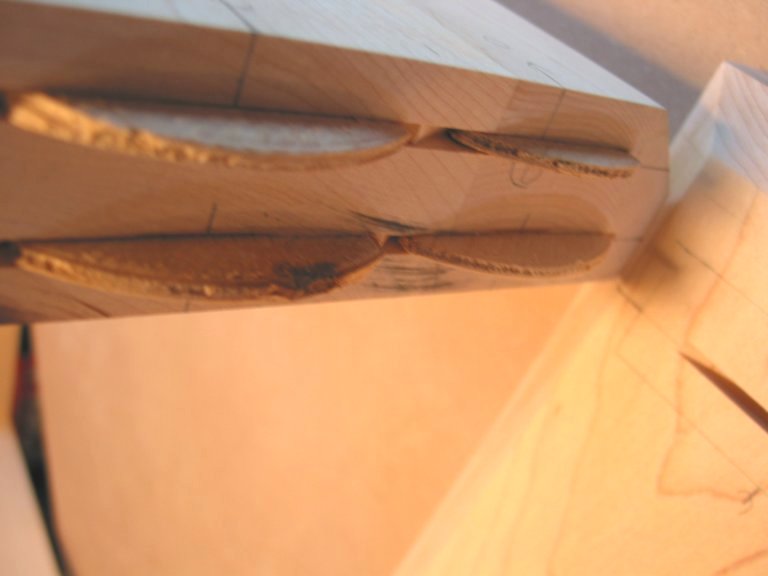
They are a relatively new joinery method, invented in the 1950’s and used extensively in post-war European cabinet shops.  It crossed The Pond in the 1970’s and was adopted in North American production shops shortly after.

And, once Norm Abram started using one in the New Yankee Workshop, well, everyone wanted to get their hands on one.

The biscuit – or plate – jointer did speed the process of joining two boards together.  Whether connecting two pieces of plywood, solid wood, MDF… or whatever other material you may be working with… the biscuit joint has proven to be a versatile way of connecting boards.

However, joint test data suggests that for nearly all joints, the biscuit is probably one of the weakest joinery methods available.

So, this week, how do you feel about the biscuit joint?  Super strong and versatile shop hero, or gimmicky joint with little more strength than a butt joint?

[poll id=”96″]

Link of the Week

Denim Pine

When life hands you a bowl full of lemons, make lemonade. – Ann Landers

So, you have a stand of lodgepole or ponderosa pine trees that have been  infected by the mountain pine beetle, and now the wood you have harvested is a pale shade of blue.

What can you do about it?

Well, if you are an association of foresters in British Columbia, Canada, you harvest the timber and sell it as Denim Pine.

This unique looking lumber is  safe to use (any beetle larvae or eggs are killed in the kiln drying process) and is as structurally sound as non-stained pine.

While the folks who market Denim Pine are having some fun marketing this lumber, their site also offers a very serious look at the mountain pine beetle infestation in western Canada and documents the massive effort to address this important issue.

Woodworking Spotlight: Mike Siemsen

There is nothing quite as noble as teaching others – especially when it comes to woodworking.  There’s just something that happens in that interaction between the students and instructor when a rough board makes that journey to becoming a masterpiece.

And, when it comes to teaching about woodworking, there are few instructors as patient – and funny – as Mike Siemsen.

Mike’s school – the appropriately named Mike Siemsen’s School of Woodworking, is located north of the Minneapolis/St. Paul metroplex in Minnesota.  His first memories of woodworking have helped shape the direction his school takes with students. “My father was always doing carpenter work and built things well, square and straight, mostly with hand tools. That gave me the interest when I was a kid, and I ended up making things with coping saws from scraps. Wooden fruit crates from behind the grocery store and off cuts from construction sites were rich sources of material.”

While Mike was out earning his woodworking chops, he did learn all about power tools.  However, the more he learned about them, the more he realized what a great experience it is to come back to those hand tools.  “Hand tools better communicate back to the user what is going on with the material and the tool. They allow the woodworker to get closer to the work and see what is going on.” Mike pointed out a classic example. “When I start a saw cut with a handsaw my knuckle is right against the blade so I can accurately get the kerf going and ensure a clean cut. Needless to say, I’d NEVER do that with a table saw!”

Mike’s instruction process is very methodical, giving his students the best chance of success. “In the beginning stages of learning woodworking, it is not speed we are after so much as understanding of the material and the processes. For instance, sharpening is number one, two and three on the list of things beginners need to learn. Getting the tools to work properly, along with other aspects such as wood movement and joinery are critical to enjoying woodworking.”

For the grunt work, Mike’s not against turning to power.  Many tasks –such as thicknessing and resawing – go faster when power tools get involved. Mike sees these tools as a replacement for  strong-bodied teenage apprentice who would traditionally do the drudgery work during a long day in the shop. “I am not against the use of power tools, I have just heard too often the lament from someone wanting to get started in wood working, ‘I can’t afford the equipment and I have no place to put it!’ A decent hand tool kit isn’t that expensive, and doesn’t take up much room. I typically ask students what they have in their shop to work with so I can teach them methods they can use at home.”

Mike is the primary instructor for most classes; however, the school has no trouble attracting other talented instructors.  Tom Schrunk and Garret Hack have signed on to teach different aspects of woodworking.  “Garret was our last instructor.  He is a meticulous craftsman and an all-around interesting guy. We built a demi-lune table with a bent lamination front apron and tapered legs. Many of the students improved their sharpening and planing skills along with learning the joinery for the table. It was a great class, and the students appreciated the hands on assistance.”

Mike’s students come from all walks of life. “The only thing truly common about my students is a keen interest in learning more about woodworking. Some are beginning woodworkers and want an overview to help them understand what it is they need to learn, others are more experienced and want to take things up a level or get past a stumbling block.  I have had a nuclear physicist, a farmer, a surgeon, a dentist, an accountant, a mayor of a small town, and an actuary, as well as many others.  There doesn’t seem to be a common profile – we aim to please all of our students. If you like woodworking, we’ll help you out!”

What does the future hold for Mike?  “I would like to grow the school to the point where I need to add on to the shop. Eventually, I plan to add on a bench room and some more storage, and offer some more amenities. Maybe even some small cabins for students to stay in. I want to offer more in depth classes on details and design, as well as longer classes on bigger projects.”

Mike’s always looking to hear from the experts – his potential students. “I am still trying to figure out what people would like to see for classes, and I gladly accept suggestions!”

Now, that’s a teacher!

“…Who will pick up the flag?”

One of my favorite movies of all time is Edward Zwick’s 1989 work Glory.  It is the retelling of the story of the 54th Massachusetts Regiment during the US Civil War.  The 54th was the first all black regiment to take the field in battle, and they proved themselves brave warriors as they attempted – and failed – to take Fort Wagner which guarded the city of Charleston, South Carolina.

One of the most poignant moments in the film was when Col. Robert Shaw (Played by Matthew Broderick) stood by the flag bearer at the head of the column of soldiers just before the climactic battle and asked, “Should this man fall, who will pick up the flag?”

Why was this so important?  Sure, the flag is the symbol of a nation, and as such, it shouldn’t touch the ground as a sign of respect.  But, that’s not the main reason why Shaw asked for a volunteer.

Back in the days before field radios and instant satellite communications, it was a difficult job commanding men in battle.  So, the commanders for different units had to rely on two tools.  The first was the bugle’s call.  By having a bugler sound a different tune, the soldiers on the field were able to tell if they had to retreat or advance.  The second – and probably even more  important – tool the commanders used was the standard bearer.  By hoisting the unit’s colors high in the air, the soldiers were able to tell where their unit was headed, and if they were still in formation during the attack. That flag guided their movements and helped them stay on track.

Knowing that importance, opposing forces were quick to locate the standard bearer and gun him down.  By doing this, they could easily thrown their opponents into disarray, possibly turning the tide in battle. Being the standard bearer was a very dangerous occupation.

2009 has been a tough year for woodworkers.  We have seen the passing of two woodworking legends, and the end of an era on television.

Sam Maloof was a truly inspired genius when it came to the craft.  From his California workshop, Sam let his vision guide his work for more than 60 years.  Even until his final days, Sam’s skill and  love for wood poured out into the creations he planned and assembled.  Primarily known for the sinuous curves of his rocking chairs, his designs graced the White House as both presidents Jimmy Carter and Ronald Regan each owned one.  He was described by the Smithsonian Institution as “America’s most renowned contemporary furniture craftsman” and People magazine dubbed him “The Hemingway of Hardwood.” But his business card always said “woodworker.” “I like the word,” he told a Los Angeles Times reporter, his eyes brightening behind large, owl-eyed glass frames. “It’s an honest word.”

A few months later, we bid farewell to James Krenov. This Siberian-born woodworker started woodworking back in the mid 1920’s, when an airplane dropped supplies for his town in his family’s new  new Alaskan home.  In this package, he found a jack knife and began carving toys for himself and other children.  As the handmade aesthetic had nearly died out in the 1950’s, James was one of the standard bearers for a return to the honest, well-built projects turned out by talented woodworkers today.  His seminal 1976 work A Cabinetmaker’s Notebook helped to light the fire and bring woodworking back to the fore.  It remains one of his most popular works.  He helped establish the woodworking program at the College of the Redwoods, which instructed a new generation of notable woodworkers.

While not a death, last week’s announcement that the New Yankee Workshop will cease production proved to be the talk of woodworking forums across the Internet.  Norm Abram and Russ Morash broke ground the first time in 1979 with This Old House, and in again when they launched the New Yankee Workshop in 1988.  Sure, there were the questions.. who would watch one guy build furniture in his shop for half an hour?  Apparently, lots of folks.  Norm’s easy-going attitude and communication ability gave woodworkers the inside look at how furniture is made.  Always dressed in his plaid with tool belt strapped around his waist, Norm exhorted woodworkers to get out and build safely.  There is little doubt that many woodworkers today got their start in the craft while sitting in their easy chair watching the show.

We now enter into a new era in woodworking.  Many of the old masters who brought the craft out of the sterile 1950’s are getting up there in age.  Sam Maloof, James Krenov, George Nakashima, Tage Frid… they are passing on, leaving memories and their written – and spoken – words for future generations to learn from.  Speculation is that the 21-year run of the New Yankee Workshop was halted by the current economic conditions and a lack of sponsorship money.

These two men and this one show carried the banner for woodworkers, showing them that yes, you can do this and yes, you will improve if you stick with it and invest the time to work at it.

Who now will pick up  the flag?

After reacting to the shock of the two passings and show cancellation, the next post typically asked the most logical next question – who will take their places?

Of course the answer is no one… Krenov and Maloof were pioneers and visionaries.  Their styles are as famous and imitated as those from the Shakers and the Arts and Crafts movement.  The New Yankee Workshop broke ground and laid the path for televised craftsmen such as David Marks and Scott Phillips.

However, the same question also has a logical answer – it’s right under your nose.  The computer you are working on right now is a doorway to the rich online woodworking world.  Woodworking blogs, written by many gifted craftsmen and women, have sprung up across the net.  This is where the next woodworking standard bearer will be discovered.

In many ways, the Internet is far superior to TV programming.  For instance:

  • The cost to get started in blogging and podcasting is insanely cheap.. when compared to the cost of equipping a full-blown TV production set.
  • You can dial in your interests precisely. If you love the router, you will find websites that deal with that tool.  Turning?  Yep. Hand tools?  You betcha.
  • The content is available 24 hours a day.  You can subscribe to the RSS feeds from several different sites and review the new content as it is posted.  This beats watching the same TiVo’d show over and over for a week until the next program comes along.
  • And, most importantly, regardless of the economic conditions, web woodworking contributors can continue to post, where TV programming needs the infusion of cash to keep the show on the air.

With the changes in technology, the arrival of High-Def visual programming has arrived. Today’s powerful computers and high-bandwidth Internet connections make the fast and easy access of programming a piece of cake. And, as woodworking web contributors continue to target their audiences and hone their video and audio production skills, the quality of the programming will only rise.

Maloof and Krenov carried the banner through some of the roughest times for woodworkers, and their contributions will never be forgotten.  And, even though the New Yankee Workshop will no longer be producing new shows, the 21 year long body of work will exist in perpetuity on DVD’s and through the ‘measured drahhings.’

But, you have to remember that while these losses seem major, there are hundreds – thousands of woodworkers out there  who are willing to step to the front and answer the question by saying, “I will.”

Quick Poll

While you may not think it’s true, just about everyone is an avid reader.  Sure, maybe you aren’t leafing through Faulkner, Shakespeare or Poe… but woodworkers have collections of woodworking magazines and books, wannabe chefs have their cookbooks, gear heads have their auto repair manuals…

So, needless to day, one of the most important pieces of furniture in any house is a bookcase – somewhere to stash all those books!  Book cases can run the gamut from fancy to plain, difficult to build or easy afternoon projects… take your pick.

At least one of these shelves – the bottom one – is typically fixed in place. After all, a bookcase is typically a large box that needs all four sides and a back.  The other shelves are usually adjustable to allow different sizes of books – tall photo albums vs. paperback novels.

This week’s question – when you build a bookcase, what kind of system do you use for making the adjustable support system for these movable shelves?

[poll id=”95″]