Category Archives: Spotlight

Woodworking Spotlight: Lake Erie Toolworks

In so many things in life, bigger is better.

If you have a bigger hammer, you can drive large nails faster. If you have a bigger offensive line in football, you can block better and move the defense out of the way to score a touchdown. If you have a bigger truck, you can haul more wood home!
And, when it comes to workbenches, a bigger, more massive model gives you more stability when cutting, planing, routing and doing all manners of other woodworking.

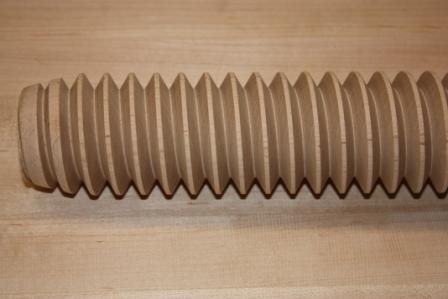
Keeping with this theme, the folks up at Lake Erie Toolworks believe that bigger is better when it comes to vise screws. And, when I mean big, I really mean big!
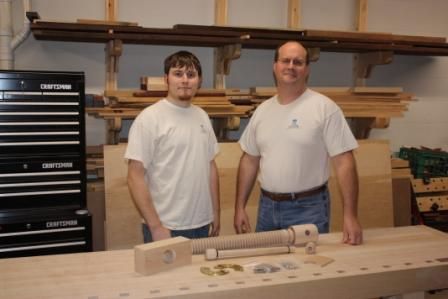
You see, Lake Erie Toolworks currently makes the largest wooden vise screw in the world. I had a chance to talk with Nick Dombrowski, owner of the company, to talk about his enormous vise screws. But first, Nick started with the basics. “First of all, a solid, well designed workbench make woodworking faster and more enjoyable. You don’t have to waste time and energy trying to work around the shortcomings of a table on sawhorses or even most of the commercially available benches out there. There is plenty that already has been said about solid workbenches, and we are working to make our vises an essential part of any solid workbench.”

Nick’s first experience with massive vise screws was when he worked at an organ building shop. “They all used vises with 2 1/2” maple screws, and they all worked great. Very smooth, quiet and fast acting.”

Nick later went on to build his own workbench with a steel screw vise. While the screw gave the vise plenty of muscle, it didn’t have the same ‘feel’ as the wooden models. That’s when Nick set out to make vise screws as good as – if not better – than the antiques he had already worked on.
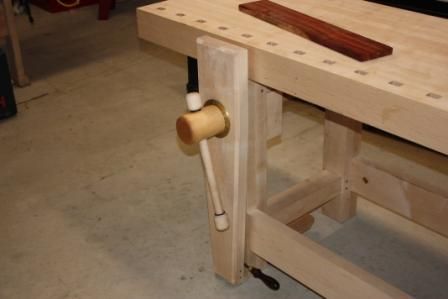
Now, it’s important to disclose the kind of vises you can build with these wood screws – twin screw vises, tail vises, face vises and even a cool vise design that had fallen out of favor for decades – the leg vise. It’s a traditional form that today’s woodworkers should look into building on their benches. “Leg vises have a lot more capacity than the fast-acting face vises. This gives you a lot more flexibility without getting your prized lumber close to guide bars.”

Currently, Lake Erie Toolworks is also working out the details for a shoulder vise screw to build the vise commonly seen on European benches. “Shoulder vises, while a little more complex, are totally worth doing if you like to dovetail.”

“Sure, there are no perfect vises out there; that’s why we encourage woodworkers to consider these other designs.”

Nick’s vise screws are made with a combination of CNC equipment, dedicated machines for internal threading purposes, lathe work and hand finishing. Hard Maple is the wood of choice. It has the highest shear strength of typical vise screw woods (beech, ash, etc), lessening the likelihood of having the long-grain fibers shearing off, or chipping, in use.
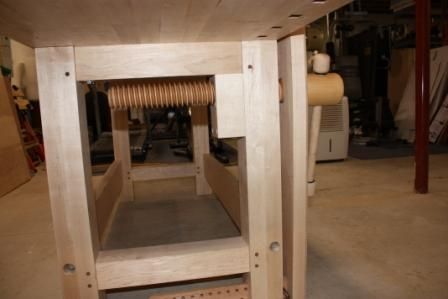
While you might suspect caring for a wooden screw vise would be challenging, it’s not as difficult as you would expect. “We recommend our customers use a penetrating finish on the screw and furniture wax to make sure things move smoothly. The beauty about this screw is that after a lot of use, you may not need wax anymore, as the action against the retaining nut will smooth the wood out on its own.”

Lake Erie Toolworks sells the screw with everything you will need to install on your bench. “You will have to provide your own ‘chop’ for the vise, but all of the running gear is included and is very easy to install.” Nick likened it to building a simple furniture project. The Lake Erie Toolworks site also offers detailed installation instructions, walking woodworkers step-by-step through the process of installing vise on their benches. And, woodworkers also have an option of how they would like to attach their bench screws. “We offer an external brass garter as well as an internal maple garter to hold the screw to the bench. Customers can make their own garter or even go with no garter at all. It’s all a matter of choice.”
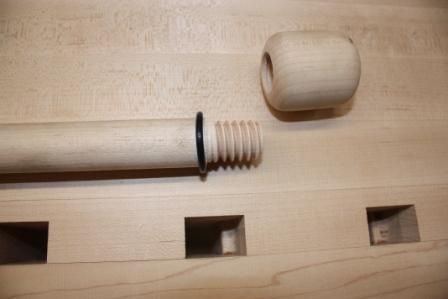
Nick has even gone to the trouble of threading both ends of the vise handle and providing a tapped cap for both ends. “It’s so much more sturdy and durable than trying to friction fit a cap on the end, an if you have to remove the handle, it’s a piece of cake, unlike a glued on cap.”

What does the future hold for Lake Erie Toolworks? “We are very responsive to the needs of our customers. In fact, we have a survey on our web site that lets customers tell us what products that they would want.”

What does Nick like the most about making these massive wood screws? “Tool building really is different than typical woodworking. You get the satisfaction of knowing that someone is using what you’ve made to make other things. Also, I have gotten the opportunity of learning a whole new skill set, that being machining. I’m finding that I like machining about as much as I like woodworking and building tools allows me to exercise both skills on a regular basis.”
Species Spotlight: Flame Birch

Yellow birch is one of those woods you see quite a bit.  It’s been used as the veneer of basic cabinet grade plywood.  It’s been one of the go-to woods for kitchen cabinets for decades.  And, any boy scout or girl scout worth their merit badge will tell you the bark is an excellent tinder for starting a fire.

But, have you truly seen the flame?

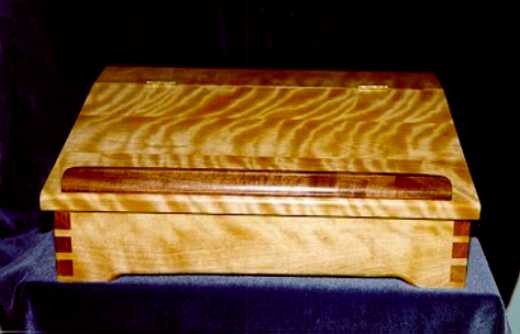
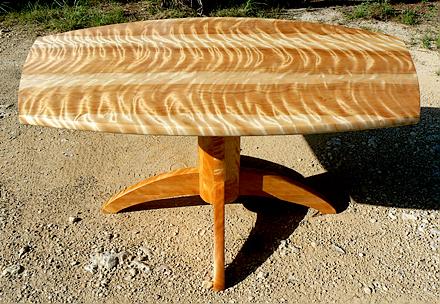
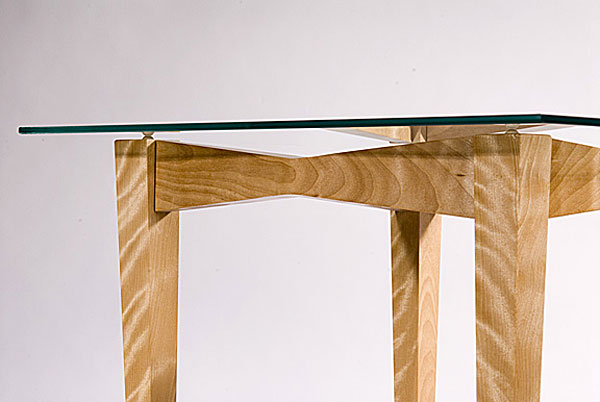
Flame birch – also known as figured or curly birch – is seen very rarely in this valuable species.  Just as with curly maple, the board exhibits quite dramatic waves through the sawn boards.  The only difference is that it is much wider and bigger than curly maple. According to Eric Poirier at Bell Forest Products, “It looks more like figured cherry with wider bands of curl.  I also love the color variation you see in the timbers.  Birch sapwood is quite blond – similar to maple – and the heartwood is rather red like cherry.”

Because flame birch’s figure is over a much larger scale, it shines in big projects such as tabletops, bar tops and other flat surfaces. In smaller projects, you aren’t going to get the same effect. “In those cases, curly maple will give you a much better result, as the figure works in a much smaller scale.”

As with other figured woods, flame birch does require a great deal of care when it’s worked with. “It is very susceptible to tear-out and does not respond well to production milling.  Slow speeds, sharp bits and grain direction all play an important role in milling this stuff properly.  Drum sanders work great for thickness planing. Sharp hand tools are also very effective.”

The stresses that helped make the figure in the first place also tend to make the boards more prone to warping.  “We’ll see most of the warping take place during the kiln drying.  However, once it’s dry, the movement is going to be minimal. Even so, it’s best to adjust your plans to accommodate this kind of movement.”

While the wood does have its frustrating moments during construction, once you apply the finish all will be forgiven. “Just about any type of finish will bring out the figure in wood, but some are said to work better than others.  Boiled linseed oil is supposed to be one of the best.  Some types of finish will bring out the figure and give the wood more of a yellow or amber color – shellac, oil-based polyurethane or lacquer, and penetrating oils.  If you want to keep the wood as close to the natural color as possible, I would recommend using a water-based polyurethane or lacquer.”

Finding flame birch does take a bit of detective work on behalf of the sawyer. “There are graders in local log concentration yards that look for and set aside these figured logs. They go through millions of board feet per year, so with that huge volume it makes sense that they find all the good stuff!”

Once the exceptionally figured woods are discovered and local sawmills are notified about the product, that’s when Eric and company will travel to these yards and bid on the logs. “We want to find the best to ensure woodworkers have plenty of this stuff for their projects.”

Currently, Bell has quite a bit of 4/4 flame birch on hand.  But, a recent trip to one of these log auctions netted them some large specimens that allowed for 8/4 boards to be sawn.  “Right now, it’s drying in the kiln.  It should be ready right around Halloween… so it looks like our customers are in for a real treat!  No tricks, we promise.”

Woodworking Spotlight: Mike Siemsen

There is nothing quite as noble as teaching others – especially when it comes to woodworking.  There’s just something that happens in that interaction between the students and instructor when a rough board makes that journey to becoming a masterpiece.

And, when it comes to teaching about woodworking, there are few instructors as patient – and funny – as Mike Siemsen.

Mike’s school – the appropriately named Mike Siemsen’s School of Woodworking, is located north of the Minneapolis/St. Paul metroplex in Minnesota.  His first memories of woodworking have helped shape the direction his school takes with students. “My father was always doing carpenter work and built things well, square and straight, mostly with hand tools. That gave me the interest when I was a kid, and I ended up making things with coping saws from scraps. Wooden fruit crates from behind the grocery store and off cuts from construction sites were rich sources of material.”

While Mike was out earning his woodworking chops, he did learn all about power tools.  However, the more he learned about them, the more he realized what a great experience it is to come back to those hand tools.  “Hand tools better communicate back to the user what is going on with the material and the tool. They allow the woodworker to get closer to the work and see what is going on.” Mike pointed out a classic example. “When I start a saw cut with a handsaw my knuckle is right against the blade so I can accurately get the kerf going and ensure a clean cut. Needless to say, I’d NEVER do that with a table saw!”

Mike’s instruction process is very methodical, giving his students the best chance of success. “In the beginning stages of learning woodworking, it is not speed we are after so much as understanding of the material and the processes. For instance, sharpening is number one, two and three on the list of things beginners need to learn. Getting the tools to work properly, along with other aspects such as wood movement and joinery are critical to enjoying woodworking.”

For the grunt work, Mike’s not against turning to power.  Many tasks –such as thicknessing and resawing – go faster when power tools get involved. Mike sees these tools as a replacement for  strong-bodied teenage apprentice who would traditionally do the drudgery work during a long day in the shop. “I am not against the use of power tools, I have just heard too often the lament from someone wanting to get started in wood working, ‘I can’t afford the equipment and I have no place to put it!’ A decent hand tool kit isn’t that expensive, and doesn’t take up much room. I typically ask students what they have in their shop to work with so I can teach them methods they can use at home.”

Mike is the primary instructor for most classes; however, the school has no trouble attracting other talented instructors.  Tom Schrunk and Garret Hack have signed on to teach different aspects of woodworking.  “Garret was our last instructor.  He is a meticulous craftsman and an all-around interesting guy. We built a demi-lune table with a bent lamination front apron and tapered legs. Many of the students improved their sharpening and planing skills along with learning the joinery for the table. It was a great class, and the students appreciated the hands on assistance.”

Mike’s students come from all walks of life. “The only thing truly common about my students is a keen interest in learning more about woodworking. Some are beginning woodworkers and want an overview to help them understand what it is they need to learn, others are more experienced and want to take things up a level or get past a stumbling block.  I have had a nuclear physicist, a farmer, a surgeon, a dentist, an accountant, a mayor of a small town, and an actuary, as well as many others.  There doesn’t seem to be a common profile – we aim to please all of our students. If you like woodworking, we’ll help you out!”

What does the future hold for Mike?  “I would like to grow the school to the point where I need to add on to the shop. Eventually, I plan to add on a bench room and some more storage, and offer some more amenities. Maybe even some small cabins for students to stay in. I want to offer more in depth classes on details and design, as well as longer classes on bigger projects.”

Mike’s always looking to hear from the experts – his potential students. “I am still trying to figure out what people would like to see for classes, and I gladly accept suggestions!”

Now, that’s a teacher!

What I learned from Toshio Odate

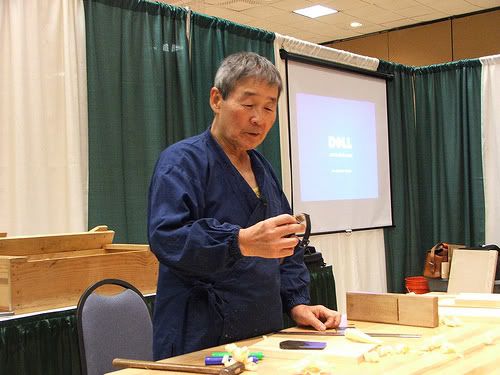
This past weekend at the Woodworking in America conference in Valley Forge, PA, I had the pleasure of sitting in on three very informative and entertaining seminars held by master craftsman Toshio Odate.  His insights helped me get a better understanding of how and why Japanese tools work they way they do.

Some of the valuable lessons I was able to learn from Master Odate include:

* He came up through the very demanding apprentice program common for Japanese woodworkers of his era.  His master was tough.  Odate told us about his early days learning how to joint a long board using a traditional planing beam.  The complicated process involves taking a step back with one leg and shifting the weight from the front leg to the back in order to create a long shaving with no hesitation. When he didn’t move his leg properly… whack.  A crack from his master in the offending leg.  Needless to say, it  didn’t take long for him to learn the craft – or learn that master knew best.  These skills are still deeply ingrained in his hands, his eyes and his muscle memory even at 79 years old.

* The Japanese plane has only four working parts (The block, blade, chipbreaker and pin) compared to the 60 plus seen in western style metal planes.  However, the simplicity of the tool doesn’t necessarily make it an easier tool to understand.  In fact, Odate told us several times that there are only four parts you can see… there are 996 more parts that can’t be seen but must work together to get the plane to perform at its best.  These include the woodworker’s senses, the material the block is made from, how the edges of the plane are shaped… it went on and on.  This is why it’s not easy to find a comprehensive ‘’how-to’’ guide that addresses every aspect of Japanese plane craft – ultimately, the woodworker must interact with the tool to make it work properly.

* Japanese plane irons are forged of two different types of steel – a very thin base of very hard steel that is too brittle to stand on its own without cracking and a thick layer of softer, more malleable steel that  couldn’t hold an edge even if it wanted to.  Why mix these dissimilar materials?  Because, the softer steel serves as a shock absorber for the harder steel… and the harder steel is capable of holding an exquisitely sharp edge. The same holds true for Japanese chisels as well…

* But, what about those hollows on the back?  I remember when I was given a set of Japanese chisels and I tried sharpening them for the first time. I wondered what I could have done so wrong to have such a dramatic uneven area on the back side.  It turns out this hollow is there for a very important reason – when you hone, you only have to remove some of the steel behind the bevel and along the sides instead of having to grind away an entire flat area of Rockwell 64 hard steel.

* But, what happens to the hollow after you sharpen the chisels or plane irons several times?  Eventually, the back side of the bevel will fall into the hollow, making the edge useless.  Here’s where the two cutters vary wildly.  The chisel’s hollow gets deeper the further away you get from the bevel.  This way, you can grind the material away to keep the area flat behind the bevel.  On plane irons, however, the hollow is a very shallow and consistent depth.  When enough material is removed to see the bevel’s back fall into the hollow, the woodworker must hold the back side of the bevel against the end grain of a wooden block and tap the beveled face with a plane hammer to push the bevel’s back side forms the new flat. After that, the bevel is resharpened to remove the ever-so-slightly deformed bevel back into shape.  Is this nerve wracking? You bet.  Has Toshio ever cracked the brittle steel while doing this?  You bet.  Twice.  His master was quick to let him know what he had done wrong…

* Why oak for the block?  The Japanese oak used for plane bodies has very elastic properties which allow the chipbreaker and iron to be seated deeply if needed, yet tapped out gently.  Hundreds of times.  Softer woods would just collapse under the pressure of the wedge being driven in, and harder, inflexible woods such as ebony would simply split.  He repeatedly inserted and removed the iron with slight hammer taps, and the plane body willingly took and released pressure.

* Oh, and that oak block should never be finished.  Master Odate told us about a plane maker who would seal the mouth of the plane with tape and pour linseed oil into the blade well. This would soak in for a week and saturate the block. Sounds like a good idea, right?  Well, what happened was that the planes would always be wicking oil out, and they would pick up every single bit of dust, grit and grime. The blocks would become pretty nasty looking, and the company folded a year later.  Just the sweat and oils from the artisan’s hands are enough to impart a rich patina.

* Even the corners and edges of the plane block were important. Most plane makers will chamfer the top and bottom edges of the sides as well as the top of the ‘front’ of the plane.  The top rear edge is always chamfered to allow a relieved surface to tap with the plane hammer in order to exert force in the right direction.  The bottom front and rear edges, however, are always left sharp, especially on smoothing and trying planes.  This sharp edge sweeps sawdust and other grunge off the board so the body can get solid contact with the surface of the board both on the cutting pull stroke and the pushing return stroke. The only exception to this rule is when a plane is being used to ‘touch up’ a cabinet, when an unintentional bump with a sharp corner could damage a previously assembled joint.

* Finally, a plane iron is expected to require five carefully prepared oak blocks during its lifetime.  As the iron wears away, the sole of the plane is carefully scraped – or conditioned – to be absolutely tuned to the needs of the iron.

While the Japanese tools do exactly the same job as their western counterparts, their simplicity gives no clue to the intricacies in the ways they are forged, built, cared for or used.  I  went to Valley Forge hoping to learn more about hand tools, and I wasn’t disappointed. With the passing of Maloof and Krenov this past year, learning directly from a master craftsman from a previous generation is something I will treasure as I keep discovering new things about woodworking.

Special thanks to Lord LQQK for the awesome photos!

Woodworking Spotlight: Dawn Lindgren

Do you remember your first few days as a woodworker? Maybe it was the time you set foot in a shop class at the start of a new school year. Perhaps it was the time when your dad took you into his shop on a sunny Saturday morning to build something.

Regardless of when or where it took place, many of us recall that moment very vividly, almost as if we are living through it all over again. The sights, the smells, the feel of the tools in your hand.

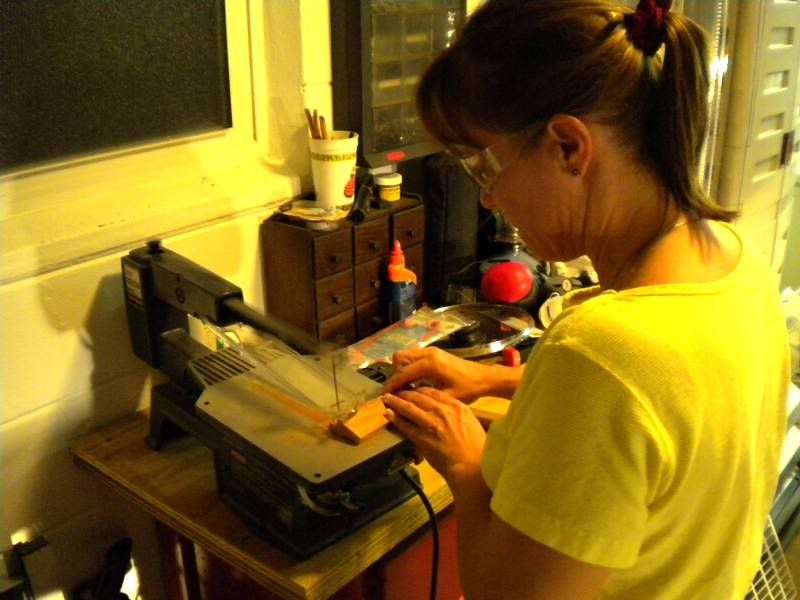
For some woodworkers, they are living those first few moments today. One of my co-workers for Pinellas County is just starting on her woodworking journey. It’s not too often that we get a chance to see folks just at the budding beginning of their woodworking adventures, so I graciously asked her if she would agree to be interviewed.

Dawn may be new to woodworking herself, but her memories of woodworking stretch back to her childhood. “My great grandfather was a pattern maker and I have many of his antique tools.  He made a beautiful tool box out of Birdseye maple, teak, and mahogany.  Both of my grandfathers also did woodworking and I enjoyed watching them build things.  I still have quite a few items that they built and were handed down to me or were gifts.”

While the thoughts of those sawdust-covered relatives were running around in her head for years, she faced one of the greatest obstacles which confronts just about every woodworker – a lack of time. “I have wanted to do woodworking for a long time. I just didn’t make the time – there was always something else which pulled me in another direction. Now, it’s time to try something different in my life. I have made the time to learn and see if I have the ability.”

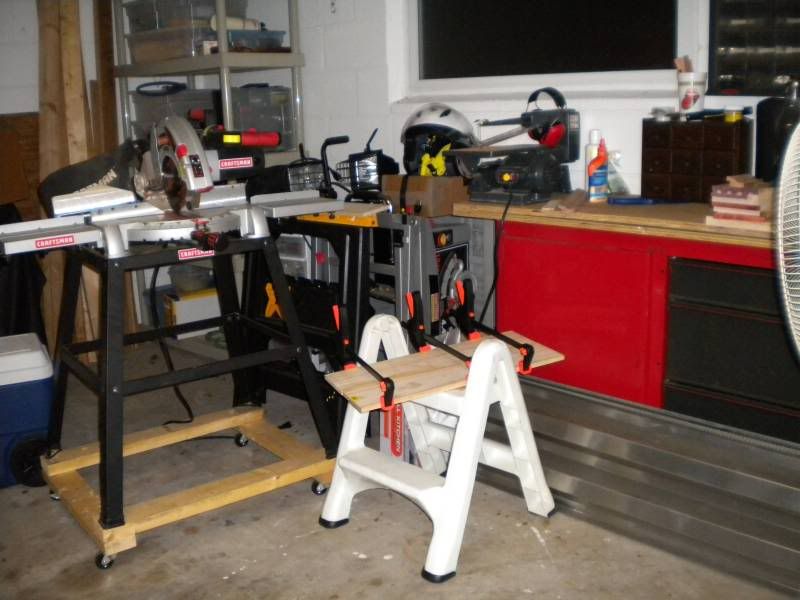
While a beginner, it’s not as if Dawn is entering woodworking with absolutely nothing. She has amassed a number of tools through the years as she tackled different home improvement tasks. These include a table saw, a compound miter saw, some chisels, other power saws and the various assorted pliers, screwdrivers and other small hand tools. “Originally, all the tools were purchased for home improvement projects with the hope that someday my house projects would be done and that I could also use them create wood working projects. You know things like bookshelves, custom benches… or what ever else I could build.”

As far as shop space is concerned, Dawn is experiencing those growing pains all new woodworkers seem to face. “I have a two car garage and a large driveway that I plan to use for my shop for now.  Most of my larger pieces are on wheels and I move them around as needed. I have added several electrical boxes in the garage over the years, so power shouldn’t be a concern, and I have a faucet just outside the door if I need to clean things up.”

With the gentle coaxing of her new husband Greg, Dawn has taken some first steps into fine woodworking. Recently, she completed a class at a local Woodcraft on box making. “There were three of us in the class and we each made a box using our own dimensions and selecting what type of wood we wanted to use.  I selected maple for the box, cedar for the liner and lacewood for the veneer top.” The first day was an exercise in cutting joinery and assembling a nice cube. “I couldn’t understand how that cube was going to become a box. How was I going to get it open?”

Dawn learned on day two just how it was going to happen. “It really freaked me out when the instructor told us we would be cutting the lid off on the table saw.  I had visions of the entire box falling apart. As I cut my lid off, I was pleasantly surprised that it did not collapse or fall apart.  The cut was even all the way around and the lid came apart easily with a utility knife cutting though the last bit.” The final box is something to behold – the first piece of advanced woodworking she was able to complete from scratch.

While Dawn is just in those early stages now, she does have a vision of where she would like to be in the future. “In five years, I would hope to be fairly proficient.  Not an expert woodworker, but certainly proficient at making those things that I currently want to make.  I expect to be beyond the rookie mistake stage and working on more detailed projects.” And, that’s just the start. “At that time I hope to be looking at retiring in the next several years and beginning to design a better shop that is dedicated to woodworking, not sharing the space with a car. I would think by then I would have built my bench, bookcase and even a wine rack or two.  I hope that I come up with some other inspiration along the way.”